
The Profit Line
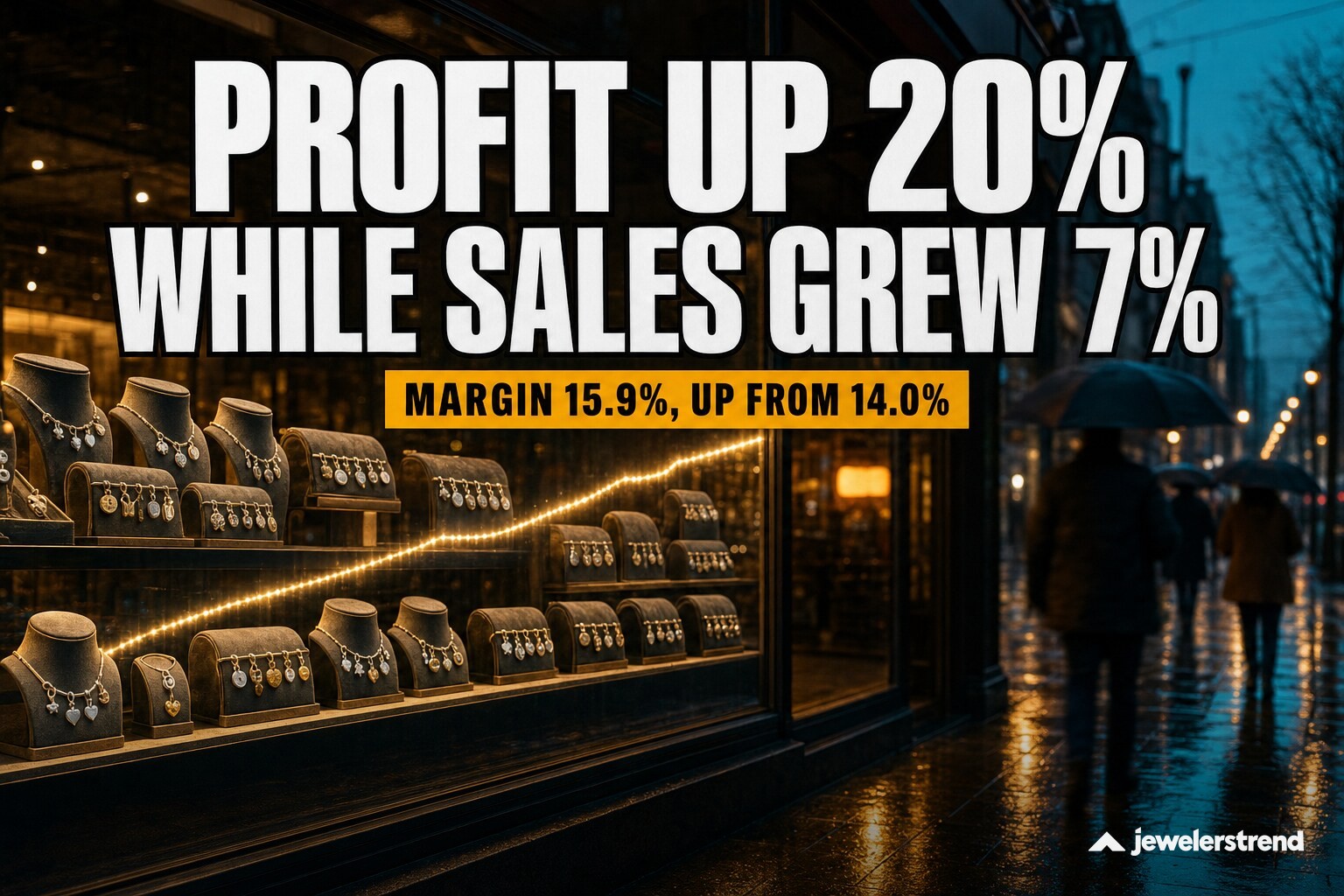
Pandora's third-quarter report, released November 4, is most instructive below the revenue line. Revenue rose to 6.69 billion kroner from 6.27 billion kroner a year earlier, an increase of 420 million kroner, or about 6.7%. Operating profit (EBIT) rose to 1.06 billion kroner from 880 million kroner, an increase of 180 million kroner, or about 20.5%. The EBIT margin widened to 15.9% from 14.0%, a gain of 1.9 percentage points.
Key figures
- Revenue: 6.69 billion kroner, versus 6.27 billion kroner a year earlier
- EBIT: 1.06 billion kroner, versus 880 million kroner
- EBIT margin: 15.9%, versus 14.0%
- 2026 organic growth guidance: low end raised to 2% from 0%
Put simply, profit grew about three times as fast as revenue. Of the 420 million kroner in additional revenue, roughly 180 million, or about 43%, reached the operating line. That incremental conversion is well above the 15.9% margin on the business as a whole, which is what margin expansion looks like in the arithmetic.
Expressed another way, every 100 kroner of third-quarter sales produced about 15.9 kroner of operating profit, against about 14.0 kroner a year earlier. On a 6.69 billion kroner revenue base, each percentage point of margin is worth roughly 67 million kroner of operating profit in the quarter.
The figures available here do not break out how much of that came from pricing, mix, cost control or currency, and this analysis does not assign it. The headline is the conversion rate itself.
Guidance: The Floor Moves
Pandora lifted the low end of its 2026 organic growth range to 2% from 0%. The change removes a flat organic year from the company's own guidance. Raising the floor is a narrower signal than raising the whole range: it says the downside case has become less likely, which is a meaningful statement with the holiday quarter still ahead.
For suppliers and retail partners, the floor matters more than the ceiling. Inventory and staffing plans for the fourth quarter tend to be built on the downside case, and that case is now 2% organic growth rather than zero.
The LVMH Comparison
LVMH reported in October that group organic revenue rose 1 percent in the third quarter to 18.5 billion euros. Its watches and jewelry division posted a 6 percent increase. The comparison with Pandora is imperfect, since one is a diversified luxury group and the other a single-category jewelry brand selling at far lower price points, and the figures cited are not on identical bases. But both point in the same direction: within luxury and accessible luxury, jewelry is outperforming the broader business.
At LVMH the gap between the watches and jewelry division and the group is five percentage points. At Pandora, reported revenue growth of about 6.7% sits well above LVMH's group-level 1% organic figure. Neither number is large in absolute terms, but the direction is consistent across two very different price tiers.
Scale is worth keeping in view. LVMH's third-quarter group revenue of 18.5 billion euros is many times the size of Pandora's 6.69 billion kroner quarter. The point of the comparison is not size but direction. A 1% organic gain on 18.5 billion euros describes a group that is close to flat. A 6% gain in its watches and jewelry division marks the part of that group still growing at a pace close to Pandora's reported revenue growth.
What It Means for the Retail Trade
For independent retailers, the read-through is about where consumer spending on jewelry and watches is holding up. Demand at the top of the watch market is visible in the week's auction results, covered in our Geneva XXIV results report, where Phillips realized $112.3 million. Branded accessible jewelry is growing profit faster than revenue. The weaker segment remains small natural diamonds, where the Rapaport index for 0.30-carat goods fell 5.5% in October, as detailed in our diamond price-gap analysis.
The Pandora result also carries a competitive implication. A branded operator converting roughly 43% of incremental revenue into operating profit has room to spend on marketing, stores or price, and an independent jeweler competing at similar price points rarely has that cushion. Regional chains selling fashion jewelry face the same arithmetic.
For buyers at the independent level, the useful comparison is not Pandora versus LVMH but Pandora versus their own fashion-jewelry counter. If a branded competitor in the same mall is widening its operating margin by close to two points year-over-year, holiday pricing and assortment decisions should assume a better-funded rival, not a struggling one.
Hong Kong provides a further data point on regional demand. Jewelry and watch sales there rose 22% year-on-year to HK$45.8 billion, about $5.8 billion, in the first nine months of the year.
The fourth quarter will test whether the margin step holds. Pandora's 15.9% third-quarter EBIT margin was 1.9 points above last year's. If the holiday quarter shows a comparable gain, the margin story extends beyond a single quarter. If it does not, was the third-quarter conversion rate of about 43% a one-quarter effect?


Comments 0
Sign in or create a free account to join the conversation.
No comments yet. Be the first to share your thoughts.