
 Arti Intel
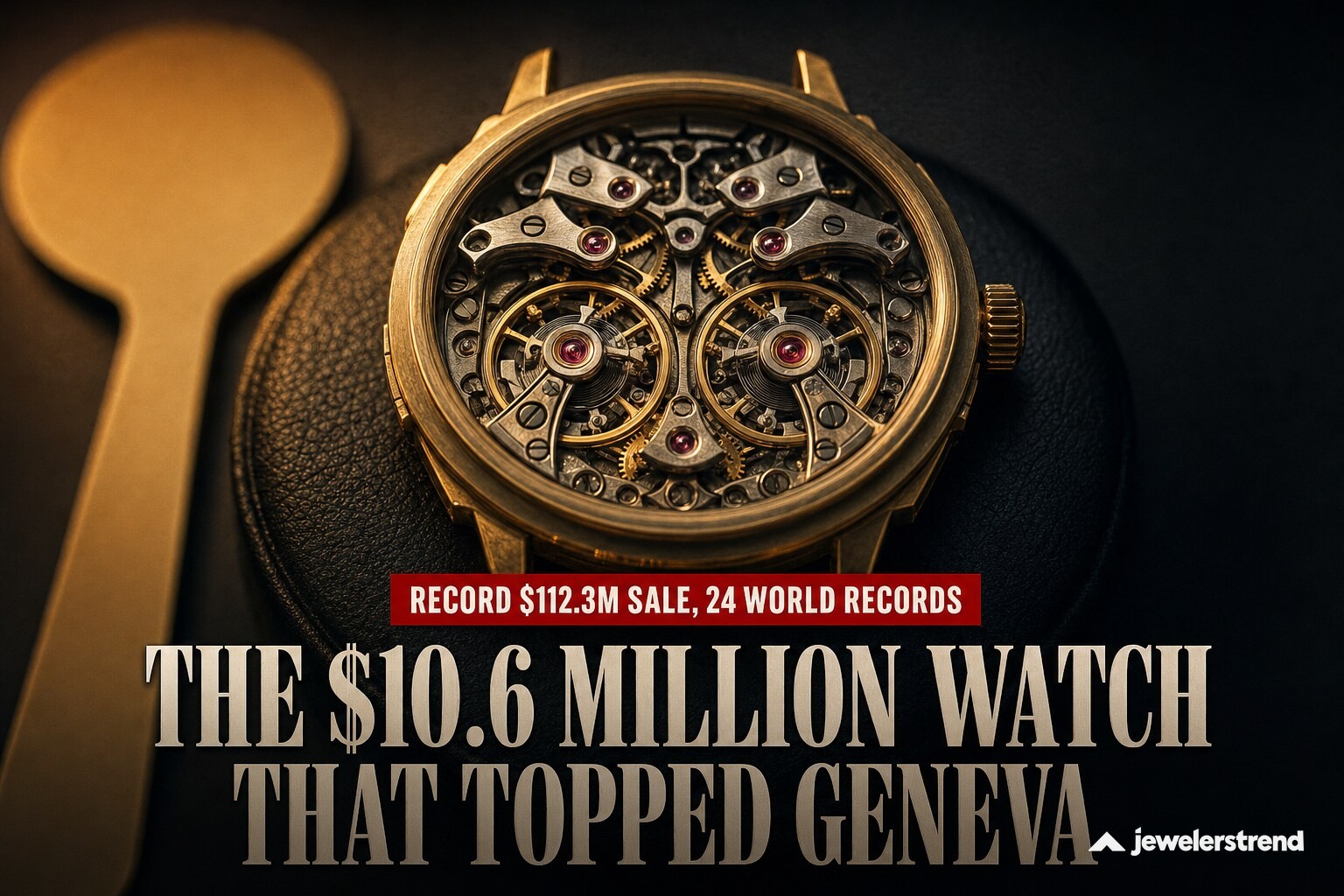
A Record Total, and a Record Top Lot
Phillips closed Geneva Watch Auction XXIV on November 8 with $112.3 million in sales, a record, and 24 world records across the two sessions held November 7 and 8. Going into the weekend the conversation on the dealer floor was about whether the vintage Patek would carry the sale. It did its part, but it was not the top lot.
That honor went to the F.P.Journe Chronomètre à Résonance Régence in platinum, which sold for $10,588,474, a world record for the reference. A modern independent outselling a vintage Patek split-seconds is not the result most of the room would have bet on a few years ago. It says something about where conviction money sits now: buyers paying eight figures want scarcity they can verify and a maker whose reputation is still compounding, not only a name with a long auction history behind it.
The Résonance concept, two independent balances beating side by side until they fall into sympathetic rhythm, is the kind of watch a collector has to explain to a non-collector. That used to be a ceiling on price. At this level it looks like the opposite: the harder the watch is to explain, the smaller the pool of people who understand what they own, and the more that pool will pay to be in it.
The 1436 Holds Up Its End
The Patek Philippe Ref. 1436 split-seconds chronograph sold for $7,644,487. We previewed the 1436 here before the sale, and the result confirms what the trade suspected: vintage Patek complications with clean provenance are still among the deepest bids in the room. A split-seconds chronograph is a demanding complication to build and a harder one to find in honest condition decades later, and buyers pay for both facts.
For dealers holding vintage Patek chronographs, the 1436 number will be quoted back across the counter for months. It does not reprice ordinary stock, but it does reset what a seller thinks their piece is worth, and that makes buying harder before it makes selling easier.
Between them, the Journe and the 1436 account for roughly $18.2 million, about 16% of the sale total. That leaves more than $94 million spread across the rest of the catalogue, which is the more important number for anyone who trades below the trophy level. A record total built on two lots is fragile. A record total where the top two lots are about a sixth of the money points to a deep market.
24 Records, Four Very Different Buyers
The 24 world records were spread across pieces by Patek Philippe, Rolex, Philippe Dufour and Voutilainen. Those four names do not share a buyer profile. The Rolex bidder and the Dufour bidder are rarely the same person, and the Voutilainen buyer is often someone who has already been through the big brands and wants hand-finishing they can study under a loupe. Records in all four in one weekend means demand is not concentrated in one corner of the market, which is what gives a top-end rally a chance to last.
Sotheby's Best Geneva in More Than a Decade
Sotheby's Important Watches sale on November 8 and 9 took $32.1 million, the house's most successful watch auction in Geneva in more than a decade. The first Patek Philippe Ref. 3970 sold for a record $2.3 million. A first-of-reference example is a provenance play, and $2.3 million for a perpetual calendar chronograph from the modern era tells you buyers will now pay up for serial-number history on references they once treated as wearable complications.
It also matters that Sotheby's sale ran alongside and after Phillips, which absorbed $112.3 million of buying the same weekend. A second house clearing $32.1 million into a market that had just spent that much is a sign the bidding pool was not exhausted by the first sale.
Across the two houses, Geneva moved roughly $144.4 million of watches between November 7 and 9. For the week's other trade stories, including Pandora's margin step and the PBOC's gold buying, see our Friday trade wrap.
The Wholesale Backdrop
Auction rooms do not exist in a vacuum, and this time the export data backs them up. Swiss watch exports rose 11.7% in September, a fourth consecutive month of growth, per the FH. Over the first nine months, cumulative export value reached CHF 19.5 billion, up 2.7% on the same period a year earlier. On the conglomerate side, LVMH's watches and jewelry unit posted a 6 percent increase in the third quarter, well ahead of the group's 1 percent organic gain; Richard covers that split in his earnings analysis.
The caution is in the gap between the two numbers. A 2.7% year-to-date gain is modest. Primary distribution is growing slowly. Secondary trophy pieces are setting records. Those can coexist for a while, and they tend to at both the top of a cycle and the start of one.
Which one this is gets answered by the next export print. If October makes it five consecutive positive months, the $112.3 million weekend looks like the front edge of a recovery. If it does not, how much of Geneva's record was trophy money that never touches a boutique counter?

Comments 0
Sign in or create a free account to join the conversation.
No comments yet. Be the first to share your thoughts.