
A Market Split by Size
The October Rapaport Trade Diamond Index data did not move in one direction. RAPI for 0.30-carat diamonds fell 5.5%, its weakest reading since December 2025. The 0.50-carat index fell 2.3%. The 1-carat index dropped 0.9%. The 3-carat index rose 0.9%. Prices declined across most of the market as inventories rose.
The 0.30-carat number got the headlines last week, and it deserves attention. The more useful reading for buyers and retailers is the gradient. Each step up in size produced a smaller decline, until the largest category turned positive. The spread between the best and worst performing size bands in a single month was 6.4 percentage points.
Put in sequence, the October moves were: 0.30 carat down 5.5%, 0.50 carat down 2.3%, 1 carat down 0.9%, 3 carat up 0.9%. The decline at 0.30 carat was more than twice the 0.50-carat decline and roughly six times the 1-carat decline. That is not a uniform repricing of the market. It is a market where pressure is concentrated in the smallest sizes tracked by the index.
Why the large goods held
The data does not say why 3-carat goods rose while everything smaller fell, and it would be speculation to assign a single cause. Two structural points are worth noting. First, buyers of large natural stones are typically shopping for rarity rather than size alone, a segment where lab-grown has been a weaker substitute. Second, smaller goods move in higher volumes through the wholesale pipeline, so an inventory build shows up there first. Both points are consistent with the October pattern. Neither is confirmed by it.
The 1-Carat Gap
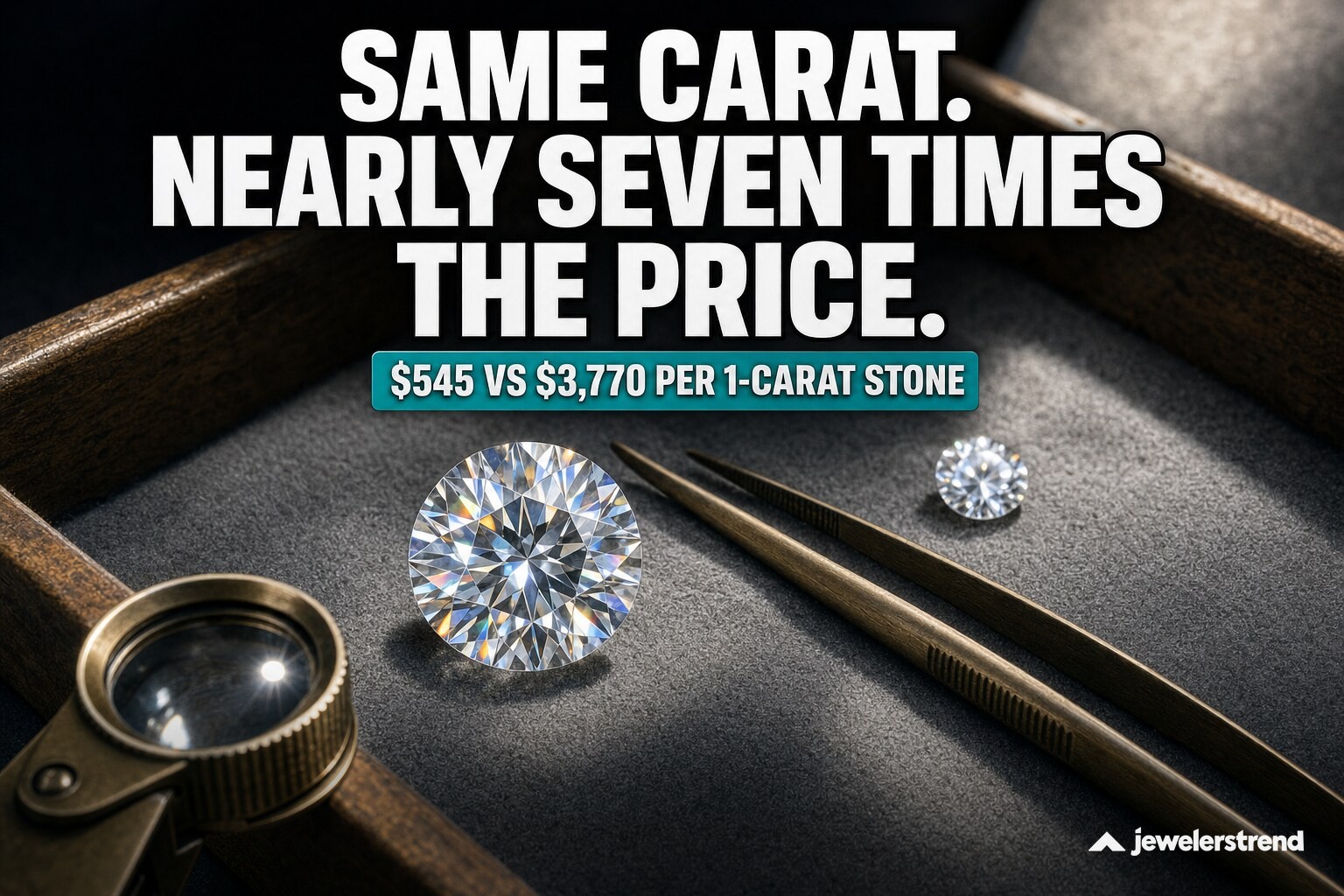
Retail listing data from early November puts the substitution question in plain numbers. A 1-carat lab-grown diamond averaged $545 across 337,988 listings. A 1-carat natural diamond averaged $3,770. The natural stone costs about 6.9 times the lab-grown equivalent, or put the other way, the lab-grown stone sells for roughly 14.5% of the natural price. The absolute difference is $3,225 per stone.
For a bridal counter, that $3,225 is the number the sales conversation turns on. A couple with a fixed budget can buy a larger lab-grown stone, a smaller natural stone, or a natural stone in a lower color or clarity grade. The 1-carat RAPI decline of 0.9% in October barely changes that arithmetic. Applied to the $3,770 average, a 0.9% move is roughly $34, which is not what decides a sale.
The listing count also matters. A pool of 337,988 lab-grown listings at a single size point describes a market with deep, interchangeable supply. That is a pricing environment where retailers compete on service and setting rather than on the stone, and where margin on the stone itself is hard to defend.
What the ratio means for a typical budget
The ratio is easier to grasp in budget terms. The $3,770 that buys one average 1-carat natural stone would cover the average 1-carat lab-grown price nearly seven times over. A retailer cannot close that gap on service alone. What the natural side can sell is the rarity argument, and the October RAPI data suggests that argument is landing better at 3 carats than at 0.30 carat.
De Beers Holds Rough Steady
Upstream, De Beers kept rough prices stable at its most recent sight. Sales volumes were low, because customers had bought goods early following the July price cut. Stable rough prices into a month when polished prices fell in three of four RAPI size bands would squeeze manufacturer margins in the smaller categories, where the polished decline was steepest.
Low sight volumes are not necessarily a negative signal. Buying early after a price cut is rational, and it means some of the demand that would have shown up at this sight was pulled forward. The question is whether manufacturers who bought early are now carrying goods into a polished market that is still softening at the small end.
For context, our earlier coverage of the 0.30-carat move focused on the sight itself. The point here is the combination: rough steady, polished soft at the small end, large goods firm. That mix tends to compress margins for the cutters who process the most volume.
What Retailers Should Watch
For jewelers setting holiday inventory, the October data argues for caution on small natural goods where the index is weakest, and for less concern about large natural stones, which gained value last month. Branded jewelry is a separate case; Pandora's third-quarter numbers, covered in our industry earnings report, show that the volume end of the market can grow profit even when stone prices soften. The wider trade picture for the week, including the Geneva watch sales, is in our Friday wrap.
The next RAPI release will show whether the 3-carat gain was a one-month anomaly or the start of a divergence. If small goods fall again while large goods rise, the 6.4-point spread from October could widen. If the 0.30-carat index recovers from its weakest reading since December 2025, was the October drop about inventory timing rather than demand?


Comments 0
Sign in or create a free account to join the conversation.
No comments yet. Be the first to share your thoughts.