A Guide to Necklace Lengths and Chain Styles
Ask two people what a 'princess' necklace is and you may get slightly different answers, but the trade works from a shared vocabulary of standard lengths. Knowing where each length falls on the body, and which chain styles flatter it, turns a guessing game into a deliberate choice that you can repeat with confidence.
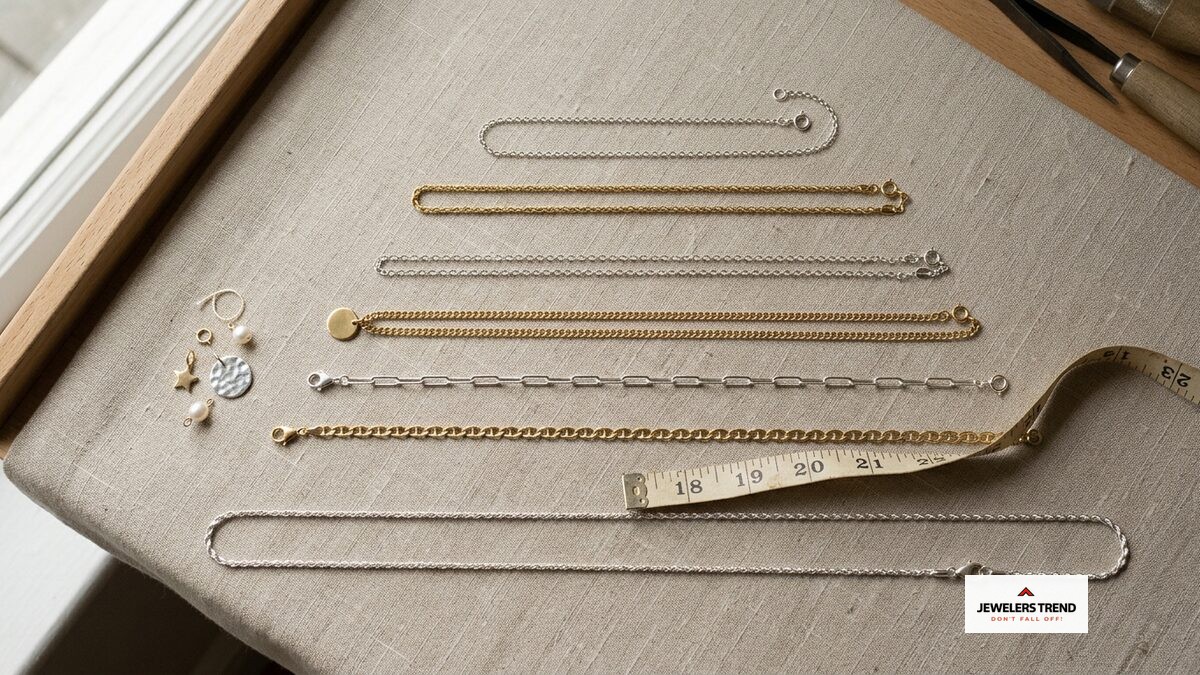
How standard necklace lengths sit, from collar to rope
Necklace lengths are measured end to end with the clasp included, and the industry sorts them into six familiar categories. A collar runs roughly 12 to 13 inches and wraps high against the throat, often as a multi-strand piece that sits above the collarbone. A choker falls a little lower, at about 14 to 16 inches, resting at the base of the neck where it frames an open neckline rather than competing with it. Both styles draw the eye upward and suit anyone who wants a necklace to read as part of the face rather than the outfit.
To measure a length you already own, lay the necklace flat and run a tape from the tip of the clasp to the far end; that single figure is the stated length. To predict where a new length will sit, compare it to a necklace that already hangs the way you like. A soft tailor's tape held around the neck and dropped to the target point gives a close preview, which spares you the disappointment of a piece that lands an inch short of a favorite neckline.
The princess length, around 17 to 19 inches, is the default for a reason: it lands at or just below the collarbone and flatters most necklines and most pendants, which is why so many finished necklaces ship at this size. Step down to the matinee, roughly 20 to 24 inches, and the piece falls between the collarbone and the bust. That extra drop gives a pendant room to read as a focal point and pairs naturally with business and daytime wear.
Opera lengths of about 28 to 36 inches reach to or below the bustline and work either as a single strand or doubled into a shorter, layered effect. Anything past 36 inches is a rope, long enough to knot, loop, or divide into several tiers. Ropes are the most adaptable length in the case, because a single strand can imitate several shorter ones depending on how it is worn.
These figures are conventions rather than rules, and vendors label them with slight variation, so one shop's matinee may be another's long princess. The practical point is that a two-inch change moves a necklace to a visibly different place on the body. When you are choosing for yourself or advising a customer, picture the endpoint on the neckline instead of fixing on the number printed on the tag.
Matching chain styles to necklines, pendants, and layering
Length decides where a necklace sits; the chain style decides how it behaves and what it can carry. A cable chain, with uniform round or oval links, is the versatile workhorse that suits almost any pendant. Curb and figaro chains use flattened, interlocking links that lie flat and read as substantial, which makes them a sound choice when the chain itself is meant to be seen. Box and snake chains are smooth and fluid, good for a sleek line and for pendants that slide. A herringbone lies like a ribbon of metal and wants a clean neckline to show its surface, though it can kink if handled roughly.
Men's chains follow the same families but run heavier and often longer, with a common length near 20 to 24 inches sitting at the collarbone over a shirt. The length logic is identical; only the proportions shift upward in gauge and drop.
Neckline is the other half of the equation, and the guiding principle is simple: a necklace should not fight the neckline it is worn with. Open and V-shaped necklines echo a pendant that follows their line, so a princess or matinee with a drop pendant tends to work. High, closed necklines such as a turtleneck or crew give a longer matinee or opera length a clean field to rest against, while a choker can look crowded in that space. Strapless and wide necklines leave room at the collarbone that a choker or short princess fills neatly.
Pendant weight deserves attention too. A heavier pendant needs a chain gauge that can hold it without kinking, so pairing a bold charm with a very fine box chain invites both sagging and wear at the bail over time. Lighter chains suit delicate stations and small solitaires. When you are unsure, match the visual weight of the chain to the pendant rather than relying on metal color alone to tie the piece together.
Everyday wear adds one more filter. A piece reached for daily benefits from a secure clasp and a link style that resists catching on clothing, which is where box and cable chains tend to outperform more delicate weaves. Occasion pieces can afford more fragile construction because they spend most of their life in the box. Thinking about how often a necklace will be worn, alongside where it sits, rounds out the decision.
Layering is where a range of lengths earns its keep. The reliable formula is to separate each strand by about two inches so the pieces stack cleanly without tangling: a choker over a princess over a matinee reads as intentional, while two necklaces of nearly equal length tend to overlap and knot. Mixing chain styles within a set, say a fine cable beside a flat curb, adds texture, and keeping the metal tone consistent holds the group together. A rope earns its flexibility here, since doubling it instantly produces two of the shorter tiers.
None of this requires memorizing a chart. Hold the piece against the neckline it will actually be worn with, note where it lands, and settle the length before you weigh anything else. Chain style, gauge, and pendant all follow from getting that first decision right. Once the six standard lengths and the common chain styles are familiar, matching a necklace to its wearer becomes quick and repeatable, whether you are building a personal collection or guiding a customer across the counter toward a piece that sits exactly where they intended.