Mixed Metal Jewelry: How to Layer Gold and Silver
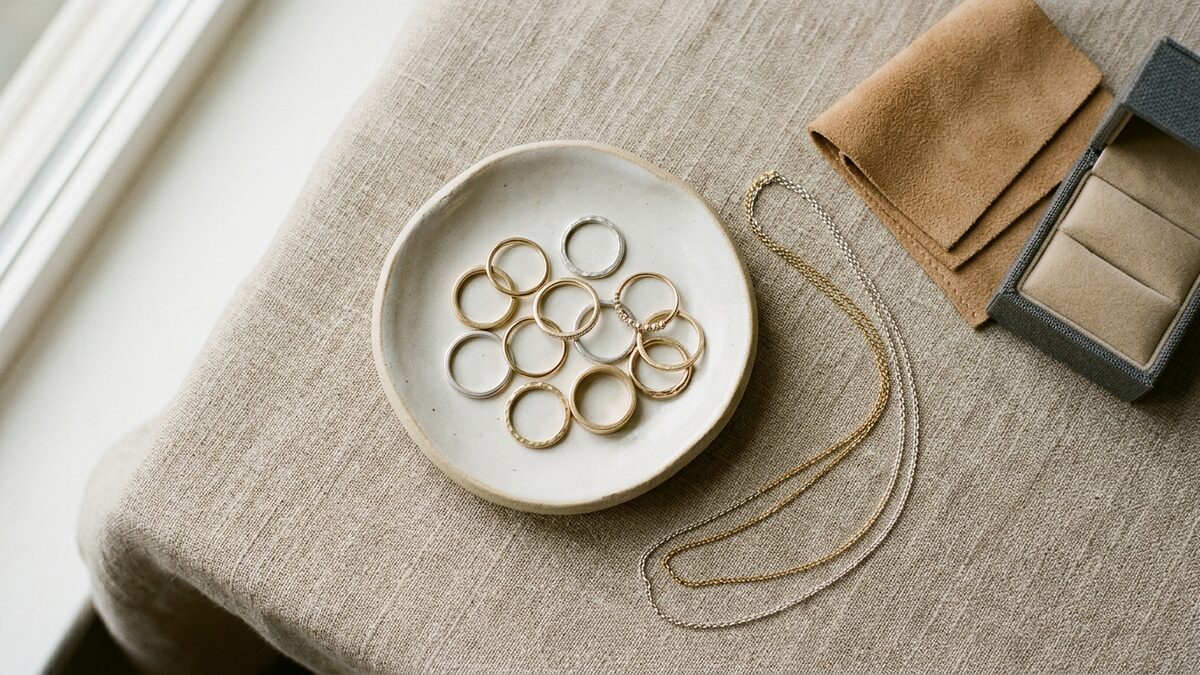
The old rule said pick one metal and commit to it for life. The better-looking truth is that gold and silver were always meant to share a wrist, a hand, or a neckline. The only real trick is knowing how to let them do it without the result looking accidental.
Mixing metals reads as intentional the moment there is a logic holding it together. That logic can be almost anything: a repeated shape, a shared finish, a single piece that carries both tones and gives the eye somewhere to rest. What it cannot be is random. Two rings that happen to sit next to each other are a coincidence; two rings chosen because one echoes the other are a decision. The difference is visible from across a room, and it is the whole game.
The reassuring part is that the hard work is often already done for you. A watch with a two-tone bracelet, a pendant with a warm stone in a cool setting, a clasp in one color on a chain of another: these transitional pieces act as a bridge. Wear one and everything else you add has permission to disagree, because the bridge has already declared that disagreement is the point.
Start With Proportion, Not With Rules
Most styling advice about metals fixates on which tones are allowed together. Proportion matters more. A stack of five delicate bands in mixed tones looks considered because no single ring dominates; the eye takes them in as one texture rather than as competing objects. Introduce one heavy signet into that same stack and the balance shifts. Now the signet is the subject and everything else is a supporting cast, so the metals need to line up behind it rather than fight it for attention.
The same thinking scales up to necklaces. When you layer chains, vary the length before you vary the color. Two pieces at the same height read as a mistake regardless of tone, while a short gold chain over a longer silver one creates depth that the color contrast then flatters. Give each layer its own airspace and the mix looks like editing. Crowd them and it looks like indecision.
A practical starting ratio: let one metal lead and the other accent, roughly two parts to one. Full parity, half gold and half silver, is the hardest look to carry because nothing anchors the composition. Leading with one tone gives the arrangement a home key, and the second metal becomes the interesting note rather than a second argument.
Scale is its own quiet tool. Thin next to thin, or thin next to one deliberate statement piece, tends to work. Several bold items in competing tones ask a lot of whoever is wearing them. When in doubt, keep the bold piece singular and let the mixed metals happen in the smaller supporting elements around it.
Finish, Skin Tone, and the Everyday Test
Finish quietly decides whether a mix feels coherent. A high polish on one piece and a brushed surface on another can clash more than the colors ever would, because light behaves differently on each and the eye notices the inconsistency before it notices the tone. Matching finishes across metals, both polished or both matte, is a shortcut to looking pulled together even when the colors are miles apart. Mixing finishes is possible, but it is an advanced move that wants the rest of the outfit to stay calm.
Skin tone is often oversold as a hard constraint, and it is gentler than the internet suggests. Warmer complexions tend to glow next to yellow gold, cooler ones often love the clean edge of silver and white metals, and rose gold sits comfortably in the middle for almost everyone. But the entire appeal of mixing is that you no longer have to choose a side. Wearing both tones means at least one of them is always doing your skin a favor, which is exactly why the mixed approach flatters so broadly.
Then there is the everyday test, the one that decides whether a look survives past the mirror. Rings that spin, chains that tangle, and clasps that snag are undone by the end of the morning no matter how good the styling looked at the start. Before you commit to a stack, wear it through an ordinary hour. Type, reach into a bag, put on a coat. The combination that still sits well after all that is the one worth keeping, and it is usually simpler than the version you first assembled.
Care follows the same low-drama logic. Softer metals mark more easily, so a delicate band worn tight against a harder one can pick up wear over time. It is nothing to worry over, more something to place: keep the piece you care about most where it takes the least friction, and let the workhorses sit where the day happens. Store mixed sets so pieces are not knocking against each other in a drawer, and a quick wipe after wear keeps every tone looking like itself.
The larger point is that mixing gold and silver is not a trend you either caught or missed. It is a way of wearing what you already own with more freedom, treating your jewelry as a small collection rather than a set of matched uniforms. Start with one bridging piece, lead with a single tone, respect proportion and finish, and let the rest be yours. The most convincing version of this look is never the most elaborate one; it is the one that looks like you reached for it without thinking, even though you thought about it exactly enough.