
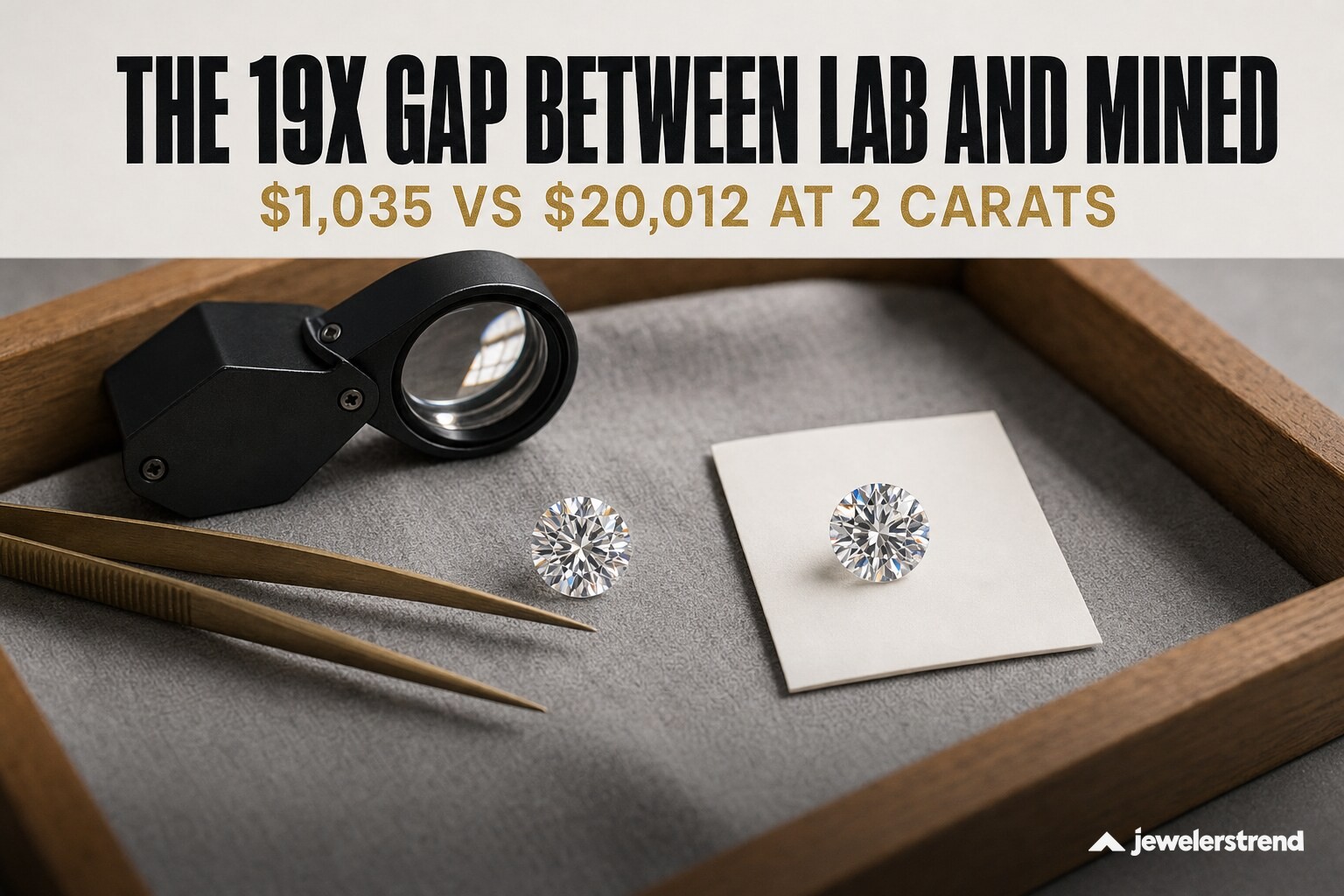
Botswana's president named GDC as the winning bidder for Anglo American's stake in De Beers on November 9, and GDC's aim is to bring customers back to real diamonds and away from synthetic gems. That ambition will be measured against retail price data, and this week's data describe a wide gap. StoneAlgo listing averages dated November 10 put a 2-carat round lab-grown diamond at $1,035 across 107,696 listings. A 2-carat round natural diamond averaged $20,012.
The spread in numbers
The difference at 2 carats is $18,977, and the natural stone averages roughly 19.3 times the lab-grown price. At 1 carat, the StoneAlgo averages dated November 12 were $559 for lab-grown and $3,828 for natural, a gap of $3,269 and a multiple of about 6.8. The multiple widens with size. Natural at 2 carats averages about 5.2 times its 1-carat level, while lab-grown averages less than double. The two sets of averages carry different dates and the 1-carat figures are not specified by shape, so the comparison is directional rather than exact.
For GDC, the arithmetic frames the problem plainly. A shopper spending $1,035 on a 2-carat lab-grown stone is not weighing equivalents. At natural averages, that budget does not reach a 1-carat stone at $3,828. Changing that decision would require persuading the buyer that the $18,977 premium at 2 carats buys something they value. That is a category argument rather than a pricing one, and none of this week's price data points to natural prices closing the gap on their own.
Rapaport: small goods still weakest
The natural side's own pricing shows pressure concentrated in smaller sizes. Rapaport reported that its RAPI for 0.30-carat diamonds fell 5.5% in October and the 0.50-carat index fell 2.3%. The 1-carat index slipped 0.9%, while the 3-carat index rose 0.9%. Sales at the De Beers October sight were low because of Diwali factory closures.
Figures dated November 11 extend that picture. Rapaport data put the 0.30-carat price at 890, down 6.36%; 0.50 carat at 1,280, down 2.43%; 1.00 carat at 3,870, down 0.86%. And 3.00 carats at 18,076, down 0.99%. Every size in that set is negative, and the 0.30-carat decline is more than seven times the 1-carat decline in percentage terms. The 3-carat line, up 0.9% on the October RAPI, shows a 0.99% decline in the November 11 figures, though the two measures are not identical.
The October sight result is relevant context for those declines. With Diwali closures keeping cutting factories in India shut for part of the month, sight sales were low, and the price weakness in polished small goods arrived in the same window. Rapaport's figures do not separate those effects, and a clearer read will need November trading after factories reopen.
For retailers, the small-goods weakness and the lab-grown gap meet at the same counter. Entry bridal and fashion pieces built on 0.30-carat and 0.50-carat natural stones compete most directly with larger lab-grown stones at similar money. That is worth weighing against the De Beers ownership change, which our industry desk covers alongside Richemont's results, and against the auction-room strength reported in this week's trade wrap.
Signet heads into December 2 on a downgrade
On the listed-retail side, Zacks Research downgraded Signet Jewelers from strong-buy to hold on November 9. Signet reports third-quarter results on Wednesday, December 2. That report will be the first quarterly read from the largest US specialty jewelry retailer since the October RAPI declines, and it follows Pandora's October like-for-like growth of 1%. In India, Kalyan Jewellers shares slipped 1.28% on November 13.
The Signet print will also matter to the De Beers story. Any disclosure on the split between natural and lab-grown sales at the largest US chain will be read directly against GDC's aim of moving shoppers back to natural stones, and against the $18,977 gap at 2 carats documented above.
What GDC would inherit
The ownership picture is still forming. Botswana would increase its stake in De Beers from 15% to 30%, and Reuters reported on November 13 that Angola is seeking a 10% holding as part of Anglo American's proposed sale. If both positions are realized, two producer governments would hold a combined 40% of a company selling into a market where its October sight sales were low and the smallest natural goods are falling fastest in price. The price data will not change because the shareholder register does.
The lab-grown data also carries a supply signal. The StoneAlgo 2-carat round lab-grown average was drawn from 107,696 listings, which indicates deep available inventory at that size. Deep inventory tends to keep asking prices under pressure, which would widen rather than narrow the gap GDC is trying to argue past.
The measurable question for the next month is narrow: whether the 0.30-carat figure, at 890 and down 6.36% in the November 11 data, stabilizes before Signet reports on December 2, or whether the smallest natural goods carry a further decline into the holiday quarter.



Comments 0
Sign in or create a free account to join the conversation.
No comments yet. Be the first to share your thoughts.