Stacking Rings: A Guide to Proportion and Balance
Most stacks that feel wrong are not wrong on any single ring; they are wrong on rhythm. Three good pieces can crowd a finger while four can breathe, and the difference is rarely the number of bands. It is proportion, spacing, and the quiet decisions about where each ring actually sits.
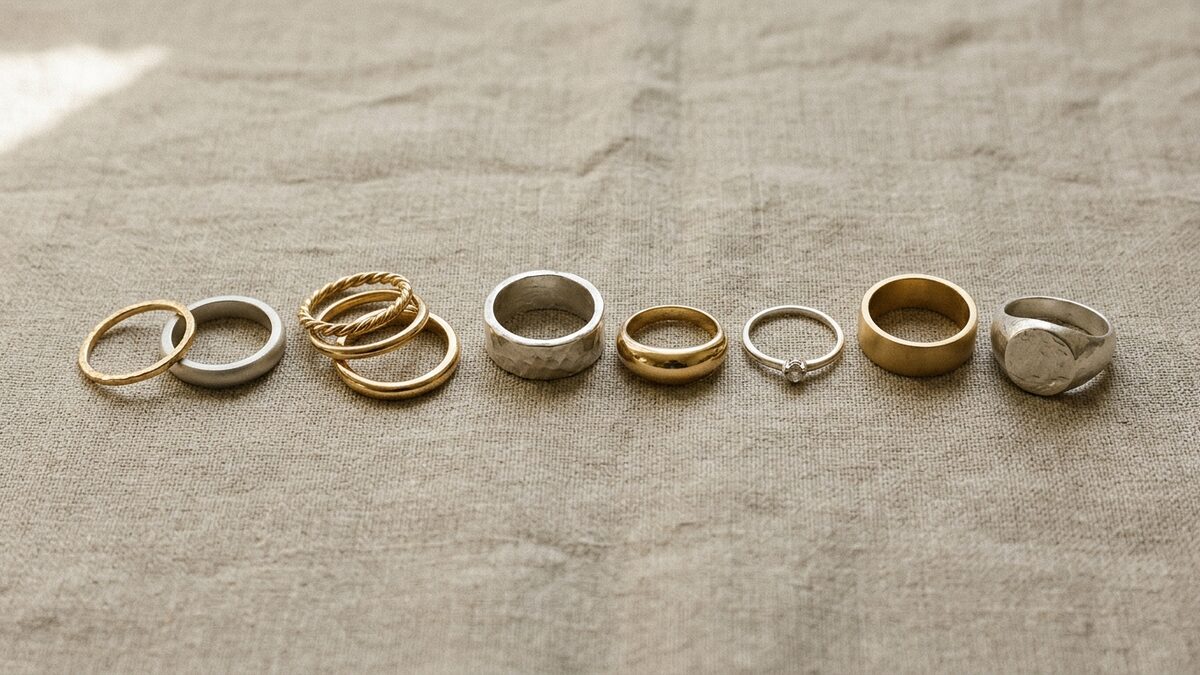
The fastest way to fix a stack is to take it apart. Slide everything off, lay it in a line, and look at the pieces as objects rather than as a set you are committed to. A stack built by accretion, one ring added whenever a new one arrives, tends to accumulate competing focal points. When you rebuild deliberately, you get to decide what the eye should land on first and what should recede into support.
The organizing idea is hierarchy. A good stack has one piece that leads and two or three that follow. The lead is usually the widest band, the tallest stone, or the strongest texture. Everything else is chosen to frame it. When two rings both demand attention, they cancel each other, and the finger looks busy without looking considered. Decide on the lead first, then build outward from that single choice.
Band width sets the rhythm before color or stone
Width is the variable people underestimate. Three bands of identical width read as a block, not a stack; the eye finds no entry point and slides off. Vary the widths and you create rhythm, the same way a line of type needs contrast between headline and body. A reliable starting pattern is wide, narrow, medium, or a graduated run that steps down from the knuckle toward the base of the finger.
Spacing matters as much as the bands themselves. A stack does not have to be a tight column. Leaving a few millimeters of bare skin between groups gives each cluster room to be read on its own terms. Think of it as paragraphs rather than a wall of text. Two rings snug together near the base, a gap, then a single statement ring above the knuckle, will almost always look more intentional than five bands crushed into one uninterrupted band of metal.
Knuckle-to-base placement is its own decision. The base of the finger carries weight comfortably and is the natural home for your widest or heaviest piece. Midi and above-knuckle rings should stay slim, because anything bulky up there restricts the finger and photographs top-heavy. If you own one genuinely delicate band, it often does its best work high on the finger, where its scale reads as deliberate rather than lost.
Test the rhythm by curling your hand into a loose fist. A stack that looks balanced flat on a table can pinch or gap awkwardly once the fingers bend. The pieces that survive that test, sitting close without biting, are the ones worth keeping in the everyday rotation. The rest can live on a different finger or come out only when your hand is going to stay relaxed.
Mixing metals and spreading pieces across fingers
Mixing metals is not the risk it is often treated as, provided you give the mix a logic. The cleanest approach is to let one metal dominate and treat the second as an accent, roughly a two-to-one ratio rather than an even split. Warm and cool tones sit together well when there is a bridge piece somewhere in the stack, a ring that carries both, or a stone whose setting picks up the contrasting tone. Without that bridge, a mixed stack can look like two unrelated stacks sharing a finger by coincidence.
Finish is quieter than color but does just as much work. A high-polish band next to a matte or hammered one creates contrast even when both are the same metal, and that contrast can carry a stack that would otherwise feel flat. If you are nervous about mixing tones, mixing finishes is a lower-stakes way to get texture and depth into the arrangement.
Resist the urge to keep everything on one finger. Two or three considered rings on a finger, with a supporting piece on the neighbor, usually reads more elegantly than a single overloaded stack. Spreading the weight lets each finger tell a smaller, clearer story, and it keeps any one finger from looking congested. Balance across the hand is part of the composition, not an afterthought.
- Lead with one piece. Choose the ring the stack is built around before adding anything else.
- Vary width. Avoid three identical bands; give the eye a way in.
- Leave gaps. Bare skin between clusters reads as intent, not omission.
- Bridge your metals. One piece that carries both tones ties a mixed stack together.
- Curl-test it. Check the arrangement with the hand bent, not just flat.
The last thing to consider is restraint. A stack that reads as intentional almost always has fewer pieces than the owner first wanted to include. When you are unsure whether a ring belongs, take it out and look again; if the stack holds without it, it was probably decoration on decoration. The pieces you already own will do more for each other with editing than with addition, and a stack you can build in ten seconds each morning is the one you will actually reach for.