
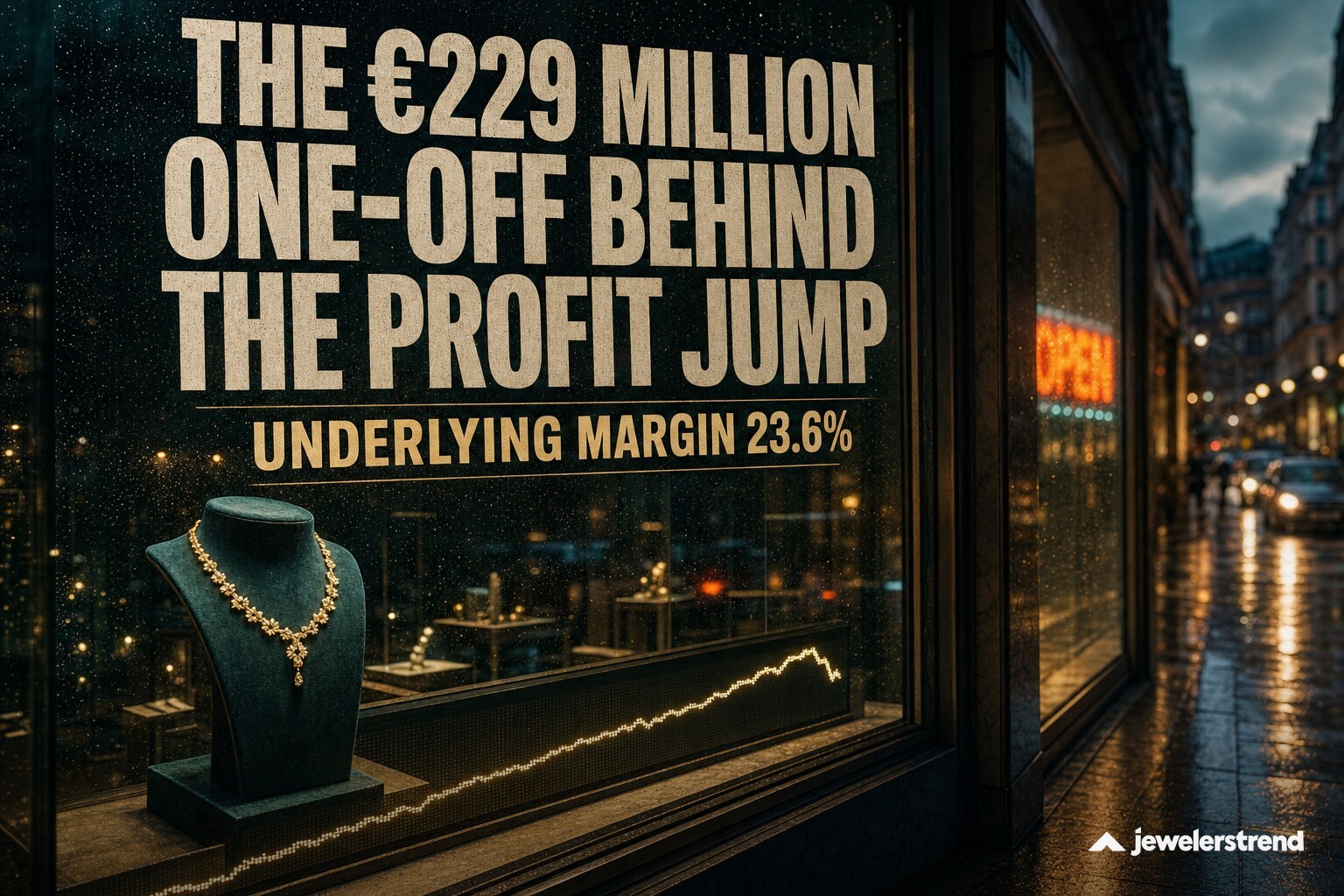
Richemont's results for the six months to September 30 contained a headline and a footnote, and the footnote changes how the headline should be read. Group operating profit rose 33% to €3.129 billion. Of that, €229 million came from positive tariff-related one-time items. Excluding them, operating profit was €2.9 billion and the operating margin was 23.6%, according to the company's November 13 release.
The one-time items do not make the underlying result weak. Group sales were €12,282 million, up 16% at actual exchange rates and 17% at constant rates, and profit was €2.528 billion, up 39%. They do mean that comparisons with the year-earlier operating line should be made on the adjusted figure.
The adjustment is not a small one. Without the €229 million, operating profit growth would still be substantial, but the 33% headline overstates the pace of the underlying business. Readers comparing Richemont with peers that did not benefit from similar items should use the €2.9 billion figure and the 23.6% margin.
Divisional Results
Jewellery, the group's largest business, increased sales 18% to €9.1 billion. The Specialist Watchmakers division increased sales 9% at actual exchange rates and 10% at constant rates, to €1.7 billion. In this period, jewelry grew at roughly twice the rate of the watch division.
The watch result deserves its own note. Specialist Watchmakers grew 9% at actual rates over the half. The secondary market has since produced its own data point: Geneva's November sales totaled about $203 million across Phillips, Christie's and Sotheby's. Retail watch demand and auction demand are distinct channels, and the divisional figure covers only the first. Coverage of the auction side is in our watch desk report.
For independent retailers, the jewelry figure is the one with competitive weight. A maison division posting 18% growth competes for some of the same customers who walk into a specialty store with a $3,000 to $5,000 budget, the band Rapaport identified on November 12 as the strongest at US retail, discussed in our jewelry desk report. Whether that growth comes at the expense of independents or alongside them is not visible in group figures.
Regional Breakdown
Growth was broad but uneven by region:
- Japan: up 30%
- Americas: up 23%
- Asia-Pacific: up 16%
- Europe: up 13%
- Middle East and Africa: down 2%
Japan and the Americas led. The Americas figure is the most relevant to US trade readers: a 23% increase in a period when US specialty retail is selling against a lab-grown 1-carat listing average of $551 on StoneAlgo suggests the high end of the market is operating on different terms from the middle. Middle East and Africa was the only region to decline.
The Share Price Reaction
Investors reacted to costs rather than sales. Richemont shares opened more than 4% lower on November 13, and Investing.com headlines described falls of 6% and 8% as gold costs offset the jump in operating profit. Lang & Schwarz quoted the shares at €181.93 at 11:42 CET that day. By 17:47 CET on November 17, the same venue quoted €187.30.
The rebound between those two readings is partial, and a few sessions do not establish a trend. The headlines on November 13 attributed the selling to gold costs rather than sales momentum, and the sales figures support that reading.
Gold cost is the variable that connects the results to the rest of the market. Spot traded at $4,031 on November 11, two days before the release, and at $3,844.97 on November 17, according to Fortune and LiteFinance respectively. Lower metal input costs would affect future periods rather than the half already reported. The trajectory is set out in our gold desk report.
Richemont and De Beers
The results arrived during a separate development involving the group. Reuters reported on November 9 that Richemont is in talks related to the De Beers sale, alongside sightholders Diarough, Pluczenik and Grandview Klein Diamonds and the jeweler Signet. The Global Diamond Consortium was endorsed by Botswana President Duma Boko as preferred bidder for Anglo American's De Beers stake the same day, with Botswana's shareholding set to double from 15% to 30%.
Mining.com reported that Botswana's 30% demand could complicate the $1 billion takeover, as it exceeds the roughly 25% stake previously discussed with the consortium. Richemont did not, in the figures cited here, quantify any financial commitment to the transaction. A luxury group with jewelry sales of €9.1 billion over six months has an evident interest in upstream supply, but the scale and form of any participation remain undisclosed.
On the Trade Calendar
Vicenzaoro returns for its January 2027 edition, January 15 to 19, JCK reported on November 16. It will be one of the first large trade events after the half-year reporting season and the De Beers developments, and an early opportunity for exhibitors to discuss holiday sell-through with buyers in person.
Two figures will frame the next reporting period: the €229 million of tariff-related one-time items, which by definition should not recur, and the 23.6% underlying operating margin, which has to hold without them.


Comments 0
Sign in or create a free account to join the conversation.
No comments yet. Be the first to share your thoughts.