

The diamond trade enters the last week of November with a few dates on the calendar and almost no prices attached to them. De Beers will not hold another sight until Sight 10, which runs Nov 30 to Dec 4. The sale of the company had no announced price, signing date or full list of buyers as of Wednesday, Nov 18. And the newest public position came from Angola, where a mines ministry spokesperson said on Nov 13 that the country wants 10%.
Angola's 10%
The statement was reported by Rio Times and TimesLive. With no price, signing date or full buyer list announced as of Nov 18, the Angolan figure stands as a stated position rather than an agreed term. For a producing country, a public percentage is a way of putting a marker down before valuation is settled. For the trade, it adds one more party whose terms have to be reconciled before a deal can close.
The practical question for sightholders is not who will own De Beers but whether ownership uncertainty changes how the company manages supply. The evidence so far points to caution. At the October sight, De Beers held rough prices stable on low volumes, according to Rapaport. Stable prices on low volume is a holding pattern: it protects the price list without forcing goods onto manufacturers who are not ready to buy them.
No sight took place this week, so there is no fresh De Beers data point on rough between the October sale and Sight 10. Manufacturers deciding how much to take at the end of November will be working from October's stable prices, their own polished inventory and the polished price trend, which has been weakest at the small end.
For retailers, none of this shows up on the counter immediately. Rough bought at Sight 10 will be cut, polished and graded before it reaches a memo, so the decisions made between Nov 30 and Dec 4 will shape polished supply well after the holiday selling season.
The polished backdrop
Rapaport's index published Nov 3, covering October, recorded these moves:
- 0.30-carat: down 5.5%
- 0.50-carat: down 2.3%
- 1-carat: down 0.9%
- 3-carat: up 0.9%
The gradient is consistent. The smaller the stone, the steeper the October decline, and only the 3-carat category rose. Smaller goods are widely seen in the trade as the most exposed to lab-grown substitution, and they are also the goods that move in volume through the cutting centers buying at the sight. A sightholder taking small rough at Sight 10 is buying into the weakest part of the polished price list.
Lab-grown at $554
StoneAlgo's data for Nov 18 put the average 1-carat lab-grown diamond at $554 across 320,722 listings. The listing count is as informative as the price. A listing count of that size in a single size band describes a market in which supply is not the constraint and price discovery happens on a screen.
For a natural manufacturer pricing 1-carat goods against a Rapaport index that slipped 0.9% in October, the lab-grown average is the figure a price-sensitive bridal customer will compare against at the counter. That comparison is now a fixed feature of the engagement ring sale, not a novelty, and it limits how far natural 1-carat prices can firm before some customers walk across to the cheaper stone.
Metal and stones, both softer
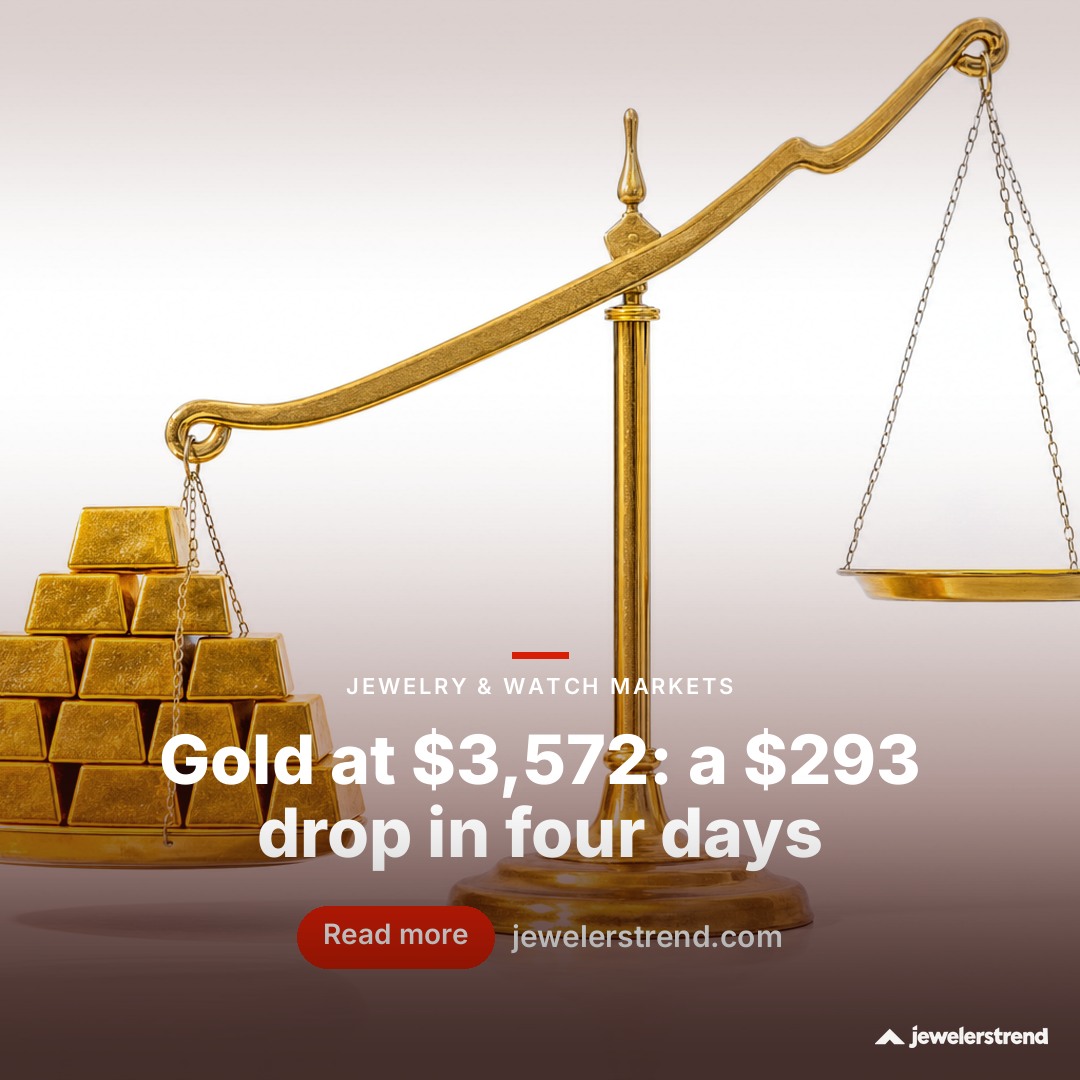
The diamond side of the bench is not moving in isolation. Spot gold fell from $3,865 on Nov 16 to $3,572 on Nov 20, by Fortune's daily marks, which lowers the metal cost of a mounting for any retailer re-quoting a bridal special order this weekend. Kamran Shak has the detail in his gold desk report. Cheaper metal and softer small-stone prices together put the cost of a finished ring with a modest center stone under pressure from two directions, at least on paper.
Branded jewelry at the top of the market is a separate business. Richemont's first half to Sept 30, covered in our industry report, showed jewelry sales up 18% to €9.1 billion. That demand sits a long way from the 0.30-carat goods that fell 5.5% in October, and it does little for a cutter in Surat or Antwerp working through small rough.
What Sight 10 has to answer
De Beers goes into Sight 10 with stable prices from October, low volumes, a sale process with no announced price and a 10% request from Angola on the record. Small polished goods are the weakest part of the Rapaport index, and lab-grown 1-carat stones average $554 on StoneAlgo's count. The rest of the week's trade movers are in this week's trade wrap.
Will De Beers hold its rough price list for a second consecutive sight while the sale terms remain unannounced, or move it with polished 0.30-carat goods down 5.5% in the latest index?


Comments 0
Sign in or create a free account to join the conversation.
No comments yet. Be the first to share your thoughts.