
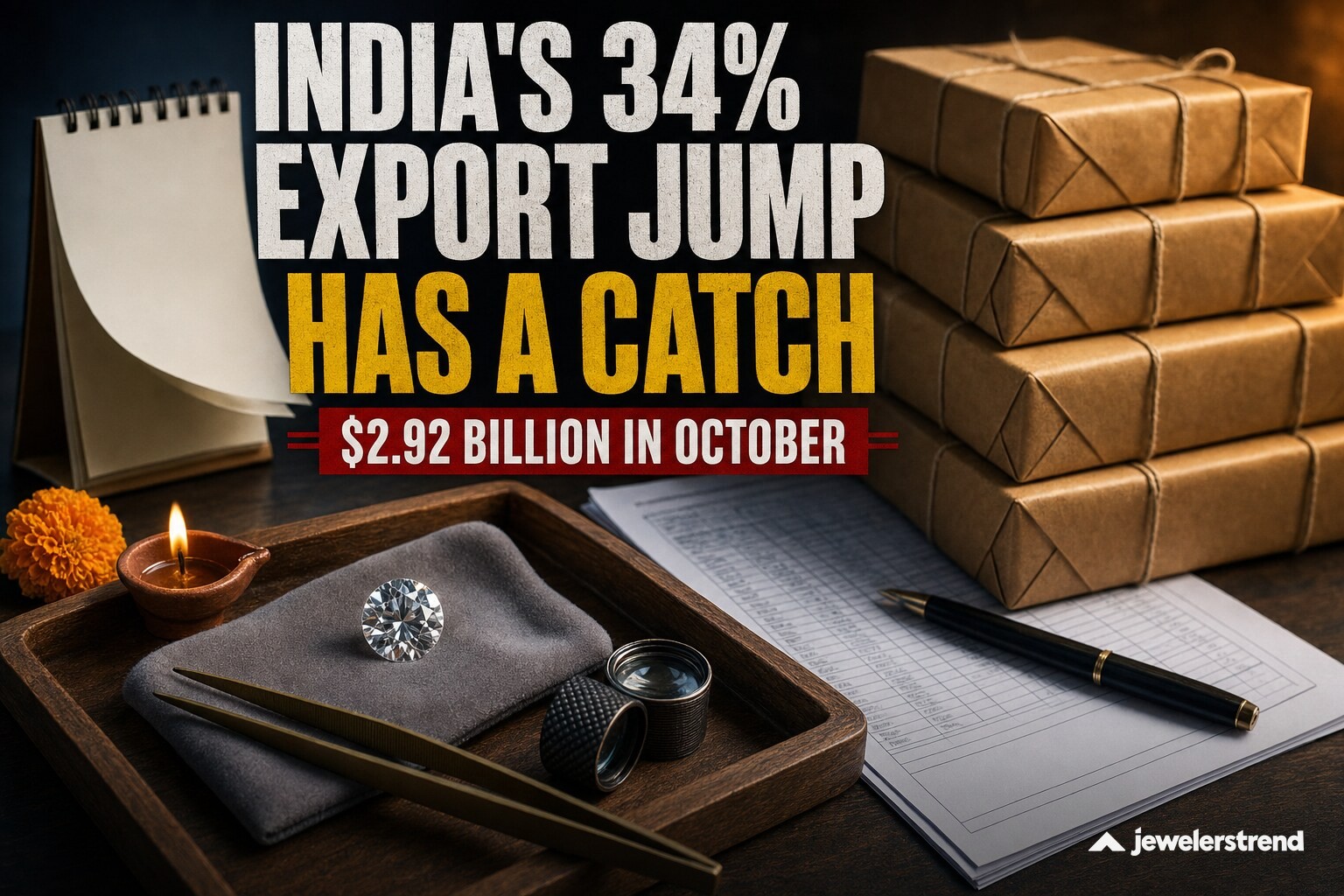
India's gem and jewelry exports rose 34% year over year to $2.92 billion in October, according to Gem and Jewellery Export Promotion Council (GJEPC) data reported by JCK on November 16. Cut-and-polished diamond exports, the category most of the diamond pipeline watches, rose 10.5% to $1.13 billion over the same comparison.
The headline needs the qualification attached to it in the same report. Diwali fell in October last year and in November this year, so the two Octobers are not like-for-like months. Part of the October increase reflects calendar timing rather than a change in underlying demand. No split between the timing effect and the demand effect was included in the figures available for this report.
The distortion runs in both directions. If October was flattered by the shift, November is likely to be depressed by it, as manufacturing centers close for the festival and shipments slow. The two months are best read together, which will not be possible until November data is released.
Polished Versus the Total
The gap between the two growth rates is the more instructive number. Total gem and jewelry exports grew 34%. Polished diamonds grew 10.5%. Polished goods accounted for $1.13 billion of the $2.92 billion total. The remainder, which includes finished jewelry and other categories, therefore grew considerably faster than the diamond line. Any reading that treats the October figure as a diamond recovery overstates what the polished data shows.
A 10.5% gain in polished exports is still positive, and it is consistent with Rapaport's assessment of the market in its November 12 Market Comment. Rapaport reported that prices of round 0.30 to 0.69 carat diamonds continue to decline, that 1 to 1.99 carat goods are stabilizing, and that 2 carats and above are steady. That is a market that has stopped falling at the larger sizes while the smaller categories remain under pressure.
US Retail: The $3,000 to $5,000 Band
On the demand side, Rapaport's November 12 comment said jewelry priced at $3,000 to $5,000 is selling best at US retail, and that natural diamonds are regaining ground lost to synthetics. For exporters, a firming middle band at US retail is a more durable signal than a single month's festival-shifted export total.
The price structure those retailers are selling against remains wide. StoneAlgo listing averages as of November 15 put a 1-carat natural diamond at $3,876 against $551 for a 1-carat lab-grown stone. At 2 carats, the averages were $17,437 natural and $1,047 lab-grown, across 391,667 listings. These are asking prices rather than transaction prices, but the gap is the context in which Rapaport's observation about natural regaining ground should be read.
For US retailers, that spread shapes inventory decisions as much as pricing. A store stocking lab-grown at 1 carat is carrying goods that list at a small fraction of the natural equivalent, and the fraction shrinks further at 2 carats. A shift in customer preference back toward natural, if Rapaport's observation holds through the holiday season, would change open-to-buy plans well before it shows up in export data.
The Top End: Bulgari Pink
At the opposite end of the market, the Bulgari Pink sold for more than US$14 million at Christie's Geneva Magnificent Jewels auction, as reported by Jewellery Outlook on November 11. A single auction lot says little about conditions in the commercial price bands discussed above, but it confirms that the auction channel for important pieces remained active in the same week as Geneva's watch sales, which totaled about $203 million across three houses and are covered in our watch desk report.
The De Beers Variable
The ownership of De Beers remains a central structural question for the polished pipeline. Botswana endorsed the Global Diamond Consortium as preferred bidder on November 9 and said its shareholding would double from 15% to 30%. Mining.com reported that the 30% demand could complicate the $1 billion takeover, exceeding the roughly 25% stake previously discussed with the consortium. Reuters reported that sightholders Diarough, Pluczenik and Grandview Klein Diamonds, along with Signet, are part of the talks, and that Richemont is also in talks. The Richemont angle is examined in our industry desk report.
For manufacturers, the presence of three sightholders in the talks matters because sight terms and rough allocation policy would ultimately sit with the new owners. No change to those terms has been announced.
Botswana's position also bears on supply sentiment. A government holding 30% of the producer, rather than 15%, would have a larger voice in production and marketing decisions, though the extent of that influence will depend on the final shareholder agreement, the terms of which have not been published.
What November Will Show
November's GJEPC figures will provide the first comparison with Diwali in the current month and not the prior-year month. If total exports hold a gain against that comparison, the October number will look less like timing. If they fall, the 34% will be remembered mainly as a calendar effect. The figure that matters most in that release is whether polished diamond exports hold above $1.13 billion.

Comments 0
Sign in or create a free account to join the conversation.
No comments yet. Be the first to share your thoughts.