
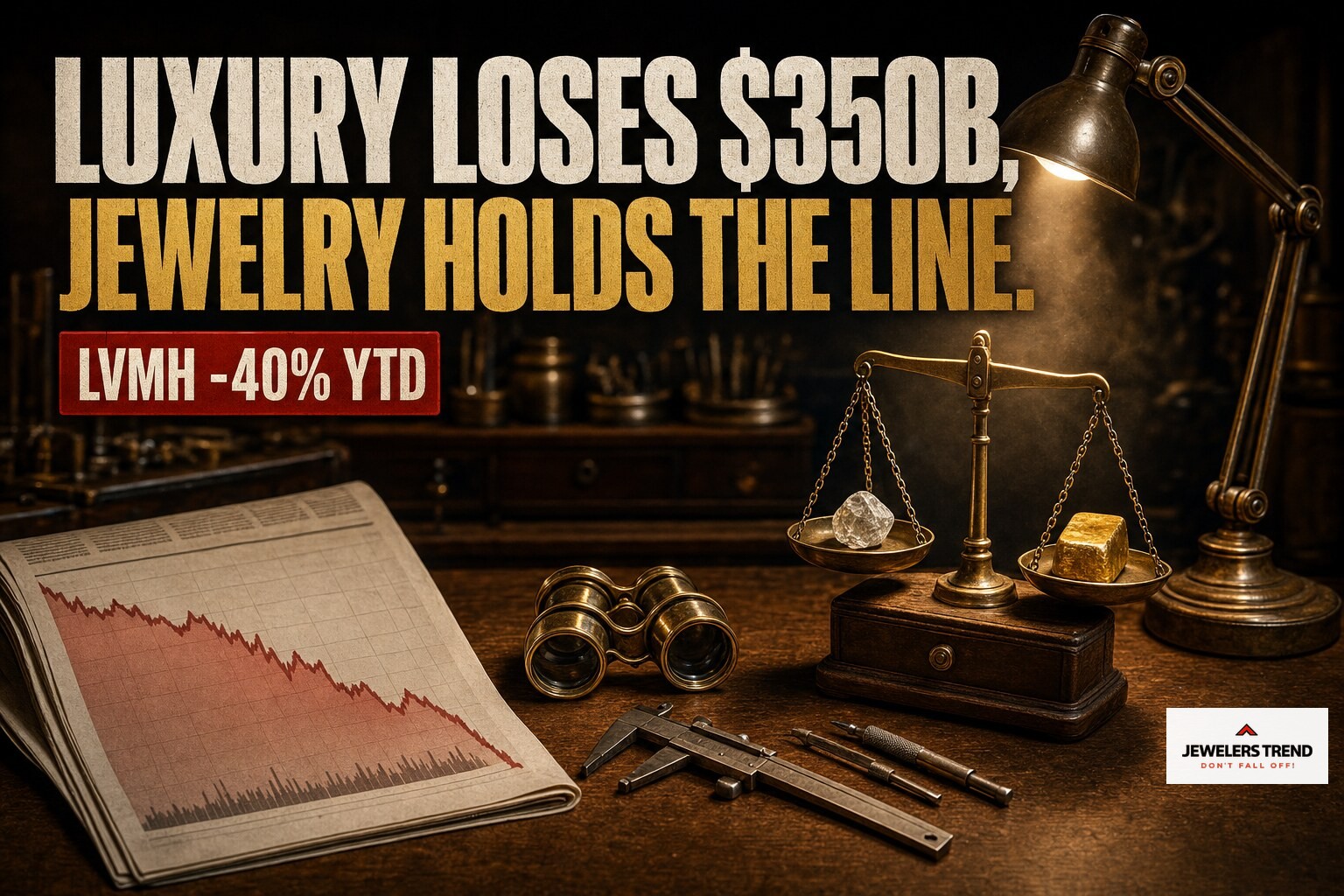
The number that set the tone for the whole week came out of Paris on Monday. LVMH reported group organic sales up just 1% to 18.5 billion euros for the third quarter, against the 1.3% the street was penciling in. That is a miss, and a small one on paper, but the composition underneath it is what dealers were talking about on the floor all week.
LVMH misses on the part that matters
Fashion and leather, the engine that has carried this group for a decade, fell 5% in the quarter. The consensus had been looking for a decline closer to 1.8%, so the gap between expectation and print was the real story, not the headline growth figure. When the most profitable division comes in nearly three times worse than forecast, it tells you the pullback in aspirational spending is not finished working through the system.
Zoom out and the damage is easier to see. Europe's ten biggest luxury companies have lost roughly 350 billion dollars in combined market value since January. LVMH itself is down more than 40% on the year. These are not small-cap names getting repriced on a bad quarter. This is the core of the European luxury complex giving back years of gains. I have watched a few of these cycles from the dealer side, and the pattern rhymes: the brands that overbuilt on handbags and ready-to-wear get hit first and hardest.
There is a second signal buried in the LVMH release that matters more to our end of the trade than the headline. The group's watches and jewelry growth slowed to 6% in the third quarter from 9% in the first half. That is still growth, and still better than fashion, but the deceleration shows the pressure reaching the one division that had been holding. Richemont has been the counterexample, with Cartier growing above 12%. The spread between a cooling 6% at LVMH and a 12%-plus Cartier is the cleanest read on which house is executing right now.
Jewelry is the part that held
Here is where it gets interesting for our end of the trade. Jewelry held up inside LVMH even as fashion cracked. The watches and jewelry division posted 8% organic growth over nine months, and Richemont has done the best job of holding up among the big European houses. Hard assets with provenance and tight supply behave differently from seasonal leather goods when the consumer gets cautious, and this quarter put that on the scoreboard. If you want the full read on the secondary side, I went deeper in this week's watch market piece, where Patek is up 18.1% over the trailing year while Rolex has gone flat.
The diamond side of jewelry is telling a similar recovery story. Smaller goods led the Rapaport index higher in September, and the one-carat index posted a second straight monthly gain. I unpacked those figures and what they mean for retail in the diamond and jewelry recap. The short version: the bottom of the market is firming before the top, which is usually how these turns start.
The auction block keeps printing records
If the public markets looked shaky, the auction rooms did not. The headline of the season was the Rolex Four Seasons set at Phillips London, where four one-of-a-kind Daytonas sold for a combined 49.5 million dollars for charity. The Summer Daytona took the top spot at 13.65 million, with Autumn at 13.52 million and Winter at 13.25 million. Numbers like that do not come from a weak collector base. They come from a part of the market that is completely decoupled from whether handbag volumes are soft in a given quarter.
The same theme ran through the smaller single-lot results this month. At Phillips New York on October 9, a stainless Voutilainen 28Sport numbered five of eight hammered all the way to 1,016,000 dollars including premium against an estimate that topped out at 240,000. At Sotheby's Paris on October 7, a circa-1968 Rolex Daytona Paul Newman reference 6241 brought 448,000 euros, about 500,700 dollars. Independent watchmaking and vintage Rolex remain the two deepest pockets of demand in the entire trade right now.
Hong Kong rounded out the auction picture. The Christie's Watches Online Hong Kong Edit closed on October 7 totaling HKD 23,125,632, about 2.95 million dollars, led by an Eska pink gold wristwatch with a cloisonne enamel dial at HKD 1,216,000. Three continents, three sale formats, and the same conclusion: the goods with provenance and scarcity are finding deep bids while the broad consumer-facing part of luxury softens.
Richemont and Signet circle De Beers
The structural story of the week broke late: Richemont and Signet Jewelers are reportedly in talks to join a consortium bidding for De Beers. That is a significant development. Anglo American has been working toward a private sale for months, and having a watch-and-jewelry heavyweight plus the largest specialty jewelry retailer in the United States at the table changes the calculus on who ends up controlling the rough pipeline.
The read-through for small dealers is simple. If strategic buyers from inside the trade take control of De Beers, the people setting rough prices will have a direct stake in finished jewelry demand. That is a different incentive structure than a mining major running the book to maximize its own margin.
Gold does not care about luxury sentiment
While equity desks fretted over LVMH, gold just kept climbing. Spot printed 4,165.55 per ounce at 9:00 a.m. Eastern on Thursday, after running 52 dollars higher the prior session to 4,147. The engine underneath is official-sector buying. Central banks bought about 63 tonnes in September, the most since November 2024, and China's central bank alone added 21 tonnes, described as its largest monthly purchase in three years.
The September buying did not come out of nowhere. Central banks reported 39 tonnes of net buying in August and 170 tonnes through August, with China adding 20 tonnes that month and Poland and Uzbekistan each adding eight. September's 63 tonnes was an acceleration on top of that, not a one-off. Spot backed this up all week, slipping 0.3% to about 4,158 on October 13 and dipping to 4,095 on the 14th before buyers took it straight back toward 4,165.
The full-year picture is even louder. Official institutions purchased an estimated 345 tonnes in the first half, including 289 tonnes in the second quarter alone, and the forecast calls for 720 tonnes across all of 2026. When buyers of that size are accumulating every month regardless of price, it puts a firm floor under the metal. I covered the flows and what they mean for refiners and bullion desks in this week's gold report.
The secondary watch market, up close
The secondary watch market told a quieter version of the same divergence. The WatchCharts Overall Market Index was virtually flat in September, yet Patek Philippe continued to rank among the top performers at plus 2.6% for the quarter and is up 18.1% over the trailing year, while Rolex lagged at plus 0.5% quarterly on a stagnation of demand against rising supply. Audemars Piguet landed in between at plus 1.2%. Flat headline, wide dispersion underneath.
The one macro print that cut against the gloom was Switzerland. Swiss watch exports rose 9.1% in August year over year, and the industry's twelve-month moving average turned positive for the first time in two years. Shipments to the United States fell 19.4%, yet the US stayed the single largest market at 197.5 million francs, about 240 million dollars, or 11% of global shipments. Through eight months, exports are cumulatively up 1.7% and have cleared 17 billion francs.
So the setup heading into the weekend is a split screen. The equity story is a European luxury complex down 350 billion dollars and an LVMH that missed on its best division. The trade story underneath is jewelry holding, diamonds firming at the low end, Swiss watch volume turning positive, auction records piling up, and gold grinding toward 4,200 on relentless central-bank demand. Two of those pictures cannot both be the whole truth for long. Which one resolves first is the question I would be watching into the next LVMH print.


Comments 0
No comments yet. Be the first to share your thoughts.