September delivered the clearest evidence yet that the natural diamond market has found a floor, and the recovery is starting where these turns usually start: in the smaller, more liquid goods that move fastest through the trade.
Rapaport index gains, led from the bottom
The Rapaport Trade Diamond Index, RAPI, rose 3.2% for 0.30-carat diamonds in September. Half-carat goods added 2.5%. The three-carat index advanced 1.5%. And the one-carat index posted a 0.3% increase, its second consecutive monthly gain, which matters more than its size because consecutive moves are what distinguish a turn from a bounce. On September 11, the Rapaport Price List raised prices on certain round, 0.30- to 0.69-carat, D-G, VVS1-SI1 diamonds, formalizing gains that had been building over recent months.
The pattern is textbook. Smaller stones recover first because they clear inventory quickest and sit closest to retail demand. When the 0.30-carat category is up 3.2% in a single month while the one-carat is grinding out a second straight gain, the recovery is working its way up the size scale rather than arriving all at once. For retailers, that means the goods moving through display cases are repricing before the statement pieces do.
It is worth being precise about where the strength sits. The half-carat index added 2.5% and the three-carat advanced 1.5% in the same month the 0.30-carat category led at 3.2%, so the gains are broad across sizes even if they are strongest at the small end. The one-carat's 0.3% looks modest next to those, but a second consecutive monthly increase in the most-watched size category is the signal that matters, because single-month moves can be noise while back-to-back gains rarely are. For a retailer pricing a case of goods, that distinction between a one-month pop and a genuine trend is the difference between discounting into a bounce and holding firm into a recovery.
Lab-grown keeps compressing
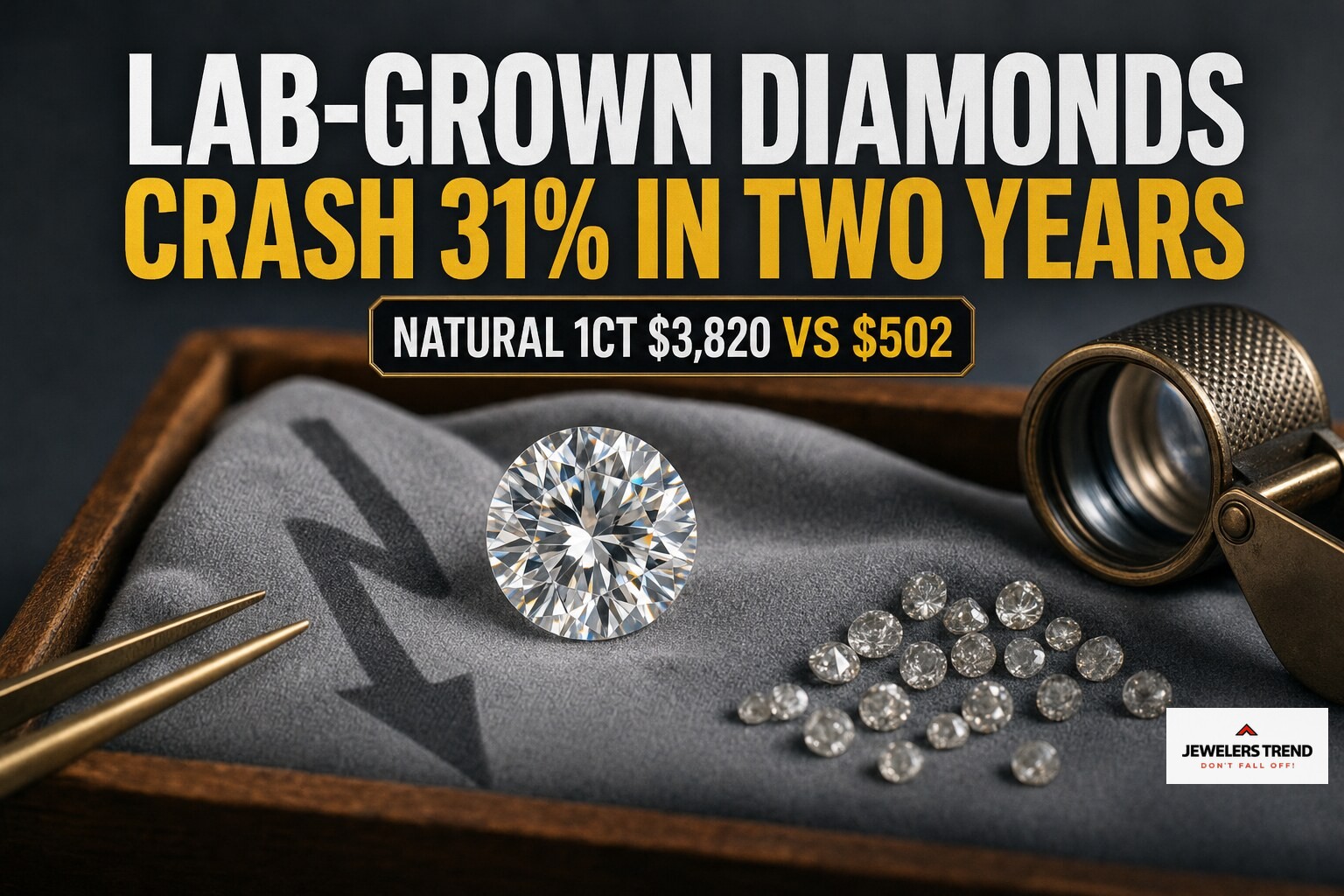
The other half of the diamond story is the continued descent of lab-grown pricing. On StoneAlgo's asking prices for October 14, a one-carat lab-grown diamond averaged 502 dollars against 3,820 dollars for a natural stone of the same size. The trajectory is the headline: from December 2023 to October 2026, the average one-carat lab-grown asking price fell 31%, from 732 dollars to 502.
That 31% decline over roughly two years is the structural reality retailers now have to merchandise around. A category whose wholesale pricing keeps sliding is difficult to position as a store of value, and the widening gap between a 502-dollar lab-grown stone and a 3,820-dollar natural one reframes the two as different products rather than substitutes. The natural market firming while lab-grown compresses is, if anything, a cleaner narrative for retailers to sell than the muddle of the past two years. I noted the read-through for the broader trade in this week's market wrap.
De Beers heads into Sight 9 under pressure
The producer side remains the pressure point. De Beers Sight 9 is scheduled for October 26 to 30. The miner enters it carrying real financial strain: in the first half of 2026, De Beers recorded an underlying EBITDA loss of 113 million dollars, an improvement from the 189 million dollar loss in the same period last year but a loss nonetheless. Falling rough diamond prices did the damage, and cost-cutting measures are what stemmed it rather than any recovery in the rough book.
So the dynamic going into Sight 9 is a polished market that is firming from the bottom up against a rough producer still reporting losses. That tension usually resolves through sightholder behavior at the box, and a firmer polished tape should give buyers a little more confidence to take goods than they had through the worst of the downturn. The structural question hanging over the producer is ownership itself, with Richemont and Signet reportedly in talks to join a consortium bidding for the business, a thread I follow in the industry roundup.
What retailers should take from September
The data lines up into an usable picture. Natural polished is recovering, led by 0.30-carat goods up 3.2% and a one-carat index now gaining two months running. Lab-grown continues its multi-year slide, down 31% at one carat since late 2023 and now averaging 502 dollars against 3,820 for natural. And the largest rough producer heads into its late-October Sight still working off losses. The open question is whether the polished recovery has enough momentum to reach the larger goods by year-end, or whether the gains stay concentrated in the small, liquid stones where they began.


Comments 0
No comments yet. Be the first to share your thoughts.