
Two sets of numbers framed the watch trade this week, one from the primary market and one from the secondary. Put together, they describe a business that is quietly healing at the top while the broad middle sorts itself out.
Switzerland turns the corner
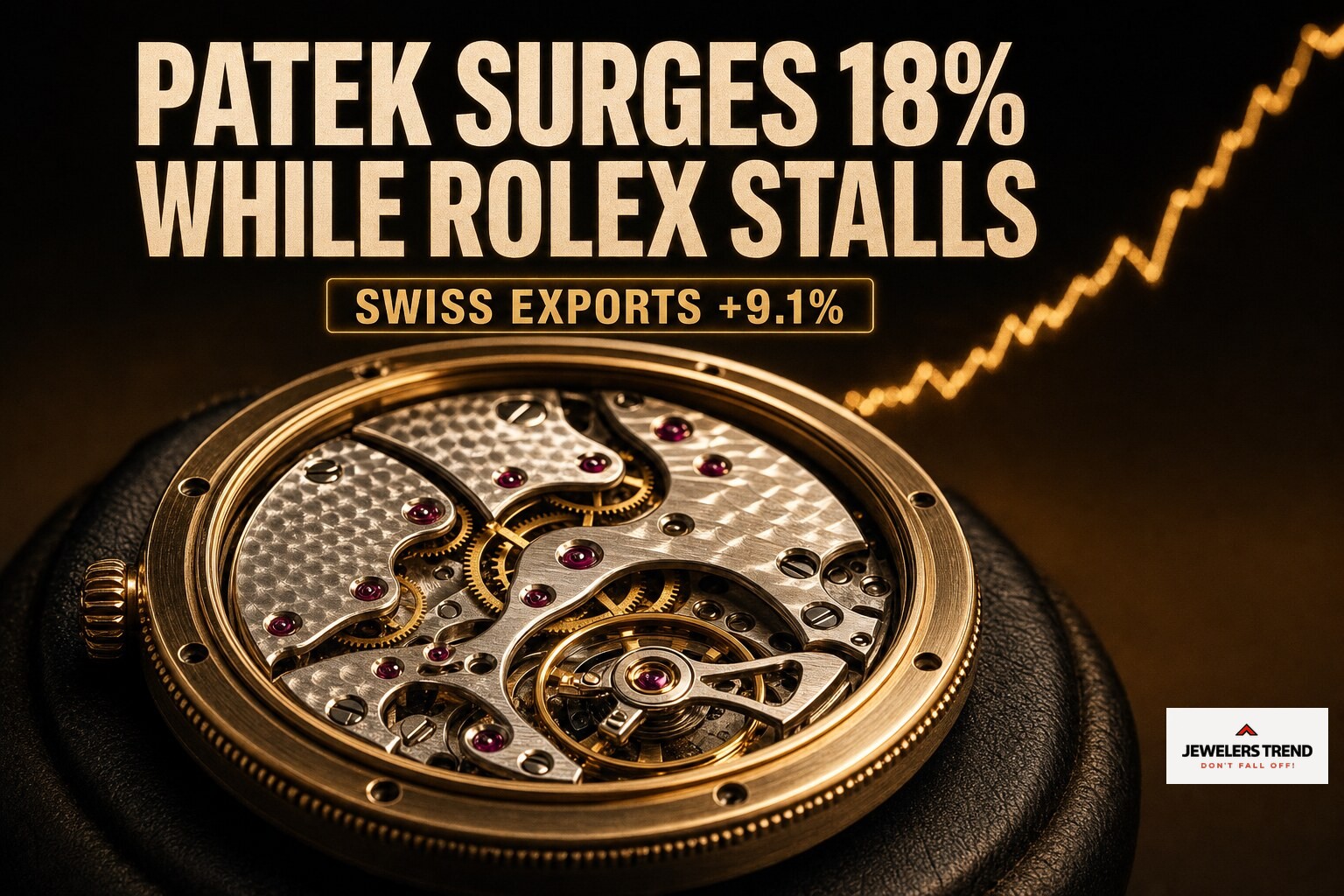
The Federation of the Swiss Watch Industry reported exports up 9.1% in August against the same month last year. More important than any single month, the industry's twelve-month moving average turned positive for the first time in two years. That is the number I watch, because it strips out the monthly noise and tells you which way the trend actually points. Through the first eight months of 2026, exports are cumulatively up 1.7% and have cleared 17 billion francs, about 20.6 billion dollars.
The one soft spot is the market closest to home. Shipments to the United States fell 19.4% in August. Even so, the US stayed the single largest destination at 197.5 million francs, roughly 240 million dollars, or 11% of global shipments. The tariff drag is real on the import side, something I touched on in the week's wrap, but a 19% drop in the top market and still finishing up on a twelve-month basis tells you how strong demand is everywhere else.
Patek climbs while Rolex stalls
On the secondary side the WatchCharts Overall Market Index was virtually flat in September, up 0.0%, which is exactly the kind of quiet tape where the leaders separate from the pack. Rolex declined 0.4% for the month, with 11 of its 15 collections falling. The read is simple and I have been saying it on the floor for a while: Rolex is fighting a stagnation of demand against rising supply. Its quarterly move of plus 0.5% lagged the group for that same reason.
Patek Philippe is doing the opposite. It nudged up 0.2% in September and, more to the point, is up 18.1% over the past year, with a plus 2.6% quarterly move that kept it among the top performers. Audemars Piguet gained 0.5% in September, led by the Royal Oak at plus 0.7%, and came in at plus 1.2% for the quarter. When the overall index is dead flat and one maker is up 18% on the year, that is where the money is voting.
The quarterly picture confirms the monthly read. Patek posted a plus 2.6% move for the third quarter and held among the top performers, Audemars Piguet came in line at plus 1.2%, and Rolex lagged at plus 0.5% as a stagnation of demand met rising supply. When the brand with the deepest production is the one going sideways, it is a supply story rather than a demand collapse. The makers with disciplined output are being rewarded for that discipline, and that is the lesson I would carry onto the show floor.
The auction block ran hot from New York to Hong Kong
The salerooms backed up the secondary data with real hammers. At Phillips New York on October 9, lot 22, a stainless Voutilainen 28Sport numbered five of eight, sold for 1,016,000 dollars including premium against an estimate of 120,000 to 240,000. That is a result more than four times the high estimate for an independent in steel, and it tells you everything about where collector appetite sits for the best independent watchmaking.
Across the Atlantic at Sotheby's Paris on October 7, lot 368, a circa-1968 Rolex Daytona Paul Newman reference 6241 brought 448,000 euros, about 500,700 dollars, against an estimate of 120,000 to 260,000. And the Christie's Watches Online Hong Kong Edit closed the same day totaling HKD 23,125,632, about 2.95 million dollars, led by an Eska pink gold wristwatch with a cloisonne enamel dial at HKD 1,216,000. Vintage Rolex, independents, and rare enamel dials: the three buckets that keep clearing estimates.
Phillips sets up its biggest U.S. Sale
The forward-looking news dropped on Thursday. Phillips announced what it calls the highest-value watch auction ever assembled in the United States, with a rare pink gold Patek Philippe expected to fetch more than 3 million dollars leading the sale. The New York Watch Auction XV will take place December 5 and 6. The timing is not an accident. You assemble a sale like that when you are confident the top of the market will show up with their paddles raised, and the Patek data this week says they will.
Put the week together and the picture is coherent. Swiss volume turned positive on a twelve-month basis, the secondary market is rewarding Patek and independents while Rolex digests supply, and the house that reads collector sentiment for a living just bet on a record US sale heading into December. For dealers working the shows, the signal is to lean toward what has provenance and tight production. If you want the broader diamond and gold context from the same week, the jewelry recap covers the other half of the hard-asset story. The open question is whether a 19.4% drop in US shipments keeps widening, or whether the December sale marks the point where American demand turns back up.


Comments 0
No comments yet. Be the first to share your thoughts.