
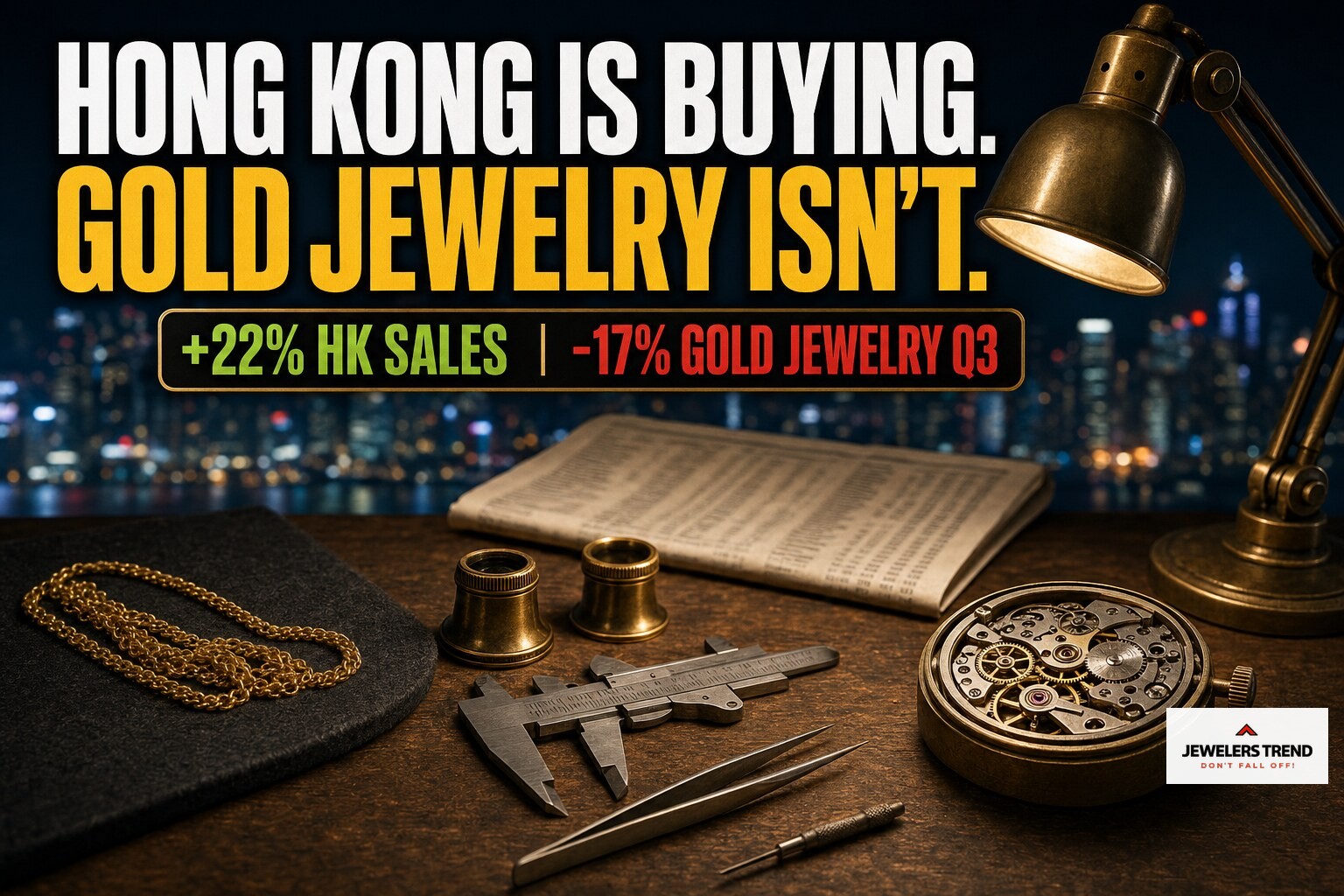
Two numbers framed the week for anyone working a counter or a dealer floor, and they point in opposite directions. Hong Kong jewelry and watch sales rose 22% year-on-year to HK$45.8 billion ($5.8 billion) in the first nine months of 2026, the highest level since 2019, according to Bloomberg and Business of Fashion reporting published November 4 and 5. A day later, JCK reported that gold jewelry consumption fell 17% year over year in the third quarter, the weakest third quarter in the data series. One market is buying. The metal itself is pricing a lot of buyers out of the gold case.
Those two lines sit on top of a Swiss export print that turned the year positive, a Hong Kong flagship lease that tells you where one major independent maison thinks the money is going, a central bank buying spree, and a Geneva auction weekend that opens tomorrow. Here is how the week stacked up from where I sit.
Hong Kong is back on the map
For a stretch of years, Hong Kong was a market dealers discussed in the past tense. Attention in the watch trade drifted toward other hubs, and the city's retail operators spent more time talking about what used to be than what was coming. The nine-month figure changes that conversation. A 22% gain to HK$45.8 billion is not a rounding error or a single strong month. It is three quarters of sustained buying, and it puts the city at its best level since 2019.
The detail I would watch is the mix. The figure combines jewelry and watches, and the reporting does not split the two cleanly. If the gain leans toward watches, it lines up with what the Swiss are reporting. If it leans toward jewelry, it sits awkwardly against the third-quarter gold consumption number. Either way, Hong Kong retailers have something they have not had in a while: a trend line pointing up.
The Audemars Piguet bet in Central
The clearest vote of confidence came from Le Brassus. Audemars Piguet announced plans in late October, per Bloomberg and Swissinfo, to open one of its largest Asian flagships: 13,000 square feet at New World Tower in Central, at a rent of over HK$2 million a month. The space replaces Emperor Watch & Jewellery in February 2027.
Think about what that rent means on a dealer's spreadsheet. A brand does not sign a lease at that level on a hunch. It signs because its own sell-through data in the city supports it, and because a flagship of that size is as much about owning the client relationship as it is about moving pieces. For the multi-brand retailers who have held prime Hong Kong addresses for decades, the Emperor handover is the part to study. The brand is taking the floor back, and it is doing so in the same year the city's sales posted a 22% gain.
Gold jewelry hits a wall
JCK's report that third-quarter gold jewelry consumption fell 17% year over year, the weakest third quarter in the series, is the number that should worry anyone with a gold-heavy case. The cause is not hard to find. Spot gold traded at $4,121.74 an ounce on November 5, per USAGOLD, before sliding to $4,049.69 on Friday after a stronger-than-expected October jobs report. At those levels, a plain gold bangle or a heavy chain carries a ticket that a lot of retail customers simply walk away from.
What the consumption number does not tell you is how much of the decline is weight and how much is units. When metal runs, customers usually trade down in grams before they stop buying altogether. A 17% drop in consumption can hide a fair number of lighter pieces still crossing the counter. The counters that hold up through stretches like this tend to be the ones that moved to lighter gauges and smaller pendants early, before the customer had to ask.
Central banks are on the other side of that trade. The World Gold Council reported 321 tonnes of official-sector buying in the third quarter, the fastest pace since late 2024, and 675 tonnes year to date through September. The full numbers and Friday's move are in our gold desk report on the 321-tonne quarter. Jewelry demand and official demand are running in opposite directions, and the official side is setting the price.
Swiss exports turn the year positive
The Federation of the Swiss Watch Industry's September print, released October 20, is still the reference point on every watch desk. Exports rose 11.7% to CHF 2.23 billion in September, which pulled the nine-month cumulative figure to CHF 19.5 billion, up 2.7%. Bloomberg, which put September at about $2.8 billion, counted it as the fourth consecutive month of growth and noted that exports to the United States soared 86%, a gain flattered by a tariff-related slump a year earlier.
I would not read too much into the US number on its own. An 86% gain off a depressed base tells you the channel has refilled, not that American demand has suddenly doubled. The more useful number is the cumulative 2.7%. After the tariff disruption a year ago, a positive nine months is a reasonable result, and it sets up the fourth quarter without the industry needing to dig out of a hole.
Geneva opens tomorrow
The real test of where collectors are putting money comes this weekend. Phillips Geneva Watch Auction: XXIV runs November 7 and 8 at Hotel President with 220 timepieces, headlined by a 1945 Patek Philippe Ref. 1436 split-seconds chronograph in steel, estimated at CHF 2,000,000 to 4,000,000. Sotheby's Important Watches sale follows on November 8 and 9, led by the first Patek Philippe ref. 3970, movement number 875,000, as Watches By SJX reported. Our Geneva auction preview walks through both lots and the spring results they will be measured against.
The spring benchmarks are high. The F.P. Journe Chronomètre à Résonance Souscription No. 18 brought CHF 4,875,500 at Phillips XXIII, a Patek Philippe 6002G-010 Sky Moon Tourbillon made CHF 3,242,000, and an Akrivia AK-06 in stainless steel reached CHF 3,000,000. A steel split-seconds Patek with a CHF 2 million estimate band is exactly the kind of lot where the room sets the price rather than the catalog.
Secondary pricing gives the sales a firm floor. Oliver R. Müller's Secondary Market Report 2026 found that Rolex, Patek and Audemars Piguet capture 61% to 62% of secondary market value against 45.5% of primary retail value. Haute Time had the Nautilus 5811/1G trading near $168,862 pre-owned on November 5, about double its $82,021 retail sticker.
Diamonds: the small end gives way
On the diamond side, Rapaport's October indices showed weakness concentrated in smaller goods. The 0.30-carat index fell 5.5%, its weakest reading since December 2025, while 0.50-carat dropped 2.3% and 1-carat slipped 0.9%. Only 3-carat goods rose, up 0.9%. De Beers held prices stable at its October sight, but volumes were low ahead of India's Diwali factory shutdown. Richard has the detail in his October diamond index breakdown.
Retail: Pandora steady, Richemont next
Pandora reported 6% organic growth in the third quarter on November 4, made up of 4% like-for-like and 2% from network expansion. North America accelerated to 3% like-for-like and Asia-Pacific posted 20%. The catch was the margin: guidance came down from at least 24% to around 23%, which Morningstar attributed to material and currency headwinds. That is the gold price turning up in a mass-market jeweler's income statement.
Richemont is scheduled to report on November 13, and its jewelry maisons will be read against both the Hong Kong rebound and the gold consumption slump. On the diamond ownership front, Anglo American's sale of its 85% stake in De Beers remains unresolved, with the Global Diamond Consortium still negotiating terms, per Rapaport.
What it means on the floor
Put the week together and the trade is splitting along familiar lines. Scarcity is holding its price, whether in Swiss watches or in large diamonds. The 3-carat index rose while the 0.30-carat index fell. Patek's Nautilus references trade far over retail while the broader gold jewelry category posts a series-low quarter. The middle of the market, where a customer weighs a gold chain against everything else competing for the same dollars, is the part under pressure.
What to watch next week
Three things. First, whether the Ref. 1436 clears the top of its CHF 4,000,000 estimate and closes in on the spring's CHF 4,875,500 Journe result. Second, Richemont on November 13. Third, whether gold holds above $4,000 after Friday's jobs-driven drop. With Hong Kong sales at their best level since 2019 and gold jewelry consumption at its weakest third quarter in the data series, the open question is which of those two numbers Richemont's jewelry results will look more like.


Comments 0
No comments yet. Be the first to share your thoughts.