
You can measure a week in this trade by how often the phones stop ringing on the floor. This one they barely did. Between a London charity sale that turned four wristwatches into 37.3 million pounds, a September Swiss export print showing a 56% collapse in US-bound shipments, and Signet swinging back into real profit, there was plenty to argue about at the bench this week. The spread between the top of the market and the middle has rarely been this wide, and nobody standing at a showcase is pretending otherwise.
Phillips turns the seasons into 37.3 million pounds
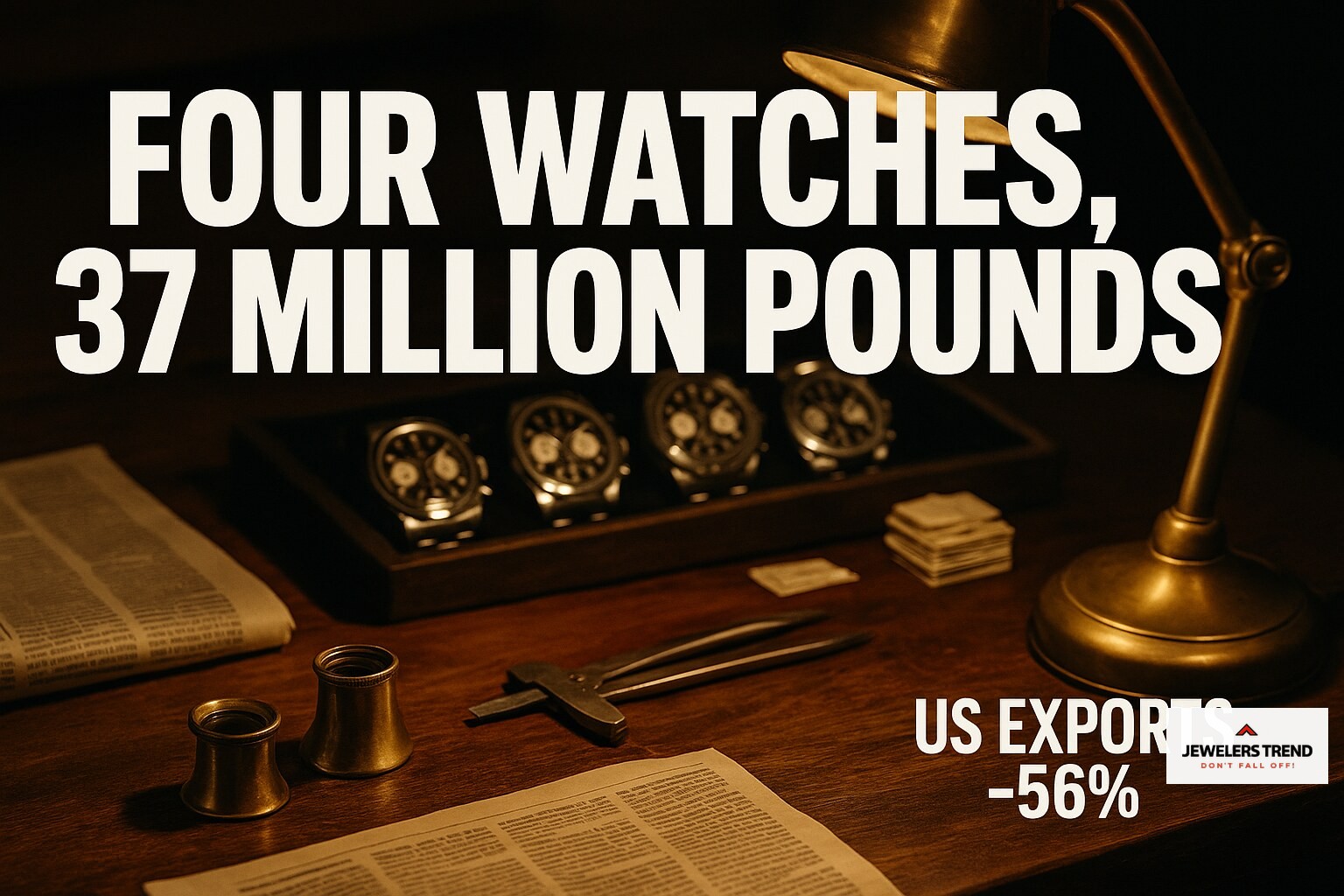
The headline hammer belonged to Phillips. In London the house sold four unique Rolex Cosmograph Daytona watches, each built around one of the four seasons, for a combined 37.3 million pounds as of September 28. These were not catalog pieces chasing a market comp. They were one-off charity lots, and the money behaved accordingly. When the piece is genuinely singular and the proceeds go to a cause, the usual anchors that keep a dealer honest on price simply stop applying.
The individual results tell you where the heat was. The Summer Daytona took 10.3 million pounds, Autumn followed at 10.2 million, and Winter landed at 10 million. The clustering is the tell here. Three of the four lots cleared within roughly 300,000 pounds of each other, which says the room was not bidding on the fine points of dial or case. It was bidding on the set, on the story, and on the names across the paddle. Proceeds went to causes including the Roger Federer Foundation. When a single Daytona clears eight figures, you are no longer pricing a watch. You are pricing scarcity, a story, and a room full of bidders who do not want to lose. I walk through the full London result and the Cartier Cheich record out of Hong Kong in this week's watch column.
Phillips was not alone at the top. Days earlier, Sotheby's Hong Kong put through a unique white-gold Cartier Cheich at HK$26,520,000, roughly 3.4 million dollars, the most valuable Cartier wristwatch ever sold at auction. Two records inside two weeks, from two houses, on two continents, is not a coincidence. It is the collector tier telling you it has cash and conviction while the broader trade waits for a shipping number to turn.
Swiss exports to the US fall off a cliff
The counterweight to the auction fireworks came from the Federation of the Swiss Watch Industry. Swiss watch exports to the United States plunged 56% on a year-to-year basis in September. That is not a soft patch. That is a door slamming on the single most important market for Swiss goods over the past two years.
What makes the number worth chewing on is the contrast with where the Swiss were in August. Total shipments grew 9.1% in value that month, the fourth straight monthly gain, and the 12-month moving average had just turned positive for the first time in two years. So the machine was running, then the biggest customer went quiet in September. You do not get a swing that violent from demand alone. A 56% cliff behind a run of positive prints looks mechanical, like inventory that moved on paper before it had to move in shop windows. Dealers I talk to read the US drop as a front-loading hangover more than a demand death. Goods got pulled forward earlier in the year, and September paid the bill. Whether that holds through the fourth quarter is the open question nobody on the floor will answer honestly yet.
If it is front-loading, the brands already have the sell-through and the quarter normalizes on its own. If it is not, then the fourth most important selling season of the decade opens with the American pipeline clogged and the gray market circling for discounts. Those are two very different Christmases, and the September print does not tell you which one is coming.
Signet swings back to profit
On the retail side, Signet Jewelers gave the bulls something to hold. The company reported second-quarter net profit of more than 52 million dollars, reversing a net loss of over 9 million dollars a year earlier. Adjusted earnings per share came in at 2.19 dollars against analyst estimates of 1.72, a clean beat as of September 9. Dig one layer down and the operating picture holds up: revenue reached 1.5 billion dollars for the quarter, same-store sales rose 2.2%, and adjusted EPS climbed 36% year over year. That is not a cost-cutting mirage. That is the register actually ringing.
That kind of reversal matters beyond Signet's own stores. When the largest specialty jeweler in the country prints a profit swing like that, it tells the vendors feeding it that the mid-market consumer did not vanish. A 2.2% same-store gain is modest, but modest is exactly what you want to see after the year the bridal category has had. It also puts a floor under sentiment heading into the holiday build. I dig into the Signet number alongside the LVMH first-half read and the show-season calendar in this week's industry wrap.
Diamonds keep grinding higher
The quieter mover, and maybe the more important one for anyone holding inventory, was diamonds. The Rapaport Trade Diamond Index rose 0.5% for 1-carat stones in August. That reading matters because it followed flat or negative figures going all the way back to May 2025. A half point is not a boom. It is a trend line bending the right way after more than a year of pain.
The smaller goods did better than the headline carat. RAPI for 0.30-carat stones jumped 2% in August, the half-carat advanced 2.5%, while the 3-carat actually slipped 0.4%. That inversion is worth sitting with: the commercial sizes that fill most retail cases are leading, and the big expensive goods are still soft. For a floor that pays the rent on melee and bread-and-butter solitaires, that is the right half of the market to be firming. I break down the full category spread, where the smaller stones outran the big ones, in this week's diamond piece. For a bench that has spent a year marking inventory down, even a modest print in the right direction changes how you quote a parcel.
Gold holds its footing
Gold spent the week doing its usual job of refusing to sit still. CNBC had spot at 4,218.01 dollars per ounce at 9 a.m. ET on October 2, up from 4,180.59 the morning before and 4,207.81 on September 30. By early afternoon Kitco marked the metal at 4,136.60, off 39.90 on the day. So depending on which clock you read, gold either firmed or softened, which is about right for a market this jumpy.
The structural bid underneath remains the central banks. They bought a record 288.9 tonnes in the second quarter, and Goldman Sachs Research expects official buyers to average 50 tonnes a month across 2026. That is a long way above the roughly 17 tonnes a month that was normal before 2022. For anyone quoting scrap or buying casting grain, that official-sector floor is the reason intraday wobbles of 40 dollars do not scare the trade the way they once did. The full read on where the metal sits and who is buying is in this week's gold column.
What the week adds up to
Put the pieces together and you get a trade pulling in two directions at once. The top of the market, the one-off Daytonas and the record Cartier, is as hot as anyone can remember. Phillips proved that again this week. Meanwhile the broad Swiss export engine just took a 56% hit in its biggest market, which is the kind of number that keeps shipping managers up at night.
In the middle sits the part of the trade that pays most of our bills. Signet printing a 52 million dollar profit on 1.5 billion in revenue and the Rapaport index ticking up are both quiet signals that the working consumer is still buying, still financing, still walking into stores. That is the base the holiday quarter gets built on.
The one number I keep circling back to is that Swiss US print. A 56% year-over-year drop in September, set against a 9.1% August gain and a 12-month average that just turned positive, is a contradiction the market has to resolve. If October bounces, this was a timing quirk tied to goods pulled forward. If it does not, the fourth quarter gets a lot harder to call. We will know which story is true soon enough.





Comments 0
No comments yet. Be the first to share your thoughts.