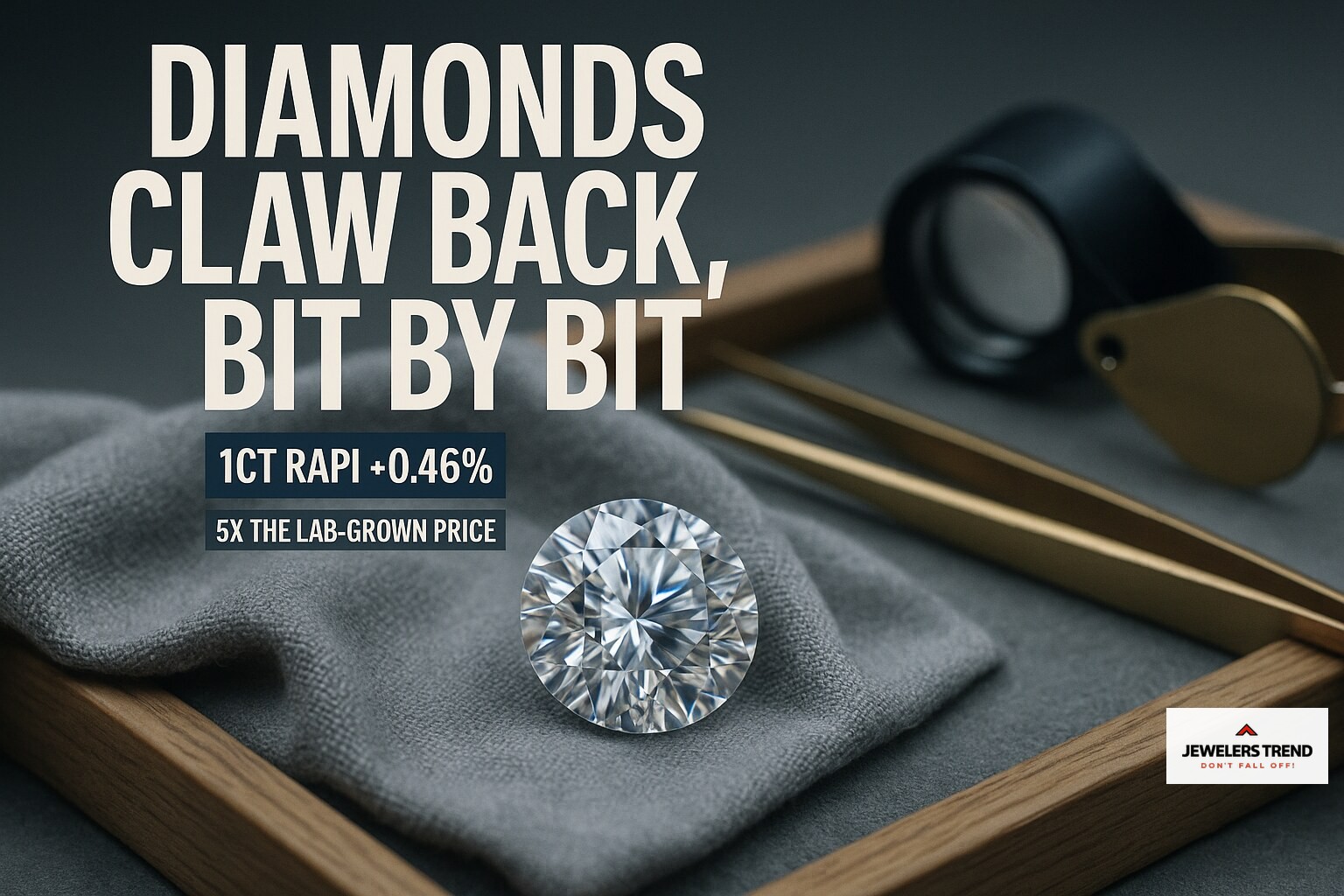
The diamond trade posted another small positive month in September, keeping a cautious recovery intact without signaling any sharp rebound. According to the Rapaport Trade Blog of October 5, the 1ct RAPI rose 0.46% in September. The composition of that gain matters more than the headline figure. Prices for 1.00 to 1.49 carat diamonds in D-J color moved up slightly, with the average change across D-F and G-J in IF-VVS and VS a positive 0.3%, a slower pace than the 0.7% gain recorded in August.
Beneath the one-carat line, the smaller dossier goods did the heavy lifting. The 0.30-carat and 0.50-carat stones advanced 2.0% and 2.5% respectively in September, while the 3-carat segment slipped 0.4%. That split, firm demand for calibrated dossier sizes and softness at the larger end, has defined the recovery for several months and points to retail restocking in commercial sizes rather than speculative buying in the big goods. For a jeweler building holiday engagement inventory, the data argues for weighting toward the half-carat and third-carat ranges that are actually appreciating.
Natural and lab-grown hold their gap
The pricing spread between natural and lab-grown remained wide. A 1-carat natural round diamond in G-H-I color, VS1-SI1 clarity carried a fair market price of $3,590 as of October 8, with most listings between $3,030 and $4,100. The same specification in lab-grown stood at $690. That is a natural stone trading at roughly five times its lab-grown equivalent, a ratio retailers have to handle every time a consumer asks why two visually identical stones carry such different tags.
The longer trend still shows natural goods well off their levels from the start of the year. Natural diamond prices are down 14.1% year-to-date on tracked data, with a 1-carat G-H VS1-VS2 moving from $4,715 on January 1 to $4,049 on October 8. The September uptick, in other words, is a stabilization off a lower base rather than a full recovery, a nuance that sits beneath the firmer top-line read across the week's trade data.
Titan's quarter signals Indian strength
The demand story reads very differently in India. Titan Company reported on October 7 that consolidated sales, including subsidiaries, advanced 25% for the three months ended September 30. Revenue from its jewelry segment, which includes Tanishq, Mia and CaratLane, rose 21% for the quarter. A 21% jewelry gain against a global natural-diamond market still 14.1% below its January level underlines how sharply regional demand has diverged. Indian consumer appetite is running well ahead of the softer Western pattern, a contrast every supplier weighing allocation should factor into fourth-quarter planning.
The sight ahead
The next read on rough comes at the end of the month. De Beers Sight 9 is scheduled for October 26 to 30. That event will test whether the polished stabilization seen in September flows back into rough demand, or whether sightholders stay cautious given the thin margins at the larger end. The sight also lands just as the US show calendar heats up, with buyers already turning toward the fall trade events and the luxury earnings cycle for direction on holiday orders.
For now the data supports a measured read. The 1ct RAPI is up 0.46% for the month, dossier goods are outrunning the larger sizes, the natural-to-lab ratio holds near five to one, and Titan's 21% jewelry growth shows where the real demand sits. The number worth carrying into the sight is the 0.3% average gain across the one-carat band in September, slower than August's 0.7%. Whether that deceleration is a plateau or a pause is the question Sight 9 will begin to answer, and it bears on how the wider gem and auction market prices risk into year-end.





Comments 0
No comments yet. Be the first to share your thoughts.