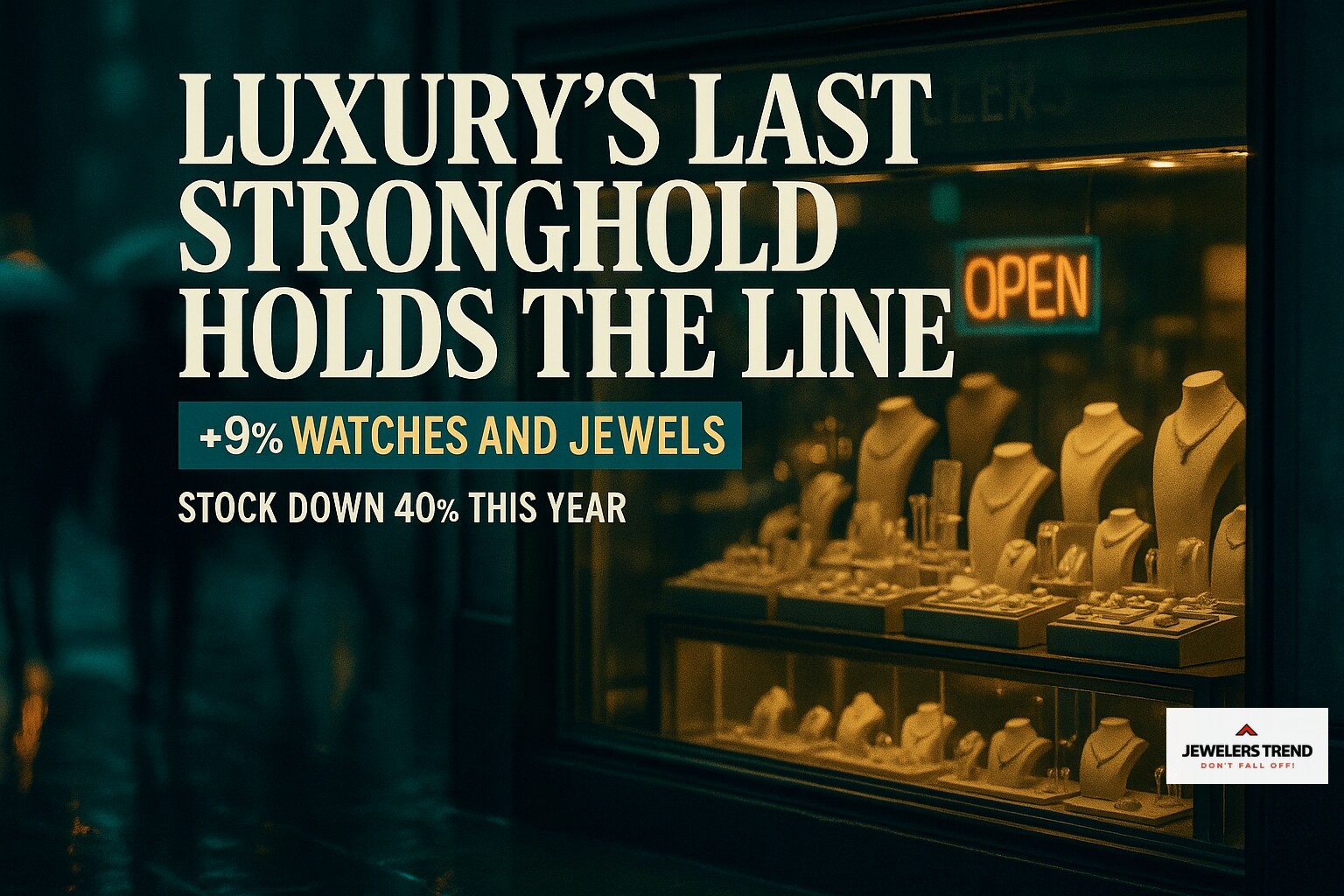
The luxury sector's most closely watched report lands Monday, and one division will draw more scrutiny than the rest. LVMH will report third-quarter 2026 revenue on October 12. The backdrop is a group under pressure at the top line but holding firm in hard luxury. LVMH reported first-half 2026 revenue of EUR 38.64bn, or $43.93bn, down 3% on a reported basis, though organic revenue rose 2% year-on-year. Organic growth then accelerated to 3% in the second quarter, a modest reacceleration that the market will want to see extended in the Q3 figures.
The standout was the hard-luxury line. LVMH's watches and jewellery division outperformed every other segment, with organic growth reaching 9% for the half and 11% in the second quarter. That lifted divisional revenue to EUR 5.22bn and raised profit 9% to EUR 831m. In a half where the overall group's reported revenue fell, a 9% organic gain and higher profit from watches and jewellery is the clearest signal available that branded hard luxury has held its footing better than fashion and leather goods. For retailers reading the tape, the division's strength is the single most encouraging data point in an otherwise cautious luxury picture.
What makes that outperformance worth parsing on the dealer floor is where the demand is not coming from. Swiss watch exports to the United States fell 19.4% to CHF 197.5 million in August 2026, even as world exports rose 9.1% to CHF 1,789.2 million. A division posting 11% organic growth against a US channel contracting by nearly a fifth tells you the engine is sitting in other markets, and it raises the question of how much of the branded-watch tailwind American independents can actually catch this quarter. The import slowdown is the number retailers should hold in one hand while they read LVMH's release in the other.
A stock priced for little
The equity market has not rewarded that resilience. Paris-based LVMH closed Friday at EUR 381.20, leaving it just 1.0% above its 52-week trough and down 40% since the start of the year. A share price pinned near its annual low heading into an earnings print signals low expectations and the potential for an outsized move on any surprise, in either direction. The October 12 number will therefore matter well beyond LVMH itself, because it sets the tone for how US jewelers and watch retailers frame fourth-quarter demand on their own calls. The same read runs through the week's broader trade data, where a charity Daytona set sold for a combined $49.47m at Phillips, proof that the collector end of the market is spending freely even as the mid-market import channel cools.
That split between the top of the market and the retail middle is the story within the story. Morgan Stanley's Q2 2026 work put Patek Philippe's value retention at 15.4%, ahead of Rolex at 9.8% and Audemars Piguet at 3%, a reminder that secondary-market strength now clusters tightly at the very top of the brand ladder. LVMH's own watch houses sit inside that same stratified picture, and the Q3 print will show whether brand-level pricing power is wide enough to lift the division or narrow enough to flatter only a handful of references.
The show calendar fills up
Away from the earnings desk, the fall trade-show season is in full swing. The 58th Watch and Jewellery Middle East Show ran September 30 to October 3 at the Expo Centre Sharjah. In the US, the Select Jewelry Show opens October 11 to 12 at the Ritz Carlton in Washington, D.C., immediately followed by JIS Fall on October 16 to 19 at the Miami Beach Convention Center. The calendar then moves to the New York City Jewelry and Watch Show, October 22 to 25 at the Metropolitan Pavilion. That cadence of back-to-back shows is where independent retailers write the orders that define their holiday floors, and it coincides with the September polished-price data that will shape buying decisions, with the 1ct RAPI up 0.46% for the month and Titan Company's jewelry revenue up 21% in its September quarter.
Those two figures frame the buying mood heading into the shows. A polished index creeping higher removes the excuse to sit on hands, while a 21% jump at one of the largest retail jewelers on earth confirms that demand, somewhere, is real. The task for a US buyer is to reconcile that with a softening domestic watch-import number and decide how aggressively to commit for the holiday window.
What Monday decides
The Q3 print has to answer a specific question: does the watches and jewellery momentum that produced 11% organic Q2 growth carry into the second half, or does it fade toward the group's slower 2% to 3% pace? A division delivering EUR 5.22bn in half-year revenue and EUR 831m in profit has become the anchor of the LVMH story, and any deceleration there would reverberate through the sector just as the US show season peaks and auction demand runs hot in the watch rooms, where a Voutilainen 28Sport just cleared $1,016,000 against a $240,000 high estimate. With the stock 40% lower on the year and clinging to within 1.0% of its 52-week low, Monday's report is less a routine update than a referendum on whether 11% organic growth was a peak or a floor.





Comments 0
No comments yet. Be the first to share your thoughts.