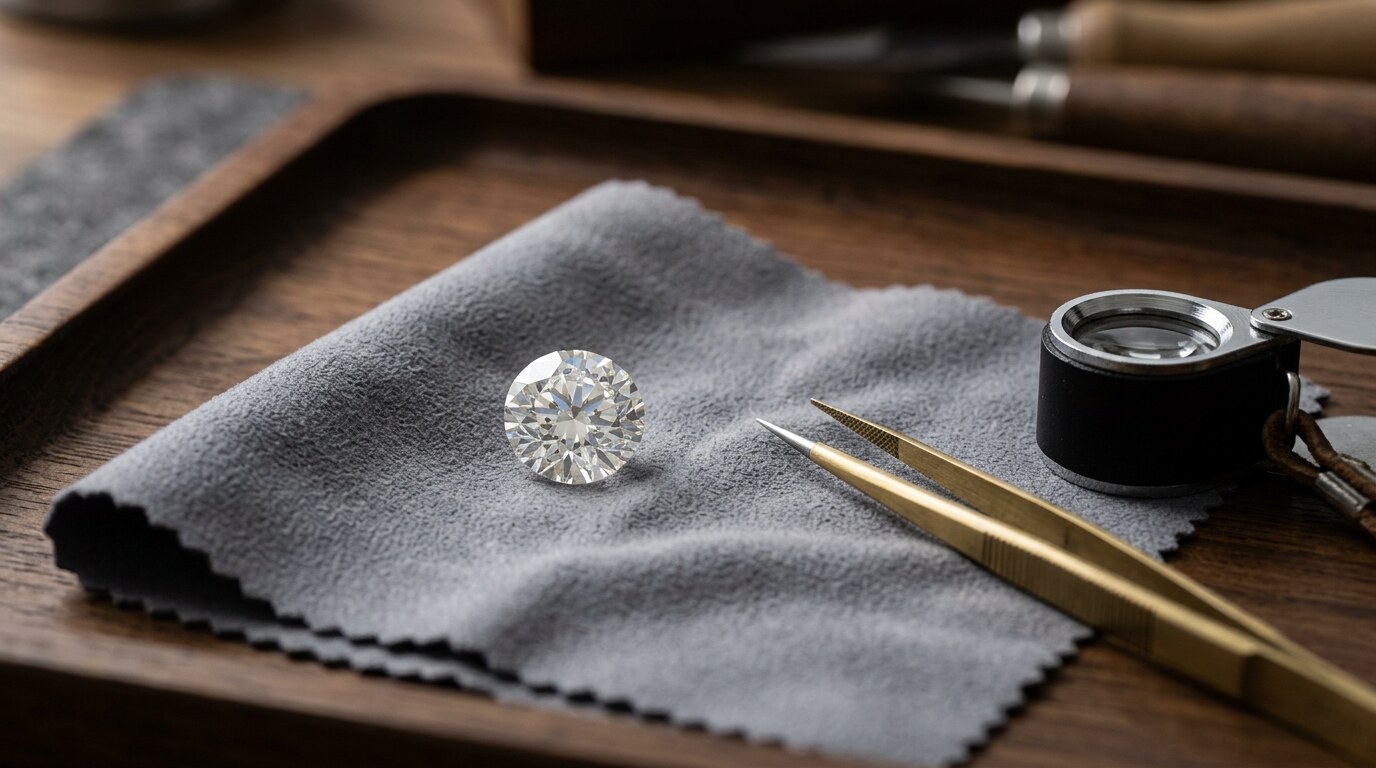
The diamond market delivered its first constructive data point in more than a year in July. The Rapaport Trade Diamond Index for one-carat diamonds was stable in July, ending 13 straight months of declines, according to Rapaport figures published August 4. Stability rather than growth is the accurate word, but after 13 consecutive negative months, a flat line reads as progress to a trade that had grown accustomed to marking inventory down every cycle.
The turn in the top of the box
The detail underneath the index is where the turn is clearest. One-carat prices in the D-F and G-J color ranges across IF-VVS and VS clarities averaged a 0.1% gain in July, a swing up from the 0.7% average decline recorded in June. That is a modest number in isolation. Its significance is directional: it is the first positive print in the categories that anchor engagement-ring inventory in over a year, and it suggests the extended reset that ran through 2025 and into 2026 has found a floor in the most liquid part of the market.
Read that 0.1% against the 0.7% June decline and the month-over-month swing is closer to eight tenths of a point. On a single parcel of one-carat goods that is the gap between a memo return that costs the dealer and one that holds its stated value. The bands that turned are not incidental either. D-F and G-J across IF through VS are the stones that move through the bridal case, the goods a jeweler has to keep in stock and cannot afford to carry at a loss through a long selling season.
Per-carat pricing on the broader year remains soft, which is the caution worth stating plainly. The StoneAlgo index put average per-carat prices for one-carat stones at $506 to $643 in August, down 2.59% year over year as of August 13. So the July turn is a stabilization off a lower base rather than a recovery to prior levels. A retailer restocking today is buying into a market that has stopped falling, not one that has clawed back the ground it lost.
Put the two figures side by side and the shape of the market comes into focus. The $506 to $643 band is where wholesale reality sits, and a 2.59% annual decline on that base is a slow bleed rather than the steep markdowns of the prior year. The flat July print does not erase the annual number. It says the rate of decline has gone to zero at the top of the box while the twelve-month tape is still red, and a buyer has to read both at once.
The natural and lab-grown spread
The number that continues to define the counter is the gap between natural and lab-grown. A natural one-carat D/VVS2 retails around $4,600 in the United States as of August 2026, while lab-grown starts at roughly $250 buying direct. That spread frames every consultation a jeweler now runs, and it is the reason the natural index turning positive matters for merchandising strategy. A stable natural market gives the retailer a firmer footing to hold price on the natural stone rather than discounting toward the synthetic alternative.
The arithmetic of that gap is what makes it durable. A natural stone at $4,600 sits at better than eighteen times the $250 entry point for lab-grown bought direct, and a multiple that wide is no longer a discount a shopper weighs against a comparable good. It reads as two separate purchases. When the price relationship is stretched that far, a small monthly move in the natural index does not push a buyer toward the synthetic, because the synthetic buyer settled that question long ago.
The direction of the two products has diverged for long enough that the trade has largely stopped treating them as substitutes and started treating them as separate categories with separate buyers. The July RAPI turn, modest as it is, supports the case that the natural side has a defensible price floor. That is a meaningfully different conversation than the one the trade was having through the declines of the past year.
Where the branded houses sit
The counter number lines up with what the listed houses reported for the quarter. LVMH posted 11% organic growth in watches and jewelry in Q2 2026, and Richemont turned in 24% growth in jewelry with watches up 8% over the same period. Those are branded, marketed goods rather than loose certified stones, but the read-through is that demand at the top of the market did not crack while the index was falling. The independent buyer restocking one-carat naturals is stepping into a category the luxury groups are still growing at double digits. I set the retail-side numbers, Pandora included, alongside this in the industry recap.
What it means for the fall
The practical read for a retail buyer heading into fall show season is that the risk profile of restocking one-carat natural goods has improved. Prices stopped falling, the top clarities turned positive, and the per-carat year-over-year decline of 2.59% is shallow enough that a jeweler is not catching a falling knife. The metal side of the ticket is a separate line to watch, with gold at $4,530 an ounce on August 21 holding near its June highs, which lifts the mounting cost even as the stone stabilizes; I track that figure in the gold note. It aligns with the broader steadying across the trade this week, which I set alongside the watch and gold data in the week's wrap.
The open question is whether a single stable month marks a genuine bottom or a pause before the next leg. Thirteen months of declines do not reverse on one flat print, and the StoneAlgo year-over-year figure still sits negative at 2.59%. But for the first time since the middle of 2025, the direction of one-carat prices is not down, and that is the number the fall buyer will carry into the Select Jewelry Shows, which open August 23 at the Ritz Carlton in Dallas.





Comments 0
No comments yet. Be the first to share your thoughts.