
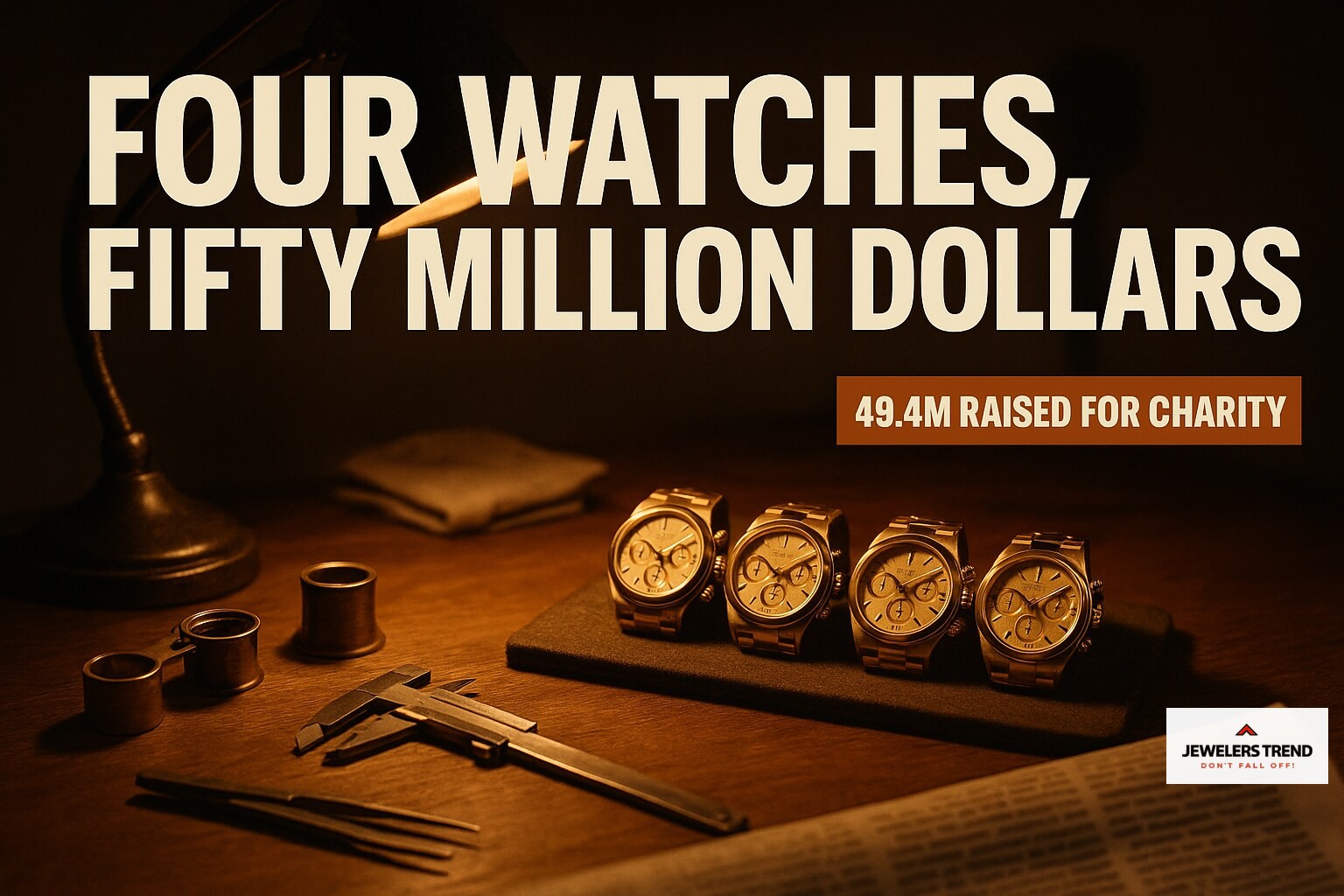
The desk this week ran on auction tape rather than retail traffic, and the single number that will outlast every other print from the last five sessions came off a London rostrum. Phillips sold four unique, gem-set Rolex Cosmograph Daytonas for a combined $49,467,260, or £37,300,000, with every penny routed to the Federer Foundation and Re:wild. That total broke the record for the biggest charity watch auction in history, clearing nearly US$50 million in a single room. When dealers talk about Daytona demand they usually mean steel references trading quietly between trays at IWJG tables. This was a different animal, and it reset what a philanthropic lot can command.
Understand what that figure is and is not. Four watches, each one-of-one, each gem-set, each carrying a cause and a name that pull bidders who never touch the secondary market on an ordinary Tuesday. It is not a read on where a plain steel Daytona trades between trays. It is a read on what a trophy with a story and a chequebook charity behind it can draw out of a room. The lesson for the floor is not that Daytonas doubled overnight. It is that the singular object, properly staged, still finds a bottomless bid while the ordinary reference waits its turn in the tray. I have watched enough charity lots over the years to know the premium does not travel home with the next steel example that crosses my desk.
The charity result mattered because it landed in a week when the secondary market has otherwise been orderly rather than frothy. Buyers are paying up for the genuinely singular piece and sitting on their hands for the merely nice one. You see the same split in the independent and vintage results out of Phillips New York, Sotheby's Paris and Christie's Hong Kong, where the headline lots ran hot and the mid-book stayed sensible.
A million-dollar Voutilainen in New York
Proof of that top-end bid came the same day on this side of the Atlantic. At Phillips New York on October 9, lot 22, a Voutilainen 28Sport in stainless steel numbered 5 of 8, sold for $1,016,000 including buyer's premium against an estimate of $120,000 to $240,000. A seven-figure hammer on a steel independent carrying a six-figure estimate tells you where the serious money is pointing. Collectors who missed the last wave of Journe appreciation are not making the same mistake twice, and the bench reputation on these pieces is doing the heavy lifting. That is the kind of result that makes a dealer rethink what he holds back from the showcase.
Put that Voutilainen next to the vintage board and the shape of the week sharpens. At Sotheby's Paris a fresh-to-market Paul Newman Daytona made €448,000, about $500,700, a clean number for a watch the market has seen priced many times over. Christie's Watches Online: Hong Kong Edit closed October 7 totaling HKD 23,125,632, roughly $2.95 million including premium, led not by a steel sports reference but by an Eska pink gold wristwatch with a cloisonné enamel dial at HKD 1,216,000. Over at Bonhams New York on October 8, the top lot was an Audemars Piguet Royal Oak Mini Frosted Gold at $76,700. Read those four rooms together and the message is consistent: the connoisseur's lot, the enamel, the numbered independent, the fresh-to-market Newman, all cleared, while the volume references underneath them traded at sensible, unexciting levels. That is a healthy book, not a bubble.
The export number under the auction noise
The rostrum theatrics sit on top of a retail picture that is softer than the headlines suggest, at least for anyone selling into the United States. Swiss watch exports to the US fell 19.4 percent to CHF 197.5 million in August 2026, even as world exports rose 9.1 percent to CHF 1,789.2 million. That gap is the whole story for an American dealer: the global machine is still shipping, but the American door has narrowed sharply. When the primary pipeline into this country contracts by nearly a fifth, the pre-owned and auction markets become the pressure valve, which is part of why a numbered steel independent prints a million dollars while new-watch allocation tightens. The value-retention tables tell the same tale of selectivity. Morgan Stanley's Q2 2026 work puts Patek Philippe out front at 15.4 percent, ahead of Rolex at 9.8 percent and Audemars Piguet at 3 percent. The money is rewarding the name that holds, not the name that merely sells.
Diamonds grind higher
The stone side kept its slow recovery intact. The 1ct RAPI rose 0.46% in September, per Rapaport News on October 6, extending a pattern of small positive months rather than any sharp snap-back. It is a grind, not a rally, and the category-by-category picture under that headline number shows the smaller dossier goods doing most of the work while the larger stones lag. The 0.30-carat and 0.50-carat dossier stones advanced 2.0% and 2.5% respectively, while the 3-carat segment actually slipped 0.4%. In D to J color, the one-to-1.49-carat goods in IF-VVS and VS averaged a positive 0.3% for September, a touch slower than the 0.7% gain in August. For a dealer stocking engagement inventory into the holiday window, that mix is a gift and a warning at once: the bread-and-butter commercial sizes are firming up under you, so replace what sells, but do not lean long on the big dossier goods that are still drifting. The next real tell comes at the De Beers Sight 9, scheduled October 26 to 30, where rough appetite will show whether the polished grind has legs through year-end.
Gold holds above 4,200
Metal stayed the loudest ticker on the wall. The current price of gold is $4,198.40 per troy ounce as of October 9, 3:07 p.m. ET, up $65.90 on the day. That is a firm close, but context matters: as of October 6 spot sat at $4,160, which is 25.6% below its all-time high of about $5,590 set on January 28, 2026. So the metal is strong on the week and still deep under its winter peak. For the scrap counter and the refining flow, $4,198 keeps the melt conversation alive without the panic selling you saw at the top. A $65 up-day pulls a few more estate pieces across the counter, but it does not spark the queue you saw back in January. I walk through what that move does to the bullion desk and refining math separately.
LVMH into the print
The macro read on luxury comes Monday. LVMH will report third-quarter 2026 revenue on October 12, and the trade will be reading the watches and jewellery line closely after that division carried the first half. Recall the H1 shape: group revenue of €38.64bn, down 3% reported but up 2% organic, with watches and jewellery the standout at 9% organic growth for the half and 11% in the second quarter, lifting the line to €5.22bn and profit 9% higher to €831m. The equity itself has been punished all year. Paris-based LVMH closed Friday at EUR 381.20, leaving it just 1.0% above its 52-week trough and down 40% since the start of the year. A stock pinned near its low into an earnings print is a market telling you it expects little and could move hard on any surprise. The Monday number sets the tone for how every US retailer talks about Q4 demand on their own calls, and whether that 11% Q2 jewellery clip held through the summer.
What I am watching
Three things carry into next week. First, whether the Voutilainen result pulls more independents out of private hands and onto the rostrum before year-end, because supply tends to follow a print like that. Second, whether the diamond grind can hold through the De Beers sight later this month without the larger goods dragging the index back under water. Third, the LVMH tape on Monday, which will either confirm the watches-and-jewellery strength or crack the one division that has been holding the luxury story together.
For the boutique floor, the takeaway is unglamorous. The genuinely rare piece is bid to the moon while the ordinary one moves at a sensible clip, gold is firm but off its highs, and stones are inching up on the small sizes and slipping on the big. That is a market you can actually trade in rather than one you have to guess at. The number I will carry into Monday is simple: $49,467,260 raised for charity on four watches, against a steel Voutilainen at $1,016,000 the same afternoon, all of it printing in the same week US exports fell 19.4 percent. When both of those clear while the import door narrows, the top of this market is anything but quiet. The open question is whether LVMH's Monday print says the same thing about the rest of it.





Comments 0
No comments yet. Be the first to share your thoughts.