The natural diamond recovery continued through September, and the strength is concentrated exactly where the trade wants to see it: in smaller stones of higher quality. According to Rapaport News, the Rapaport Trade Diamond Index rose 3.2% for 0.30-carat diamonds and 2.5% for 0.50-carat goods in September. The 1-carat index advanced 0.3% for a second consecutive increase, and the 3-carat index added 1.5%. A recovery that begins in the 0.30-to-0.50-carat band is a recovery driven by retail demand at the counter rather than by speculation in larger certificated stones, which is the healthier way for a correction to end.
There is a reason dealers read the small-stone numbers first. The 0.30-carat and 0.50-carat bands are melee-adjacent commercial goods that move on volume, and they turn over fast enough that a 3.2% gain reflects what buyers paid last week, not a stale quote on a stone that has sat in a parcel for a year. When the lift shows up there before it reaches the one-carat line, it is coming from the showroom floor upward rather than from a trading desk repositioning inventory. The 1.5% gain at three carats is a separate signal, pointing to selective demand for statement goods, but the 0.3% at one carat is the figure that decides whether this holds, because the one-carat round is the engine of the American bridal counter.
The movement showed up in the price list as well. On September 11, Rapaport raised its published prices for certain round, 0.30- to 0.69-carat stones in D-to-G color and VVS1-to-SI1 clarity. A list increase in that commercial middle, the goods that fill most engagement rings and studs, confirms that the index gains reflect real transactions and not thin trading at the margins. A list move matters more than an index tick because the list is the reference every dealer discounts against. When it rises in the heart of the engagement-ring range, the whole quoting conversation resets a notch higher.
The lab-grown spread keeps widening
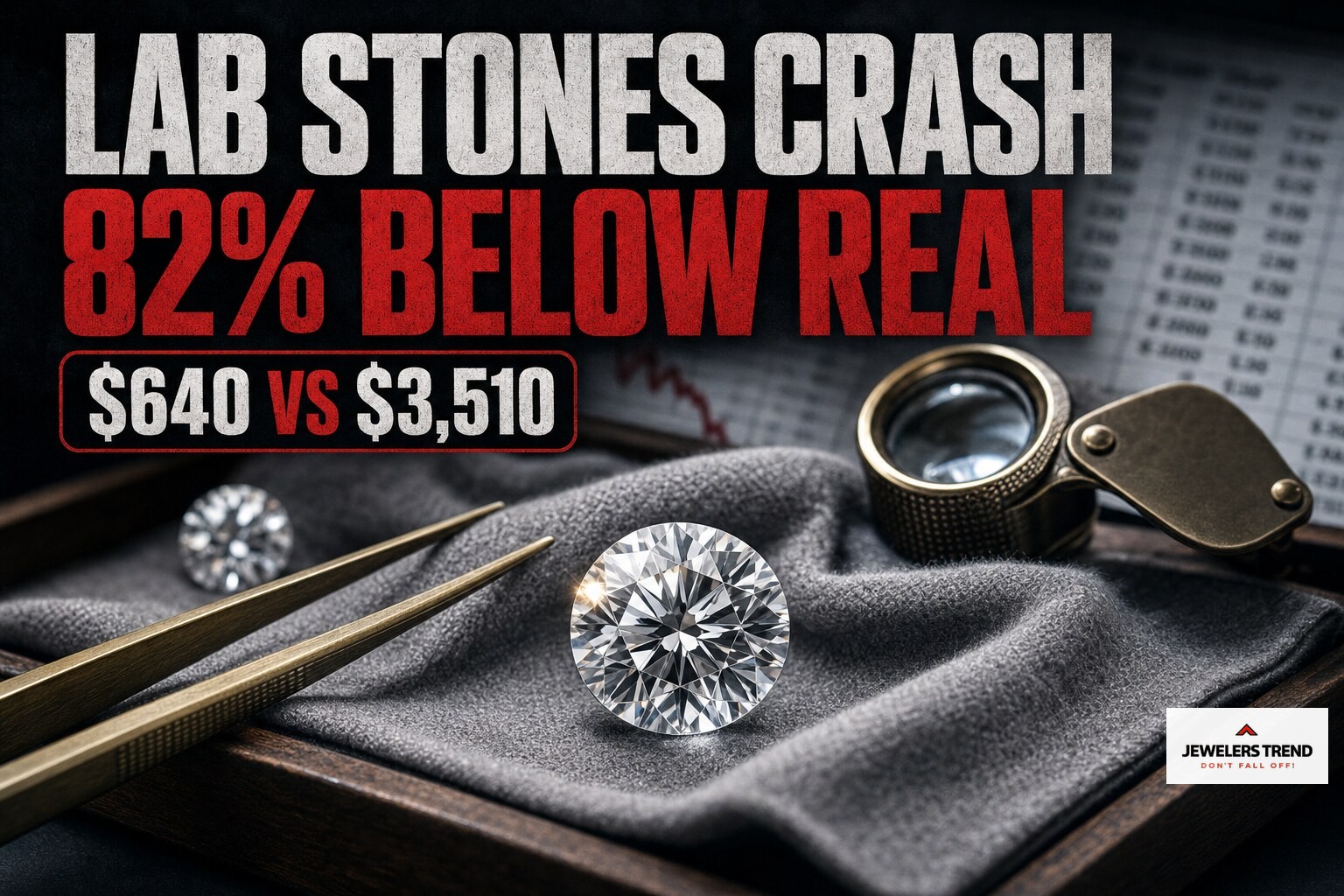
While natural goods firm, the lab-grown market continues its long slide, and the gap between the two is now the defining fact of the category. As of October 23, for mainstream G-to-I color, VS1-to-SI1 clarity round goods, a one-carat natural diamond costs $3,510 while the lab-grown equivalent costs $640, roughly 82% less. Buyers are no longer choosing between two versions of the same product. They are choosing between two products at very different price points, and the market is pricing them accordingly.
StoneAlgo's data tells the same story from a different angle. On October 19, a one-carat lab-grown diamond was listed at $640 in Clairamor's picker, while StoneAlgo's market average sat at $503, against $3,841 for a one-carat natural. As of October 14, StoneAlgo put the one-carat lab-grown average at $502 and the natural at $3,820. The grown stone has effectively settled near $500 at retail, a floor that leaves little room for the manufacturing margins that drove the early lab-grown boom. For a retailer, the practical takeaway is that the lab-grown spot is now a feature stone priced like a component, and the money in that case has to come from mounting, finishing, and the ticket on the finished piece rather than from the center stone itself.
Measuring the decline
The scale of the repricing is clearer over a longer window. From December 2023 to October 2026, StoneAlgo's average one-carat lab-grown asking price fell 31%, from $732 to $502. The Diamond Price Index, which has tracked a 1.00-carat round benchmark since March 2025, shows natural diamond prices down 4.7% and lab-grown prices down 28.5% over that span. Both categories corrected, but the natural decline has been shallow and is now reversing in the smaller sizes, while the lab-grown decline has been severe and shows no sign of a floor forming above $500. The two curves told the same story about soft demand in 2024. They are telling opposite stories about pricing power now.
For retailers that split is becoming a merchandising decision rather than a philosophical one. Lab-grown at $500 a carat supports a fashion-jewelry business built on volume and turnover. Natural goods, firming from the bottom up, support a bridal and investment business built on margin and resale. The two can coexist on the same counter, but they are no longer the same conversation with a customer, and the consolidation moves described in this week's industry report only sharpen that divide. When Richemont and Signet are reportedly circling De Beers, the parties positioning around natural supply are the same houses that will decide how the category is marketed, and that is not an accident of timing.
The number to watch is whether the 1-carat natural index can turn a second consecutive 0.3% gain into a sustained trend. For the wider market backdrop behind these moves, see this week's trade week wrap. If the recovery that started in 0.30-carat goods climbs steadily into the one-carat band through the fourth quarter, the trade will have its clearest sign in two years that the natural correction is finally over. The open question for the fourth quarter is simple: does a second 0.3% print become a third, or does the one-carat line stall while the small stones run ahead without it?


Comments 0
No comments yet. Be the first to share your thoughts.