
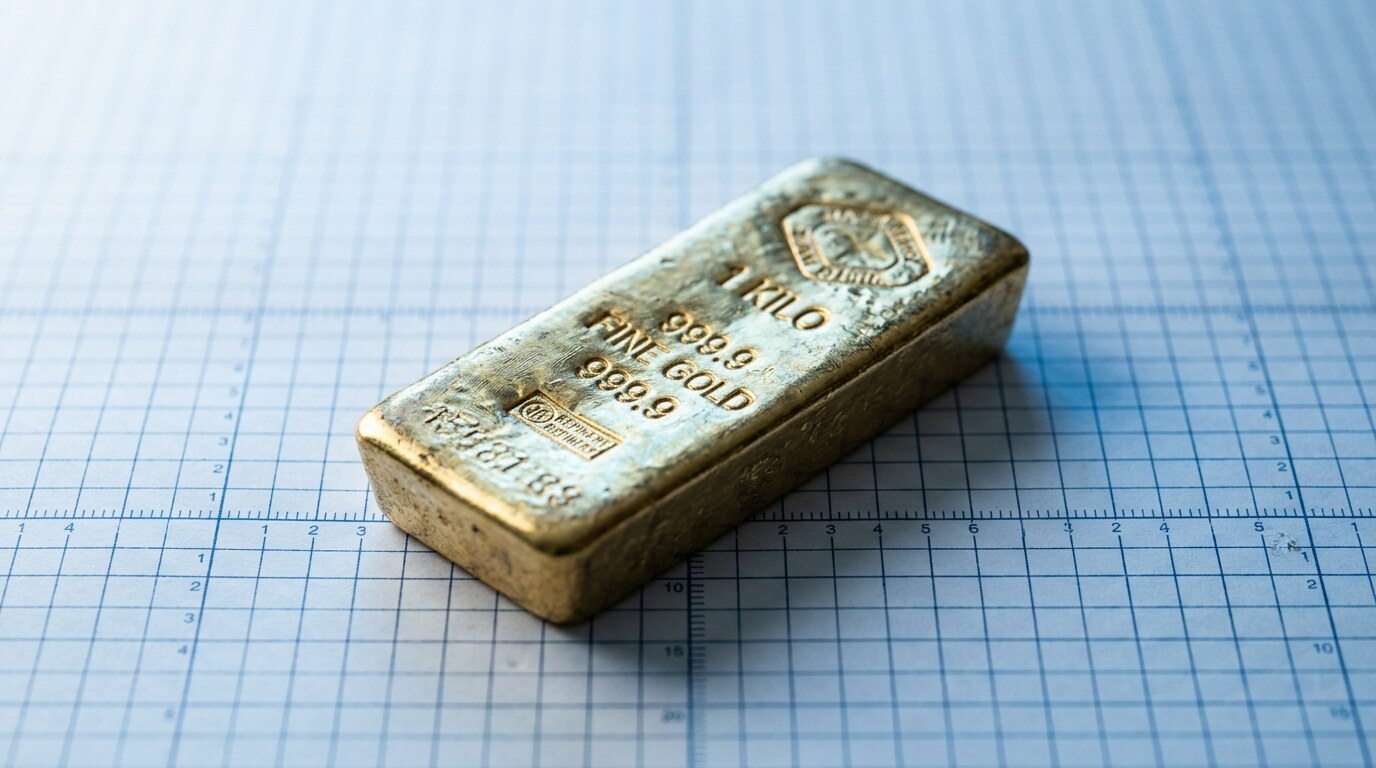
Gold came off a hot open and gave a little back, and the trade barely blinked. December futures opened Monday, August 10, at $4,400 per troy ounce, edged to $4,391.50 by mid-morning ET, and by Wednesday, August 13, spot sat at $4,354.22, down 1.23% on the session. A 1.23% down day would have rattled this desk a year ago. Now it is a shrug, because the trend under it is still one direction and the buyer holding it up has not moved.
The trend swamps the day
Zoom out and the day-to-day noise disappears. Gold is up 7.40% over the past month and 30.53% against the same point last year. Sit with that second number. A 30.53% year-over-year move reprices everything in the shop, from what you pay on scrap intake at the counter to what a plain band costs to make before a single stone goes in it. Every jeweler working a bench right now is quoting against metal that costs roughly a third more than it did last August, and the customer has not fully absorbed that yet. That lag between the metal move and the retail sticker is where the margin pressure lives.
A pullback from $4,400 to $4,354 inside three sessions is the market breathing after a fast run, not a top. When something rallies 7.40% in a month, it does not go straight up, and it should not. The $4,354 handle after a $4,400 open is consolidation, and consolidation at these levels is healthier for the trade than another vertical leg that nobody at the counter can pass through to a customer. A market that pauses is a market that can be sold into. A market that only spikes is one that leaves the bench guessing.
The sovereign bid has not blinked
The reason this desk shrugs at a down day is the buyer standing underneath. China's gold holdings rose by 640,000 ounces, about 20 tons, in July 2026, marking the 21st consecutive month of accumulation. That was the biggest single-month increase since October 2023, and it followed roughly 15 tons added in June. Twenty-one months in a row is not a trade. It is a policy, and policy does not care about a 1.23% Wednesday. When a buyer accumulates on that kind of schedule, dips get absorbed before they turn into anything the tape would call a correction.
China is not alone. Central banks worldwide purchased an estimated 289 tonnes of gold in the second quarter of 2026. When official-sector demand runs at that scale quarter after quarter, it puts a floor under the metal that speculative selling cannot easily break. That is the structural bid that has carried gold up 30.53% on the year, and until the reserve prints stop, dips get bought. July's 20-ton Chinese add, the biggest since October 2023, is the opposite of a central bank stepping back from the market.
What it means at the bench and the counter
For the trade, the practical read is straightforward. Metal at $4,354 with a 30.53% year-over-year gain means margin discipline on every gold piece, tighter scrap spreads at the intake counter, and customers who need a reason beyond metal to buy. It also means the refining and bullion flows stay busy as long as sovereigns keep printing monthly adds. This is the backdrop the fall shows open into, and it is not going to loosen while China is buying 20 tons a month.
For how gold fits against a diamond market that just turned and a Swiss export figure still running double digits, see the week wrap. The steel-sports and precious-case dynamics that flow from these metal levels are in the watch column.
The number that matters into next month is not the $4,354 close. It is the August reserve print. China has bought for 21 straight months and just posted its biggest add since October 2023. Whether month 22 keeps that pace decides whether $4,354 is a pause on the way higher or the start of the consolidation this trade has been waiting a year to see.





Comments 0
No comments yet. Be the first to share your thoughts.