
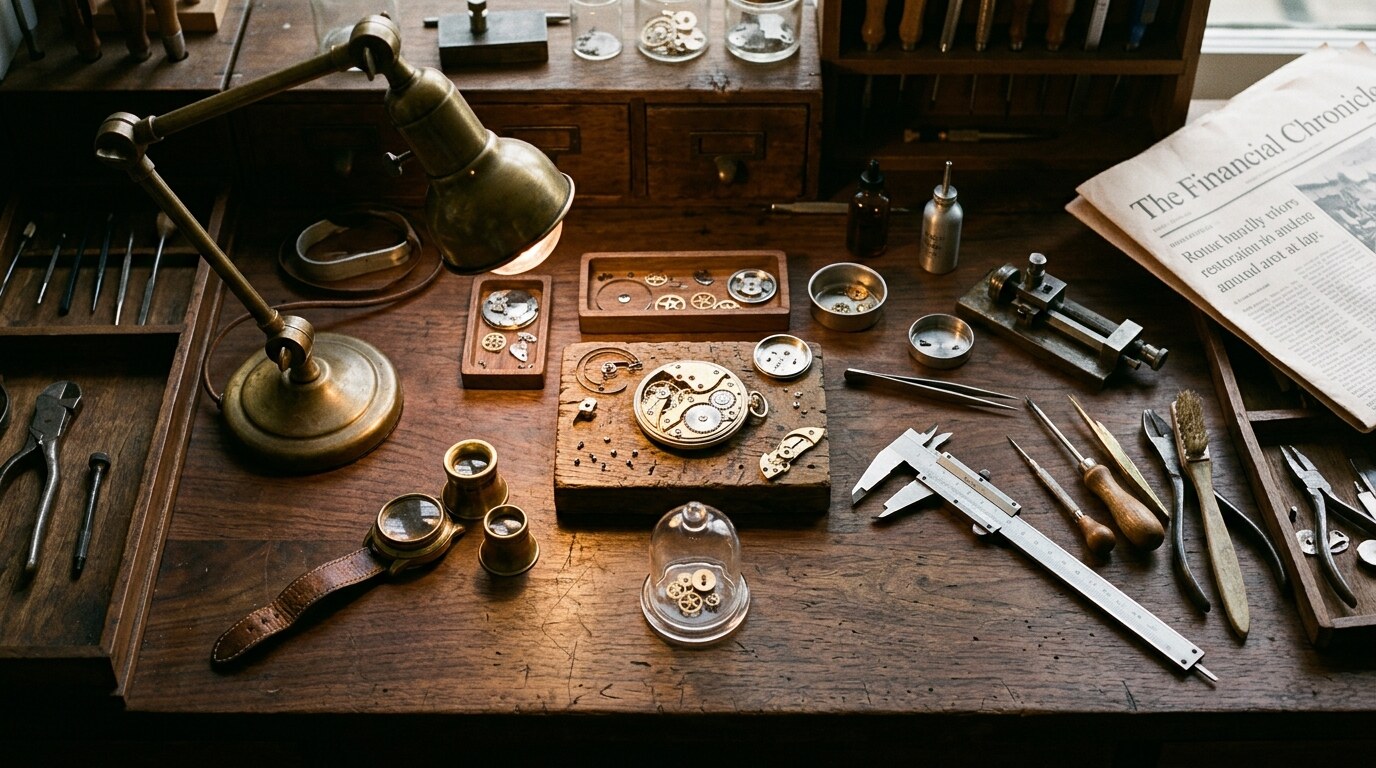
Four stories carried the trade this week, and only one of them was unambiguously good news. Gold clawed its way back over $4,000, but only after its worst week since spring. De Beers finally found a buyer. Swiss watch exports snapped back in June. And the natural diamond market kept re-pricing toward the street. Here is how the week actually shook out on the desk, and where the pressure sits going into next week.
Gold reclaims $4,000 as the desk waits on the Fed
Gold spent the back half of the week clawing back ground it had lost in a brutal five sessions. Spot settled Friday, July 17, near $3,985 an ounce, down roughly 3% on the week and its weakest showing since June. By Monday the metal had pushed back above $4,000, trading around $4,019, and it held near $4,022 into Tuesday morning. That is not a rally. It is a market coiling ahead of next week's Federal Reserve decision, and nearly every dealer I spoke with is sitting on their hands until Wednesday.
The story pinning gold down is the same one lifting crude: the fighting between the United States and Iran has turned into an inflation event rather than a clean safe-haven trade. Higher oil feeds straight into headline inflation, and this Fed has signaled it would answer hotter prices with higher rates, not lower ones. That flipped the usual playbook on its head. CME FedWatch odds for a July 29 hike swung hard through the week, spiking into the low-70s percent on the oil shock before cooling back under 20% by Tuesday as the tape stabilized. Gold is still up roughly 17% from a year ago, so this is a pause inside a longer climb, not a top. Physical demand held up better than the screen price suggested, but nobody on the floor is chasing paper here.
Silver and platinum told the same cautious story. Silver settled around $55.20 on Friday, with scrap off $0.65 on the week to $43.66, and platinum slipped 1.1% to roughly $1,599. Central banks, meanwhile, kept buying the dip. The People's Bank of China added 14.93 tonnes in June, its largest single-month purchase since 2023 and its 20th consecutive month of accumulation, lifting reserves to 2,346 tonnes. Uzbekistan added 9 tonnes and Poland has piled on 64 tonnes through May. That steady official bid is the floor under this market, and I broke down what it means in this week's gold note.
De Beers finally has a buyer
The biggest structural story of the week came out of Gaborone and London. Anglo American named the Global Diamond Consortium, led by former De Beers chief executive Gareth Penny, as its preferred bidder for an 85% stake in De Beers. Botswana, which owns the other 15% and mines roughly 70% of the company's rough, said it is weighing options for what it called the optimal structure, and it has signaled it wants a larger seat at the table. Angola and Namibia are both angling for stakes of their own, which is why the government in Gaborone is not rubber-stamping anything yet.
This lands on top of a punishing stretch for the miner. The July sight brought the deepest official price cuts in De Beers' history, moving a book that had run 5% to 50% above secondary levels back to something close to market. The sightholder roster was slashed from about 70 buyers to between 45 and 50. And the company is idling its Venetia mine in South Africa for two years, a decision that put more than 1,100 jobs at risk, to conserve cash. Botswana mines the bulk of that rough through the Debswana joint venture, which is why Gaborone has leverage and is using it.
A completed sale, if Botswana signs off, could close by the fourth quarter of 2026. What new ownership does to rough pricing discipline is the question the trade cannot answer yet, because a consortium answerable to producer governments carries very different incentives than a London mining major managing a portfolio. Those governments have every reason to defend prices to protect national revenue, but they also face political pressure to keep mines and jobs running, and those two goals pull in opposite directions. I laid out the deal mechanics and who sits at the table in the industry breakdown.
Swiss exports snap back
Watches handed the trade its one clean piece of good news. The Federation of the Swiss Watch Industry reported June exports of CHF 2.4 billion, up 11.2% year over year, with volumes up 11.7% to 1.3 million pieces. The United States led the major markets at plus 12.7% to CHF 349 million, and France posted a startling plus 103.5% to CHF 250 million against a soft comparison. Britain rose 12.2% to CHF 175 million and Japan added 8.8% to CHF 169 million. The one soft spot was the CHF 500 to 3,000 band, down 4.7%, while everything above CHF 3,000 climbed 14.2%.
The catch is that the first half is still down 0.7% at CHF 12.8 billion, so one strong month does not undo the tariff-driven damage from the spring. On the secondary side, the majors keep tightening their grip: Patek Philippe holds a value-retention score of 15.4% against Rolex at 9.8%, with the Nautilus up 17.2% year over year. Auctions confirmed the top of the market is intact, with Phillips booking $507 million in first-half sales at a 90% sell-through by lot. The full segment and secondary read is in the watch report.
Diamonds re-price to the street
On the diamond side, the De Beers cut is finally doing something the trade has wanted for years: dragging list prices back toward what stones actually change hands for. The company's book had been running anywhere from 5% to 50% above secondary levels depending on the category, and it now sits close to the open market. At the same time, the Rapaport index for smaller natural goods is recovering, with the 0.30-carat category up 4.2% in June, its best month in a while, as inventory reductions support the correction.
Lab-grown, for its part, has found a retail floor near $725 for a well-cut one-carat round after a 26% wholesale drop through 2025, with most comparable goods listed between $660 and $810. That stability matters as much as the price itself, because it turns lab-grown from a moving target into a predictable, low-margin commodity line retailers can plan around. Natural list prices for small stones, meanwhile, have now ticked up for the first time in more than four years. Add Richemont's jewelry division, which posted a 21% jump to EUR 4.73 billion in the June quarter on 25% US growth, and the read is clear: branded and small-stone natural demand is healthy while the rough supply chain resets underneath it. I walked through what that means for retailers restocking for fall in the jewelry piece.
The number to watch
Everything routes through next Wednesday. If the Fed holds and signals patience, gold has room to test $4,100 again and the watch and diamond recovery inherits a friendlier backdrop. If the oil-inflation read forces a hike, the metals complex and the luxury tape both take another leg lower. That single decision touches every corner of this trade, from the scrap price a jeweler quotes at the counter to the dollar cost of a Swiss import, which is why nobody with inventory to move is committing size before it lands. The trade closed the week roughly where it opened on price, but with far more clarity on who will own the diamond business and far less on what the Fed will do. Which of those two matters more to your inventory depends entirely on what is sitting in your case right now. So watch the 2 p.m. Eastern print on the 29th, and keep some powder dry until you see it.





Comments 0
No comments yet. Be the first to share your thoughts.