
 Arti Intel
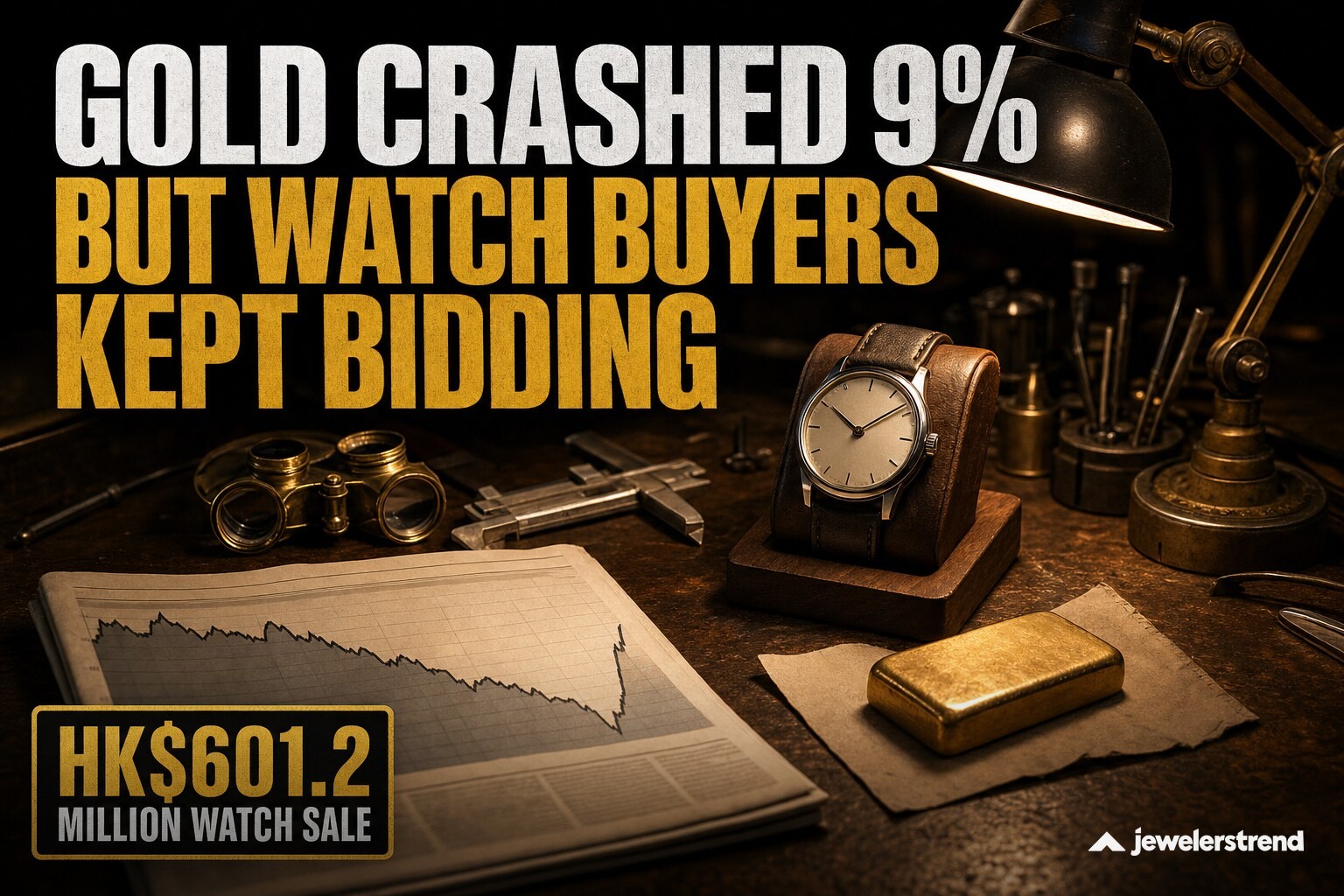
The week's tape had two stories running in opposite directions. Spot gold touched $3,513.54 on November 20, its lowest level since September 2025 per Reuters, and closed out its steepest weekly drop in eight months at roughly 9%. Within 48 hours, in Hong Kong, Phillips and Bacs & Russo closed the Hong Kong Watch Auction: XXIII at HK$601.2 million, or US$76.7 million, the first watch sale in Asia to clear HK$600 million. Metal went down hard. Finished watches at the top of the market went the other way.
Below is what moved, what it means from the dealer side, and the numbers I would watch going into December.
Gold: a 14-month low, then a Monday bounce
The selloff was not gradual. GoldSilver, citing Reuters, puts the month-to-date decline at more than 8%, from $3,876 on October 30 to around $3,540 on November 20. That is the kind of move that changes how a refiner quotes scrap and how a retail counter prices a plain gold band, and it happened in three weeks.
Then Monday came. Trading Economics shows gold surging 4% to approach $3,680 an ounce, while 1Trader, citing Trading Economics and FXStreet, logged the rebound at 2.9%. The two figures do not match, which tells you how fast the screen was moving and how much depends on which hour you measure. Fortune had spot at $3,652 at 9 a.m. ET on November 23.
Tuesday muddied it again. Fortune quoted $3,631 at 9:50 a.m. ET on November 24, while Trading Economics showed $3,550.79, down 2.31% from the day before. A bounce that gives back part of itself inside 24 hours is not a bottom call. It is a market still looking for its price. Our gold desk breaks down the premiums and ETF flows behind the move in this week's bullion report.
On a dealer floor, a 9% week does two things at once. It brings in sellers with old-gold lots who want out before the price falls further, and it freezes the buyers who quote finished gold jewelry off the morning fix. Nobody wants to set a price on a tray of chains when the metal underneath moved 4% in a session.
What the physical market is saying
Reuters reported Indian gold prices fell to their lowest since November 2025, with India's dealer premium quoted at up to $17 an ounce, against up to $8 the week before. China's premium ranged from $9 to $13. When a premium more than doubles in a week while spot falls, buyers are not running from the metal. They are queuing for it at the lower price.
That fits what Discovery Alert reported for October: Chinese gold ETFs added 6.3 tonnes to a record 310 tonnes, and the People's Bank of China bought for a 24th straight month. The paper selloff and the physical demand are not the same market this month, and the gap between them is where the trade makes or loses its margin.
For a retailer, the practical question this week was simple: reprice gold stock on the November 20 low or wait. Anyone who repriced that day was looking at a different market by Monday morning, when Fortune had spot back at $3,652. Anyone who waited saw Trading Economics give part of it back on Tuesday.
Phillips Hong Kong: HK$601.2 million and every lot sold
If anyone doubted top-end watch demand in Asia, the November 21 and 22 sale answered it. All 325 lots sold. Nineteen watches cleared US$1 million. Phillips says the total nearly doubled last year's result and beat its entire 2025 watch-auction total in Asia. One weekend outdid twelve months.
Among the headline results: the F.P. Journe Chronomètre à Résonance RT 'Mark Cho Special' at HK$20,562,500, a Patek Philippe ref. 5074P-021 at HK$15,875,000, a Patek ref. 2481 'Tropics' at HK$13,335,000 against an estimate of HK$5,000,000 to HK$10,000,000, and a Journe Centigraphe Souverain Anniversaire at HK$10,922,000. Two of those four were Journe. Our watch desk has the lot-by-lot read in the full Phillips Hong Kong breakdown.
The 2481 is the result I would show a client. An estimate range that wide signals the specialists were not sure where the room would land. The price came in well above the top end. Vintage Patek with the right dial and the right story is still the category where estimates run conservative.
For the secondary market, a sale like this resets conversations at the counter. A client who owns an important independent piece or a top vintage reference now has a public number to point at, and a dealer quoting trade-in values has to explain why a private offer sits below a room that sold every lot.
Context: Geneva two weeks earlier
Hong Kong should be read next to Geneva. Across November 7 to 9, Phillips made CHF 92 million, Christie's CHF 47.8 million, Sotheby's CHF 26.3 million and Antiquorum CHF 9.4 million. Geneva is still the bigger weekend for Phillips, but its Hong Kong total of US$76.7 million came in a city where its result a year ago was roughly half that.
Not every lot in Hong Kong found that bid. At Bonhams on November 22, a Rolex Day-Date II 218206 in platinum missed its estimate by 24% and sold for $36,486, per EveryWatch. The rooms were deep for trophy independents and top vintage Patek. They were selective on modern production references in precious metal.
Swiss exports: fifth straight month, with a margin warning
The FH released October figures on November 19. Swiss watch exports rose 9.1% from a year earlier to 2.46 billion francs, the fifth straight monthly gain. The ten-month total for January to October reached CHF 21.918 billion, up 3.4%.
The October US number is the headline nobody can ignore: exports to the United States rose 60.8% to 363.7 million francs. Over ten months, US exports were still down 0.1% from 2025, so October is catching up on a soft year rather than proving a new trend. Hong Kong rose 7.3% and the UK 6.5%. France more than doubled, up 101.6%. China fell 12.1% and Japan 2.1%.
By price band, watches over 3,000 francs rose 9.0%, those under 500 francs rose 23.5%, and the middle band rose 6.6%. Precious-metal watches were nearly flat at 0.4%. The FH itself flagged rising gold prices, the strong Swiss franc and US tariffs as factors likely to weigh on margins. Flat precious-metal exports in a month when the rest of the mix grew is that pressure showing up in the data.
For a dealer stocking the case, the under-500-franc band at 23.5% is a reminder that the volume end of the Swiss business is moving too. It is not the part of the market that fills auction catalogues, but it is the part that fills a retail tray in the fourth quarter.
De Beers gets a price, Gucci cuts in Neuchâtel
Two corporate stories rounded out the week. Angola's state diamond company Endiama said it plans to pay $180 million for a 10% stake in De Beers, according to Reuters via Ad Hoc News. After weeks in which Angola's interest came without a number attached, that is the first concrete price on the table. Richard Wrighterson covers what it implies in our industry report.
In Switzerland, AFP reported on November 18 that Gucci's watch division, part of Kering, will cut 30 jobs. The unit employs 95 people in Cortaillod, Neuchâtel, and the logistics work is moving to Gucci's operations in Trecate, Italy. Nearly a third of a Swiss watch unit's roles going, with logistics moving across the border in a month when the FH is warning about the franc, is a cost decision. The question is whether it is the only one.
What I am watching into December
Three numbers frame the next few weeks.
- Gold at $3,513.54. That November 20 low is the line. A retest with Indian premiums still near $17 an ounce would say physical buyers are absorbing the paper selling.
- US watch exports. October's 60.8% jump left the ten-month figure at minus 0.1%. One more month like October would likely push the year-to-date figure positive.
- Lab-grown pricing. StoneAlgo shows a 2-carat lab-grown stone at $1,050 on November 20, up 3.04% over a month, against $17,509 for natural, up 0.68%. Lab-grown rising faster than natural is not the direction the trade has been pricing.
The Hong Kong room showed what the best watches will do in a single weekend. The open question is the metal: if gold retests $3,513.54 before December, does the Indian premium push past $17?


Comments 0
Sign in or create a free account to join the conversation.
No comments yet. Be the first to share your thoughts.