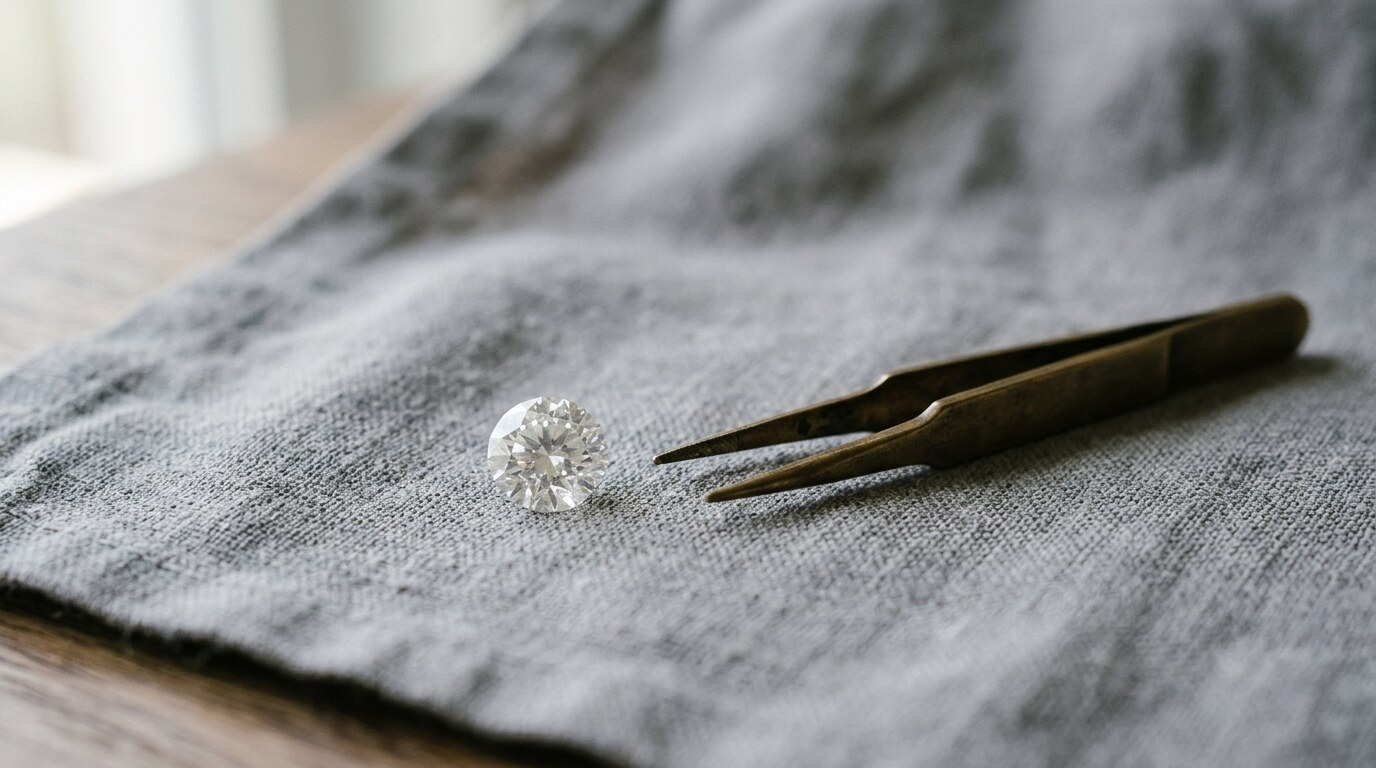
The diamond trade enters JCK Las Vegas weekend with a clear set of numbers and a less clear set of conclusions. The Rapaport Diamond Index for one-carat polished has declined roughly 30 percent from early 2024 levels through the start of 2026, according to RapNet data circulated this spring. December 2025 alone delivered a 2.3 percent month-over-month drop, contributing to a full-year 2025 decline of 11.3 percent for the one-carat segment. The small-goods bracket, defined as 0.30 to 0.50 carat stones, has carried the worst of the pressure because that is where commercial engagement-ring buyers shop and where lab-grown product has applied the most direct substitution pressure.
Rapaport's wholesale benchmark for one-carat round brilliant D-color VVS2-grade natural diamonds sits at approximately 4,200 dollars per carat in current trade. Comparable lab-grown stones average 725 dollars per carat at wholesale, with retail prices on a one-carat D VVS2 lab-grown ranging between 280 and 320 dollars at Asian e-commerce channels and slightly higher in US specialty retail. The wholesale spread between natural and lab-grown at the one-carat D VVS2 level is now roughly six to one and continues to widen. JBT, NRF, and IDEX data all point to the same dynamic: natural prices continue to soften, lab-grown prices continue to compress, and the spread between them is now the most-watched indicator on the trade desk.
De Beers Q1 2026: supply discipline, not demand recovery
De Beers consolidated rough diamond sales for Q1 2026 totaled 648 million dollars on 7.7 million carats of rough volume from two sights. Sight 3 began in March 2026 but did not close before quarter end, with the cycle extending into Q2. The reduction in sight throughput is supply discipline, not a reflection of recovering demand. De Beers has been actively managing the volume it puts into the market through 2025 and into 2026 to support price stability at the wholesale level, particularly in the smaller stone bands.
Anglo American has reaffirmed its commitment to divesting De Beers and continues to progress a formal sale process, with an expected update during the course of 2026. The bidder field reportedly includes a Gareth Penny-led consortium, Diacore, and the O'Keeffe interests, among others. Anglo American posted a 3.7 billion dollar loss in its most recent reporting period, with De Beers contributing a third consecutive writedown to that result. The divestiture timeline is the single most-watched item on the institutional side of the diamond trade.
FTC sharpens lab-grown disclosure language ahead of JCK
The Federal Trade Commission has issued refined guidance on lab-grown diamond marketing terminology that takes effect across enforcement priorities through 2026. The agency has been explicit that terms such as 'real', 'genuine', 'natural', 'precious', and 'semi-precious' cannot be used in connection with laboratory-grown product. The terms 'lab-grown', 'laboratory-created', or '[manufacturer-name]-created' must appear in conjunction with the word 'diamond' in all advertising and marketing materials, and the disclosure must be prominent and easily understandable.
The Commission has also signaled increased scrutiny of environmental sustainability claims attached to lab-grown product. Marketers asserting that lab-grown diamonds are more sustainable than mined product must have a reasonable basis for that claim, supported by documented evidence rather than industry generalizations. The guidance applies equally to online and brick-and-mortar advertising, and the trade has been instructed to review existing website content, in-store displays, and campaign creative for compliance. JCK Las Vegas, which opened today and runs through Monday, will see disclosure language under live observation across the show floor. The macro and bullion context for the week is in the gold market read.
Christie's Geneva Magnificent Jewels delivers Ocean Dream record
Christie's Geneva Magnificent Jewels on May 13 and 14 took 66.5 million dollars by one house count or 72.3 million by another, with 99 to 100 percent of lots finding buyers. The Ocean Dream, a 5.5-carat fancy vivid blue-green diamond, hammered at CHF 13.57 million (17.37 million dollars) after a twenty-minute bidding contest among three international collectors. The Ocean Dream becomes the most expensive fancy vivid blue-green diamond ever sold at auction. A 22-carat Kashmir sapphire ring by Chaumet sold for 3.51 million dollars. A 1930s Cartier Tutti Frutti clip-brooch took 1.35 million. A Boucheron necklace originally exhibited at the 1925 Paris Exposition cleared 1.54 million. Sotheby's High Jewelry on May 12 added 35 million dollars to the Geneva tally.
The auction segment continues to provide a clean read on the high end of the market while the wholesale picture remains pressured at the commercial bracket. Branded jewelry continues to outperform unbranded inventory, a dynamic confirmed by Richemont's fiscal 2026 jewelry growth of 11 percent at constant currency, led by Cartier and Van Cleef and Arpels. LVMH's Watches and Jewelry division grew 7 percent organically in Q1 2026 on 2.4 billion euros of revenue, with Tiffany cited as the primary growth driver. The full retail-and-industry picture is in the industry brief.
The combination of disciplined De Beers supply, sharpening FTC enforcement on lab-grown marketing, and record auction results for top-tier branded and provenanced pieces leaves the diamond trade with a clear bifurcation entering the back half of 2026. The high end has buyers. The mid-market remains pressured. The commercial bracket faces direct competitive pressure from lab-grown substitution that no amount of supply discipline at the rough level appears likely to reverse before year-end. JCK will provide the next concrete read by Tuesday.





Comments 0
No comments yet. Be the first to share your thoughts.