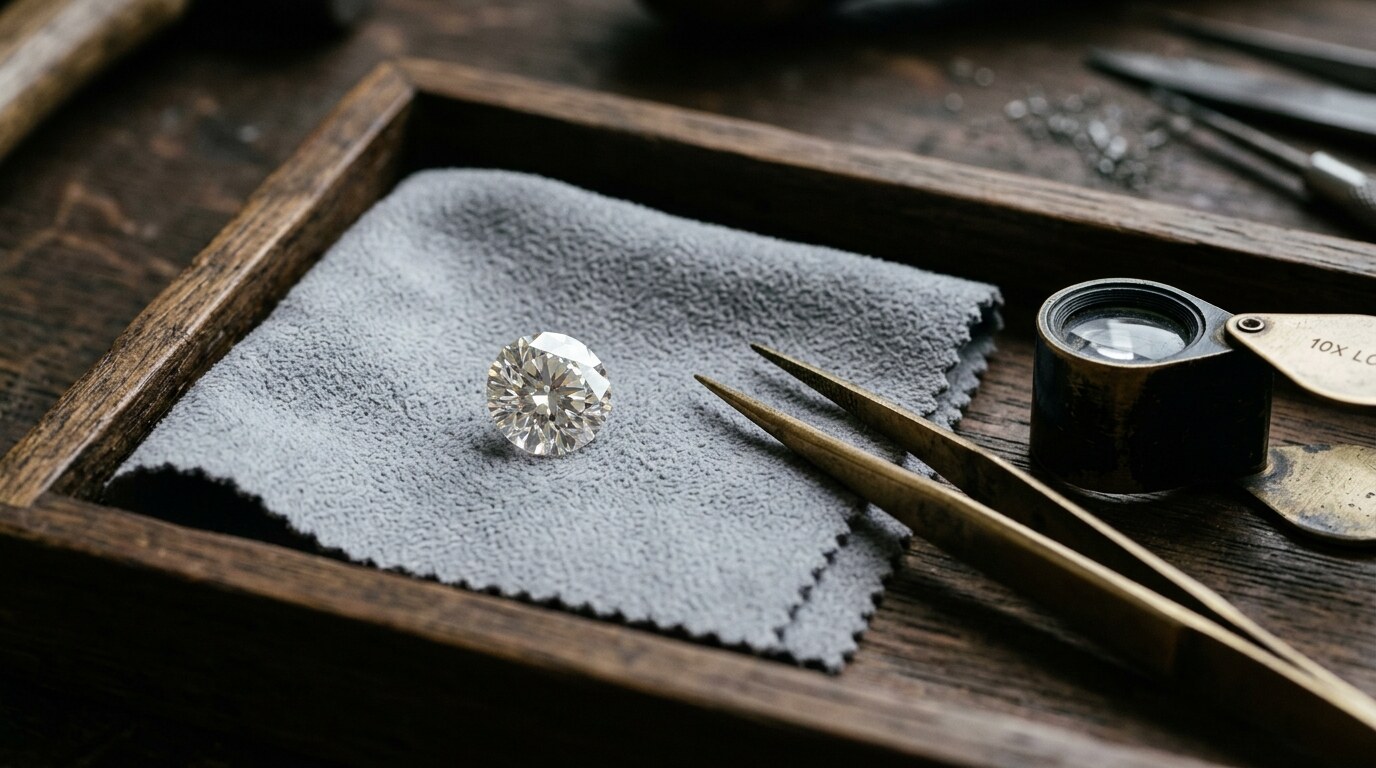
De Beers spent the first half of July doing what the market had been pressing it to do since spring: bringing its rough book closer to where stones actually trade. The producer signaled ahead of the July sight that it intended to reduce official rough prices or widen discounts, and the follow-through was sharper than the guidance suggested. For a company that has leaned on supply discipline rather than price cuts for the better part of a year, the July sight marks a genuine shift in posture. The move also sits inside a broader luxury tape covered in this week's trade week wrap.
Closing a gap the market had already priced
According to Rapaport, De Beers book prices had been running 20 to 30 percent above the market for smaller stones and 5 to 15 percent higher for larger sizes. That kind of premium is unsustainable when sightholders can buy comparable goods more cheaply on the secondary rough market, and it had been suppressing offtake for months. Sightholders do not keep taking boxes at a loss, and the growing gap between the book and the street had turned into a standoff.
The correction, when it came, was steep at the bottom of the size range. JCK reported that De Beers dramatically cut prices on certain smaller goods at its sight during the week of July 8, with decreases reaching 50 percent in some cases. A cut of that magnitude on select categories is not a routine adjustment. It is an acknowledgment that the book had drifted well past what buyers would pay, and that supply discipline alone was no longer holding the price. Cutting hardest on smaller goods also targets exactly the size range where the market premium was widest, which is a rational place to start.
There is also a volume dimension the headline cut misses. Smaller goods are where the largest share of carats moves through the trade, so a 50 percent reduction on select smaller categories touches a wide swath of the pipeline even if the marquee larger stones saw only single-digit adjustments. That is why the 5 to 15 percent premium De Beers carried on larger sizes matters less to the average retailer than the double-digit-to-fifty-percent moves at the bottom. Most counters sell far more melee and small certified goods than they do statement stones.
For the retail side, the near-term read is that polished costs on smaller natural goods should ease as cheaper rough works through the pipeline, though the timing depends on how quickly sightholders pass the relief downstream. The broader producer picture ties into the industry moves covered in this week's industry column.
The lab-grown spread is the backdrop
None of this happens in isolation from the lab-grown market, which continues to set the reference point consumers see first. A one-carat lab-grown diamond now costs around $1,000, per Liori Diamonds, while a one-carat natural of comparable quality runs about $4,200. That is roughly a four-to-one ratio at the one-carat mark, and it is the number retailers have to explain across the counter every day. That spread is the single most important fact shaping how the natural side has to price itself.
The lab-grown side is not static either. TheDiamondPrice.com pegged the fair market price of a one-carat lab-grown stone at $770 as of July 18, with most comparable stones listed between $660 and $810. The gap between that $770 fair-value estimate and the roughly $1,000 retail figure shows how much margin still sits in the lab-grown chain even as wholesale values grind lower. A retailer buying near fair value and selling near $1,000 has room the natural chain simply does not have at these price points.
Why the two stories connect
The De Beers cut and the lab-grown spread are the same story viewed from two ends of the counter. When a comparable lab-grown stone sells for a quarter of the natural price, the natural side cannot afford a rough book priced 20 to 30 percent over the market on top of that. The July cut is De Beers conceding that its pricing has to reflect a world where the lab-grown reference is permanent and visible, not a passing threat that supply discipline can outlast.
The open question for the fall buying season is whether a lower book actually lifts natural offtake or simply resets the baseline at a weaker level. A 50 percent cut on smaller goods restores competitiveness against secondary rough, but it does nothing about the $1,000 lab-grown one-carat that anchors the consumer's sense of value. The next sight, and how much of the smaller-goods relief reaches polished, will show which problem De Beers actually solved.





Comments 0
No comments yet. Be the first to share your thoughts.