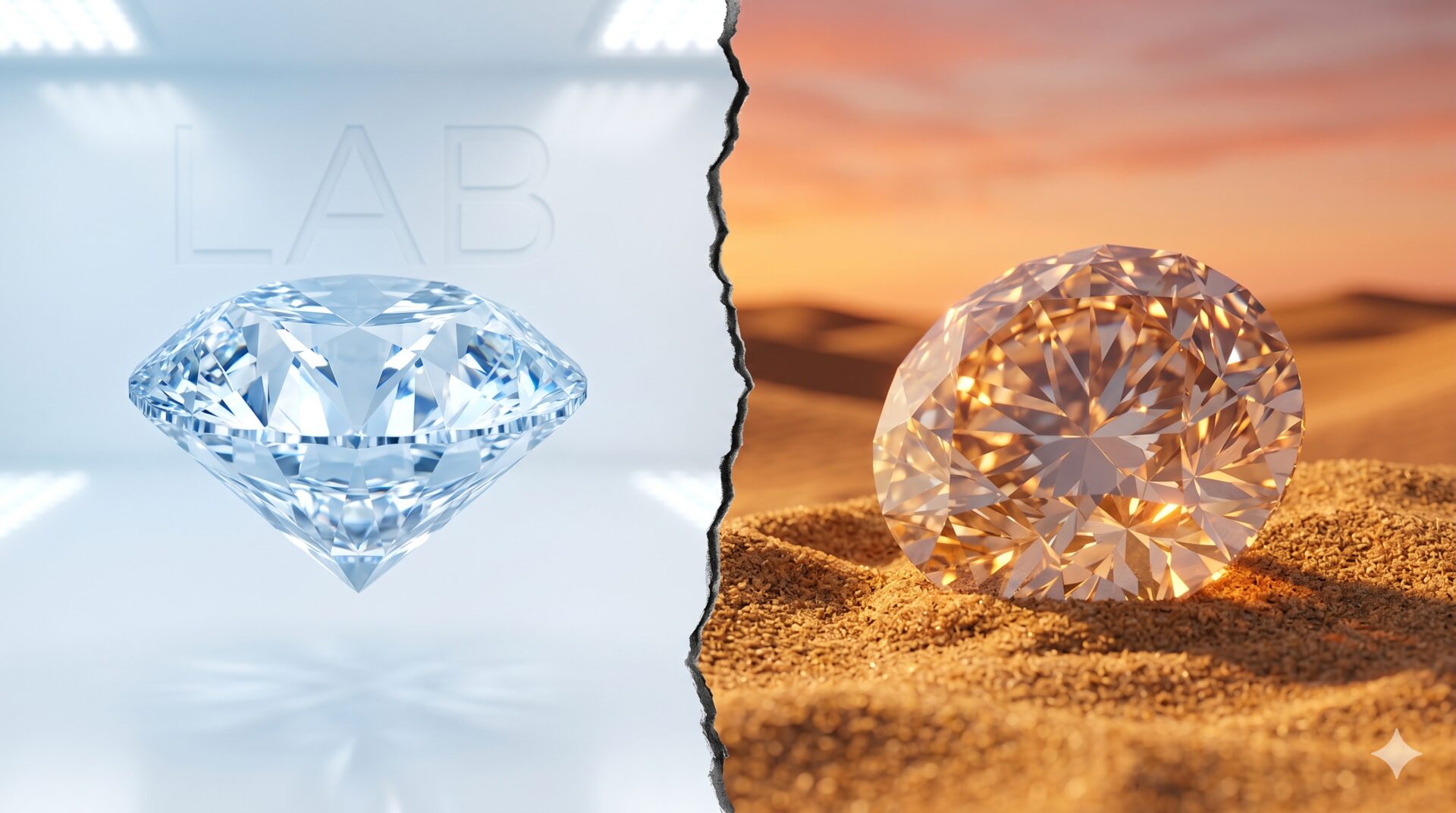
A lot of people say the diamond market is weak. That's true, but it's incomplete. The better read: the diamond market is splitting. Rapaport's April updates described March as cautious, with the market divided between small and large goods. One-carat RAPI fell 1.7 percent in March. Trading in key centers including Israel and Dubai briefly froze during the recent conflict shock, adding hesitation to an already selective environment. That is not what a dead market looks like. That is what a fragmented market looks like.
And on April 13, De Beers made the clearest strategic move of the year so far — one that formally acknowledges the split and picks a lane.
The Desert Diamond Campaign
De Beers launched its "Desert Diamond" bridal marketing campaign on April 13, 2026. The positioning is the story: warm-toned natural diamonds — warm white, champagne, soft sand, sunset glow — instead of colorless D-flawless territory where lab-grown has been eating share for three years running. It is the clearest repositioning De Beers has made since it shuttered Lightbox in 2024, and it answers the question the natural diamond industry has been dancing around since 2022: if lab-grown will always win on colorless, where does natural actually have a defensible advantage?
The technical logic is the part most outlets are underplaying. Producing consistent, gem-quality warm-tone fancy-color lab-grown at scale is still challenging and economically unappealing for lab-grown producers. The lab-grown industry has optimized for colorless, D-to-H stones because that is where consumer demand and manufacturing efficiency overlap. Fancy yellows, champagnes, and sunset tones exist in lab-grown but do not benefit from the same economies of scale. By anchoring a new bridal category around warm-tone natural diamonds, De Beers is staking out a product wedge where it has real supply-side advantages.
The Numbers Behind the Pivot
The context is a set of statistics that have gotten uglier every quarter. Lab-grown diamonds hit roughly 50 percent of US engagement ring center stones in 2024, up from 12 percent in 2019. One-carat lab-grown diamonds now run $750 to $1,000 at retail, down 74 percent from 2020 pricing. A one-carat natural diamond averages around $4,200, down from about $6,000 in 2021.
De Beers cut rough diamond prices at its first 2026 sale. The company had been selling discounted stones quietly while keeping official prices roughly 25 percent above market — a strategy that became unworkable. Adjusted for those rebalancing transactions, the effective price index fell 25 percent year over year. Production guidance for 2026 is 21 to 26 million carats, down significantly from earlier cycles. Anglo American, which owns 85 percent of De Beers, has written the business down by $4.5 billion over two years. De Beers is now valued at roughly $4.1 billion — less than half its 2022 valuation. Over 1,000 jobs have been cut, and the company has accumulated around $2 billion in unsold natural stones.
At the same time, Allied Market Research released a report on April 13 projecting the lab-grown market will hit $59.2 billion by 2032, growing at 9.6 percent annually. The two storylines — De Beers trying to reposition natural, and lab-grown scaling into mainstream luxury — are the same story told from opposite ends.
The Signet Angle
Signet Jewelers said on its fiscal 2026 call that it plans to increase lab-grown diamond mix across its fleet. That is a direct competitive signal — the largest US jewelry retailer is leaning harder into lab-grown, not less. Signet also said both natural and lab-grown have room to grow, with natural stronger at the higher end and lab-grown stabilizing on cost.
That's the rational read of the current market, and it is also exactly what makes De Beers' bifurcation strategy necessary. If natural diamonds are going to command the high end, they need a product identity that lab-grown cannot commoditize. Desert Diamond is the first serious attempt at building that identity post-Lightbox.
What Dealers and Retailers Should Do
The natural-versus-lab debate misses the real point most of the time. The issue is not category identity. It is pricing credibility, resale confidence, and inventory discipline. In this kind of market, the dealers who win will not be the ones shouting the loudest about what should sell. They will be the ones carrying the goods that still deserve to sell.
For retail jewelers. Desert Diamond as a category needs a cohesive presentation — warm-tone natural solitaires, champagne diamond halos, sunset-color three-stone settings. Position it physically and digitally apart from traditional colorless bridal inventory. Jewelers who build out the category now get an early position in a product line De Beers will be pushing hard through the rest of 2026.
For wholesale dealers. Warm-tone natural diamonds in the 0.50 to 2.00 carat bridal range have historically priced at a discount to strictly colorless stones of the same weight and clarity. If Desert Diamond gets real marketing traction, that discount compresses. Review positioning now, not after the campaign picks up steam.
For everyone. Natural and lab-grown are no longer the same business, and strategies that try to treat them as one category keep failing. De Beers has now publicly committed to that split. The jewelers who build their own businesses around the division earliest will be the ones best positioned when the dust settles.





Comments 0
No comments yet. Be the first to share your thoughts.