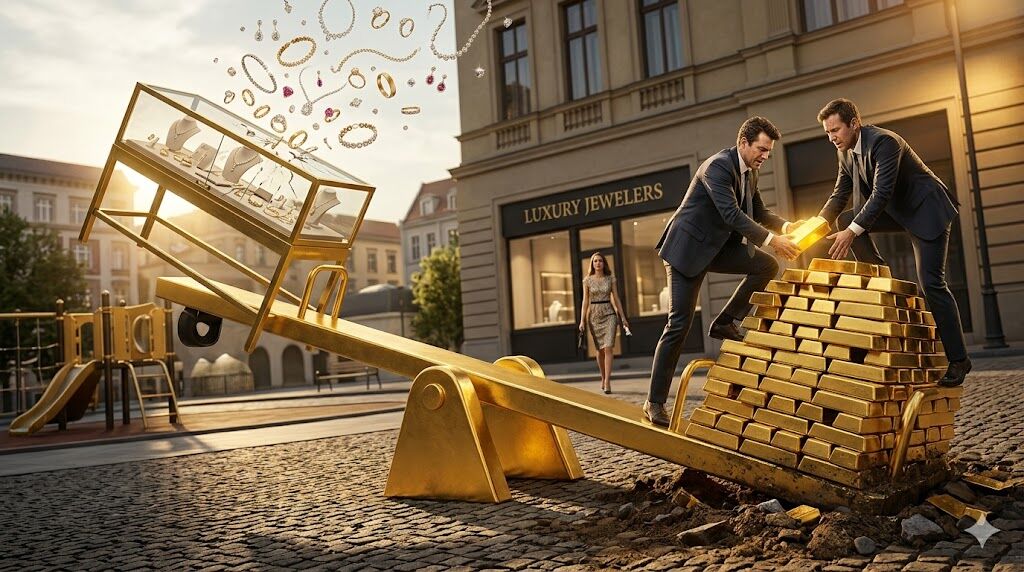
Gold is trading above $4,675 per ounce. A year ago it was around $3,100. The impact on 14K and 18K gold jewelry fabrication costs has been severe — and predictable. What is less predictable is how the trade is responding: not by abandoning gold, but by strategically shifting karat weight.
JCK reported this week that multiple jewelry designers are now building collections around 10K gold, and they are not treating it as a downgrade. The framing has shifted from "we had to use 10K because gold is expensive" to "10K gives us design advantages that higher karats do not."
The Economic Math
At $4,675 per ounce for pure gold, the raw metal cost per gram breaks down roughly as follows: 24K runs about $150 per gram, 18K about $113, 14K about $87, and 10K about $63. The difference between 14K and 10K on a 10-gram ring is approximately $240 in metal cost alone. At scale — across a collection of 50 or 100 pieces — that delta is the difference between a viable price point and one that pushes consumers out of the category entirely.
This is not just a retail problem. For wholesalers, the same pressure applies. Memo cost rises with metal content. And in a market where tariffs on Indian-made jewelry are effectively running at 15.5% and India's gem and jewelry exports to the U.S. have dropped 45.49% year over year, every cost lever matters.
The Design Argument
10K gold is 41.7% pure gold, with the balance in alloy metals that give it greater hardness and scratch resistance than 14K. For everyday wear pieces — stackable rings, bracelets, chain necklaces — the durability advantage is real. Designers are making this case to consumers directly: the piece you wear every day should not dent or scratch easily, and 10K delivers that better than 14K.
The color difference between 10K and 14K is subtle enough that most consumers cannot distinguish them, especially with modern alloy formulations. Rose gold in 10K, in particular, often reads as richer and warmer because of the higher copper content.
The Retail Opportunity
For jewelers, 10K opens a price tier that keeps customers buying gold instead of switching to silver, stainless, or vermeil. The customer who walks in wanting gold but balks at a $1,200 14K bracelet might buy a $750 10K version of the same design without feeling like they compromised. That is a saved sale, not a traded-down sale.
The margins can actually improve because the fabrication cost drops faster than the retail price — consumers do not apply the same proportional discount to 10K that the metal content would suggest.
What This Does Not Mean
10K is not replacing 14K or 18K for engagement rings, luxury pieces, or high-ticket items. It carries a perception challenge in some demographics — particularly among consumers who associate karat weight with quality rather than utility.
But at $4,675 gold, the trade needs every tool available to keep consumers in the gold category. Lab-grown took 42% of diamond jewelry sales and 48% of engagement rings in 2025 partly because the natural side did not adjust fast enough. The gold trade has the opportunity to get ahead of the same dynamic by repositioning 10K as a smart choice, not a cheap one.





Comments 0
No comments yet. Be the first to share your thoughts.