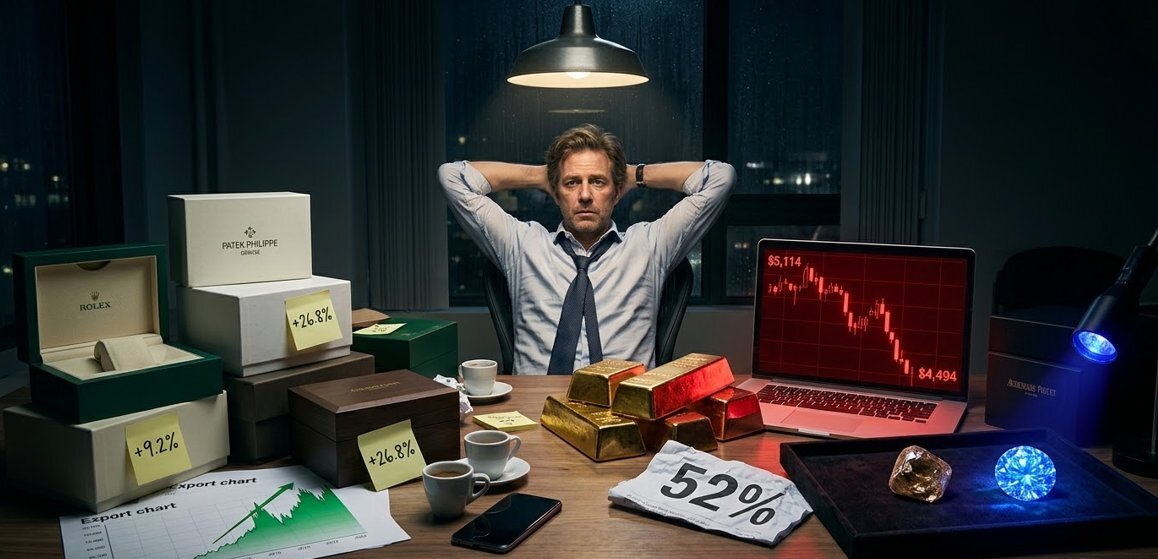
This week gave the trade three clear signals. First, Swiss watch exports bounced back in February 2026, rising 9.2% year over year to CHF 2.2 billion, with the U.S. up 26.8%. Second, gold stayed historically strong but volatile: the World Gold Council said 2025 global gold demand hit a record 5,002 tonnes, while spot gold fell to about $4,564 per ounce on March 20 after a huge run-up earlier this year. Third, the diamond pipeline is still under pressure: Anglo American took another $2.3 billion writedown on De Beers, while Signet's latest update showed consumer demand holding up better at retail than conditions suggest upstream.
Luxury Watches
Swiss watch exports bounced back in February 2026, rising 9.2% year over year to CHF 2.2 billion, with the U.S. surging 26.8% — the strongest single-market recovery in the data. Japan and France also contributed gains. That rebound matters: the FH reported that full-year 2025 Swiss watch exports fell 1.7%, with China down by more than a third over two years, so February's number is the first real signal that the primary market is stabilizing.
On the secondary side, momentum has been building for months. The WatchCharts Overall Market Index is up 8.2% year over year, with Patek Philippe leading at +16.2%, Rolex at +7.9%, and Audemars Piguet at +3.4%. Notably, 21 out of 27 tracked brands with average prices above $3,000 are now in positive territory over the past six months. Supply levels for key references — Patek's Aquanaut and Nautilus collections, Rolex's four generations of stainless steel Daytona — have declined, supporting the price recovery.
The tariff situation has stabilized at 15%, retroactive to November 14, 2025, but the underlying trade agreement must be finalized into a binding treaty by March 31. Rolex responded with an average 7% price increase for 2026, with gold models up roughly 9% and steel closer to 5%. Compared to end-of-2024 pricing, U.S. retail customers are now paying 20% more for Rolex in gold and 10% more in steel.
The next major catalyst is Watches and Wonders Geneva, running April 14–20, with 66 brands participating and Audemars Piguet joining the lineup. Over 6,000 retailers, 1,600 international journalists, and 15,000 guests are expected.
One more data point worth tracking: Gen Z is reshaping secondary market demand. Cartier's share of Gen Z watch purchases has grown more than fourfold over seven years — from 1.7% to 6.8% — driven by dress watches, shaped cases, and vintage. The steel-sport-on-integrated-bracelet era is giving way to something more varied.
Dealer takeaway: The February U.S. export rebound and secondary market strength are converging. This week's IWJG Miami show (March 23-24, Hilton Miami Airport Blue Lagoon) sits at the intersection of both trends. With tariff-driven retail increases pushing more buyers pre-owned, dealers in the secondary space are in a strong spot heading into Q2.
Jewelry & Diamonds
Retail is holding up better than upstream. Signet's preliminary fiscal 2026 update pointed to roughly $6.8 billion in full-year sales, same-store sales up 1.2% to 1.3%, and higher average unit retail. Management said both natural and lab-grown diamonds have room to grow — describing natural as stronger at the higher end while lab-grown is stabilizing on cost and pricing.
But the rough pipeline tells a different story. Anglo American took another $2.3 billion writedown on De Beers, adding to a year in which De Beers posted dramatic revenue declines, accumulated approximately $2 billion in unsold natural stones, and announced over 1,000 job cuts. Global diamond production fell to multi-decade lows of roughly 100 million carats in 2025 and is expected to stay near those levels through 2026.
Lab-grown diamonds now account for more than half of center stones sold — up from 12% in 2019 to 52% in 2024. A one-carat lab-grown stone averages around $1,000 versus $4,200 for an equivalent natural diamond. However, lab-grown prices recently ticked up 3.32%, suggesting they may be approaching the production cost floor. If that floor holds, the competitive dynamic shifts from pure price pressure to a positioning conversation.
The industry is investing in narrative. The Luanda Accord committed producing nations to global marketing for natural stones. CIBJO is moving to formally reintroduce the term "synthetics." And Lucara recovered a nearly 37-carat Type IIb blue diamond at its Karowe mine in Botswana this week.
Dealer takeaway: Merchandising at the counter is stabilizing faster than the mining and rough pipeline. The smart jewelry counter in 2026 is becoming a two-lane business — separate storytelling, pricing, and positioning for natural and lab-grown. Natural holds at higher tickets (3ct+); lab-grown wins on size and accessibility.
Gold & Bullion
Gold's long-term story remains powerful: the World Gold Council reported 2025 total gold demand hit a record 5,002 tonnes, with investment demand at 2,175 tonnes and central bank purchases at 863 tonnes. J.P. Morgan forecasts gold pushing toward $5,000 per ounce by Q4 2026, with $6,000 a possibility longer term.
But the short-term picture is volatile. Spot gold hit $5,114 per ounce on March 13, fell to roughly $4,564 by March 20, and sat around $4,494 as of Sunday morning — a swing of over $600 in nine days. For dealers who price in gold, that kind of movement changes the math on every piece of inventory.
The real tension for the trade is in the demand split. While investment demand surged, jewelry demand fell 18% globally in 2025 — including a 24% drop in China. Bullion buyers still want exposure, but jewelry consumers are increasingly price sensitive, forcing more attention to weight, karat, design efficiency, and alternative materials.
For watch dealers, gold volatility directly impacts precious metal inventory. A Rolex Day-Date or Patek Nautilus in gold isn't just a watch — it's a commodity play. With Rolex gold models already up 20% from end-of-2024 pricing, the cost basis on a single gold piece can swing thousands in days at current spot levels.
Dealer takeaway: Price your inventory daily, not weekly. Lock scrap margins quickly — elevated scrap flow is an opportunity, but holding accumulations is risky when gold can drop $600 in a week. Factor gold volatility into your show pricing at IWJG and Miami Antique this week.
Industry News
Three major trade events converge in Miami this week: the IWJG show runs March 23-24 at the Hilton Miami Airport Blue Lagoon, followed by the Miami Antique Show (March 26-30). With over 8,900 IWJG members across 77 countries, this is one of the highest-concentration weeks for dealer-to-dealer activity on the calendar.
The big upcoming date is Watches and Wonders Geneva (April 14-20), with 66 brands and public days from April 18-20. Last year's edition drew nearly 55,000 visitors from 125 nationalities. For wholesale dealers, that means fresh launches, renewed consumer attention, and a key test of whether U.S. demand can keep carrying the high end.
Corporate moves: Kering created Kering Jewelry, with Jean-Marc Duplaix as CEO. TAG Heuer appointed Béatrice Goasglas. Natalie Portman is Tiffany & Co.'s newest brand ambassador. And Rolex's Certified Pre-Owned (RCPO) program now controls an estimated 10% of the global secondhand market, with Cartier and AP developing their own CPO initiatives.
Dealer takeaway: The Miami show density this week makes it a critical buying and selling window. Start preparing your Watches and Wonders watchlist now — April 14 is three weeks out, and the releases will drive conversation through Q2.





Comments 0
No comments yet. Be the first to share your thoughts.