
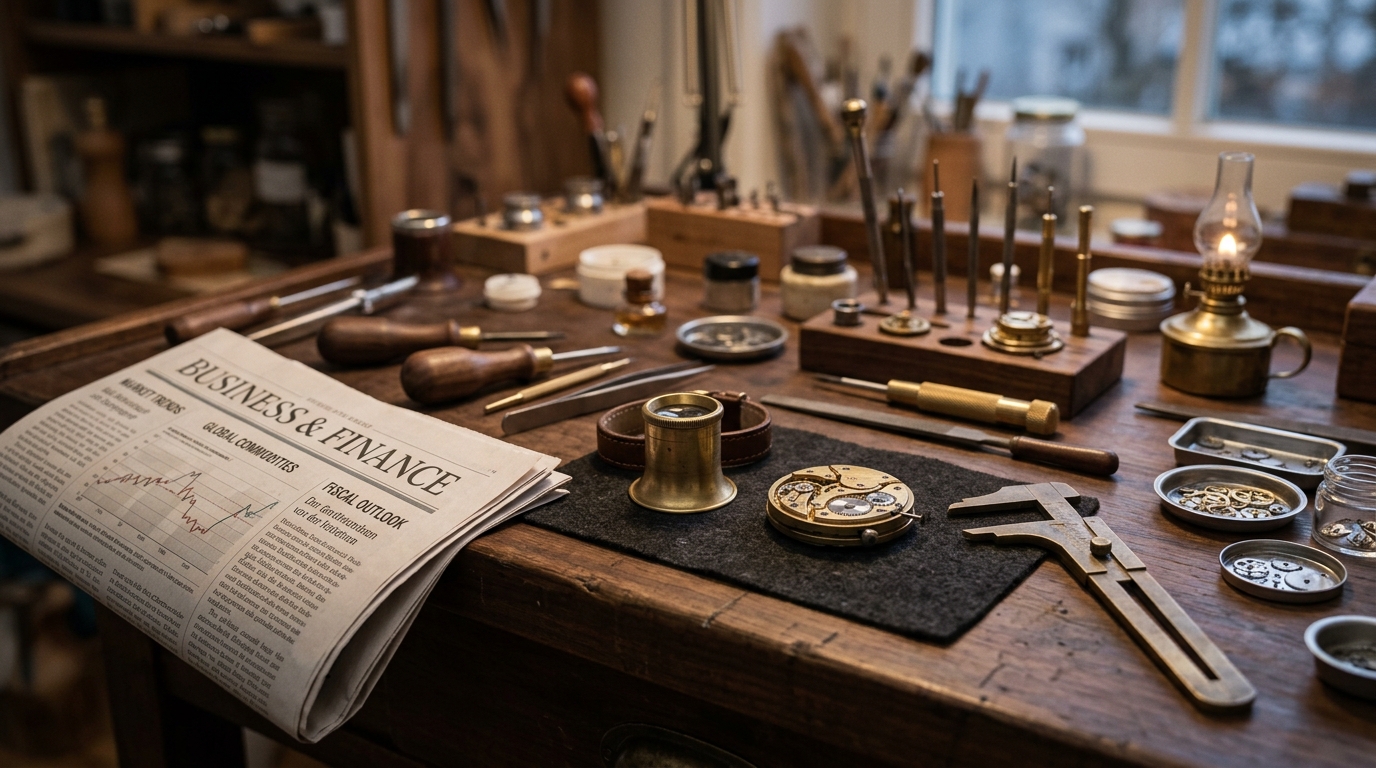
Swiss Watch Exports Show Regional Divergence in Q1 2026
The Federation of the Swiss Watch Industry reported Q1 2026 exports totaling CHF 6.2 billion, up 1.4 percent against the same quarter last year. February delivered the strongest single month with a 9.2 percent year-over-year increase to CHF 2.2 billion, but March slipped 1.0 percent, dragging the quarterly figure back toward flat. The United States drove February gains with a 26.8 percent rise in import value, marking the third consecutive monthly surge. Japan added 23.7 percent and France jumped 57.1 percent in the same period.
China remained a persistent headwind, contracting 11.0 percent in February, while Hong Kong fell 5.2 percent. The divergence underscores the ongoing bifurcation between Western markets absorbing higher-priced inventory and Greater China grappling with economic uncertainty. Full-year 2025 exports closed at CHF 25.6 billion, down 1.7 percent, with employment in the Swiss watch sector declining 1.3 percent according to the FH survey conducted in September 2025. Retail price inflation has compounded the picture: Rolex list prices rose an average 15 percent between December 31, 2024, and January 1, 2026, with gold-case models up 20 percent as bullion climbed from approximately $2,650 per ounce in Q4 2024 to above $4,500 by January 2026.
Dealers should monitor monthly FH releases closely; quarterly averages mask volatility in key markets like the US and China.
Secondary Market Platinum Watches Trade Below Material Value
Phillips New York Sessions Spring 2026, which closed April 8, saw an F.P. Journe Centigraphe realize $355,600 against an $80,000 to $160,000 estimate, while an Automatique Lune Havana brought $190,500 on a $70,000 to $140,000 pre-sale range. Phillips global watch auction sales totaled $370 million in 2025, the highest in house history. Yet the secondary market for contemporary references reveals pockets of inefficiency. SwissWatchExpo's chief executive noted in April that platinum models such as the Rolex Day-Date 40 in platinum and the Patek Philippe 5960P trade below the sum of material cost and collectability premiums, even as platinum prices rose 170 percent year-over-year. Rolex market share on platforms like Chrono24 has declined from COVID-era peaks back toward pre-pandemic levels, though multi-year growth remains positive.
Haute horlogerie has cooled from speculative highs: Patek Philippe and Audemars Piguet buyers display greater discernment now that easy arbitrage plays have evaporated. Mid-luxury brands gained ground in H1 2025, with IWC up 4.9 percent versus H2 2024 on Ingenieur relaunch momentum, and Omega and Cartier steadily claiming share. Watches and Wonders 2026, held in Geneva from April 14 to 20, featured Patek celebrating the Nautilus 50th anniversary and Audemars Piguet returning to the circuit after a hiatus. Dealer takeaways from the fair centered on moderate case-size adjustments and longer product cycles rather than headline complications.
Platinum-case inventory offers arbitrage potential if bullion holds above recent lows and retail repricing lags material cost.
De Beers Q1 Rough Sales Hit $648 Million on Volume Surge and Price Decline
De Beers sold 7.7 million carats of rough in Q1 2026 across two Sights, generating $648 million in revenue compared with 4.7 million carats and $520 million in Q1 2025. Volume surged 64 percent while revenue grew only 25 percent, pushing the average realized price down 19 percent to $101 per carat. The rough price index for the quarter declined 17 percent year-over-year. De Beers own production rose 17 percent to 7.1 million carats, driven by ore release at Gahcho Kué and a 53 percent increase at the Venetia underground operation.
The company cut its sightholder roster from approximately 69 to around 45 for the contract period starting July 1, 2026, imposing a $15 million minimum annual rough purchase requirement. Parent Anglo American committed to a formal divestiture of De Beers, with updates expected throughout 2026; the carrying value has been written down to $2.3 billion after three impairments in two years. Sight 1 in January alone accounted for $450 million in sales, according to the AIDI report published March 2. The volume-versus-price dynamic reflects midstream inventory overhang and ongoing competition from lab-grown production, which now accounts for 20 percent of total diamond sales and 52 percent of US engagement-ring center stones, up from 12 percent in 2019.
Sightholder consolidation and elevated minimum commitments signal De Beers intent to shift margin pressure downstream amid persistent rough-market weakness.
Lab-Grown Diamonds Trade 70 to 90 Percent Below Mined Equivalents
Lab-grown diamond pricing in 2026 shows one-carat stones at $800 to $1,500 retail versus $3,840 to $6,800 for mined counterparts, a discount of 70 to 90 percent. Two-carat lab pieces range from $1,650 to $2,800 against $15,000 to $25,000 for natural. Quality has improved dramatically: 85.9 percent of lab production in 2025 graded colorless compared with 37.7 percent in 2020, and VVS1 or VVS2 clarity represented 35.3 percent of output versus 6.6 percent five years earlier. The average US engagement-ring price dropped from $6,000 in 2021 to $5,200 in 2024, according to BriteCo data, directly attributable to lab-grown market penetration.
Natural diamond advocates have responded with campaigns emphasizing rarity and provenance. De Beers launched beacon branding, and the AWDC and WFDB coordinated pro-natural initiatives in key markets. Meanwhile, trophy jewelry auctions continue to perform: Sotheby's Hong Kong High Jewellery sale in April recorded HKD 257 million with an 89 percent sell-through rate, demonstrating bifurcation between commodity bridal demand and collector-grade lots. The Rapaport 2025 Annual Report, published March 11, remains the pricing benchmark for natural stones, while lab-grown lacks a uniform index, complicating wholesale trade.
Jewelers carrying both categories must segregate inventory messaging and train sales staff on clarity premiums versus blanket discount positioning.
Gold Spot Closes Week Near $4,629 After Intraweek Volatility
Gold traded between $4,577 and $4,700 per ounce this week, settling at approximately $4,629 on May 2 at 10:26 AM Eastern, according to JM Bullion. The metal dipped to $4,577 on April 28 at 9:15 AM, down $125 from the prior session, then rebounded to $4,653.69 by April 30, gaining 2.24 percent intraday. The all-time record of $5,602.22 per ounce, set January 28, 2026, remains 17 percent above current levels. Year-over-year, spot is up $1,260 from April 28, 2025.
Market technicals show support at $4,300, the bull-bear demarcation line, with the 200-day exponential moving average near $4,200. Resistance sits at $5,400, the next psychological threshold. The Federal Reserve held rates at 3.50 to 3.75 percent with 99.5 percent probability priced in by futures markets. Ten-year Treasury yields hovered between 4.3 and 4.4 percent, and the dollar index traded above 98.5. Iran tensions around the Strait of Hormuz and continued central bank accumulation in Q1 2026, per World Gold Council data, underpinned bullion above $4,600. Institutional year-end targets vary widely: JPMorgan projects $6,300, Goldman Sachs $5,400, Deutsche Bank $6,000, Wells Fargo $6,100 to $6,300, and the Reuters poll median $4,746.
Jewelers pricing 18-karat and 22-karat inventory should update cost structures weekly; $100 per ounce swings translate to meaningful margin shifts on high-gram-weight pieces.
Silver Mirrors Gold Volatility With Amplified Range
Silver spot ranged from $73.86 to $75.46 per ounce during the week, closing April 30 at $74.41, up 3.72 percent on the day. May futures opened at $75.46 on Tuesday morning April 28 before falling to $73.86 by 6:30 AM Eastern. The white metal continues to amplify gold's percentage moves, a pattern consistent with historical correlation during periods of geopolitical uncertainty and elevated real rates. Platinum's 170 percent year-over-year price surge has not yet filtered through to secondary-market watch valuations, creating a temporary dislocation that sophisticated dealers are beginning to exploit on references like the Rolex Day-Date 40 platinum and Patek 5960P.
Track weekly London Fix averages for silver and platinum; lag time between bullion moves and retail repricing offers short-term inventory arbitrage for alert wholesalers.
Conglomerate Earnings and Sightholder Consolidation Signal Industry Restructuring
LVMH Watches and Jewelry delivered 3 percent organic growth in Q4 2025, while Richemont's nine-month sales through December 2025 rose 5 percent group-wide but only 1 percent for Specialist Watchmakers at actual exchange rates. Signet Jewelers posted full-year sales of $6.81 billion for the fiscal year ended January 31, 2026, up 1.6 percent. The modest gains across major players contrast sharply with the 64 percent volume increase De Beers pushed through its sightholder network in Q1, underscoring pressure on midstream cutters and polishers to absorb inventory at compressed margins.
De Beers reduction of sightholders to approximately 45, coupled with the $15 million minimum purchase threshold, accelerates consolidation in rough distribution. Anglo American's formal divestiture process, expected to conclude or provide material updates through 2026, adds strategic uncertainty. Swiss watchmakers face headwinds from a strong franc, persistent inflation, and US tariff volatility, according to the FH outlook published in February. Retail bifurcation remains pronounced: Watches of Switzerland reported 20 percent US sales growth while UK results remained flat, and branded-boutique expansion has slowed relative to 2023 and 2024 rollout schedules.
Wholesalers should prepare for further midstream diamond consolidation as De Beers tightens distribution and Anglo completes divestiture; watch inventory cycles may lengthen if Q2 exports fail to rebound from March's 1.0 percent decline.





Comments 0
No comments yet. Be the first to share your thoughts.