
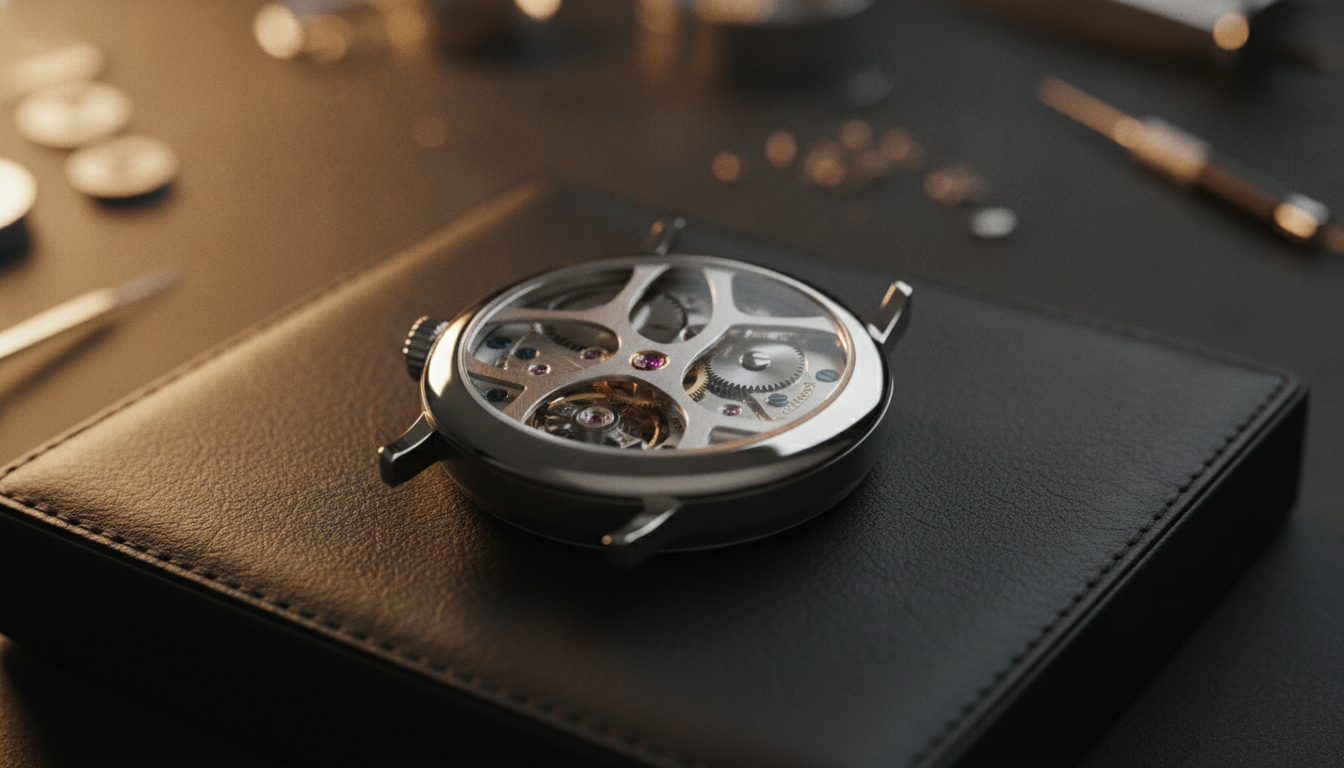
The top end of the watch market did something this season that the rest of the tape has not: it kept printing records. On the dealer floors and at IWJG the conversation has moved past whether the blue-chip references hold and onto how far above estimate the best examples are clearing.
Phillips owns the record book
Phillips' Geneva Watch Auction XXIII realized $96.3 million, the highest-grossing single watch auction in history, producing 43 new world records. The New York Watch Auction XIV followed at $75.8 million, more than doubling the sale's high estimate and shattering the record total for a watch auction in the US. Two sales, back to back, both rewriting the numbers.
The individual hammers tell the same story. An F.P.Journe Chronometre a Resonance Souscription No. 007 in pink gold and platinum reached $13.9 million, a record for any independent watchmaker and for any 21st century watch at commercial auction. On the vintage side a 1943 stainless-steel Patek Philippe Ref. 1518 sold for CHF 14,190,000, a world record for a vintage Patek wristwatch. Steel over gold, again, when the provenance is right.
The export deck is more honest
Away from the salerooms the Federation numbers give a fuller read. Swiss watch exports rose almost 11.2 percent in June to nearly 2.4 billion francs. But the first half still finished down 0.7 percent in value at CHF 12.8 billion, so one strong month does not erase a soft start to the year. The US line is the one to watch: exports to the United States fell 14.8 percent over the first six months versus the same period last year. The Federation frames it against a two-year comparison, where Swiss exports are up 2.6 percent against 2024, which it reads as confirmation the US market is holding rather than breaking.
Retail hikes and a firm secondary
Brand pricing did its part to support values. Average Rolex prices jumped 7 percent in the US and 5.2 percent in the UK at the start of 2026, and Audemars Piguet took US prices up 7.5 percent. When retail moves up, the secondary floor tends to follow, and it did. Quarter on quarter, secondary prices rose at Rolex (+1.7%), Patek Philippe (+3.0%), Cartier (+1.9%), Omega (+1.9%) and Audemars Piguet (+2.0%) in Q1.
The standout on value retention is Patek. Morgan Stanley and WatchCharts published a quarterly update showing average Patek Philippe prices rising 19 percent over the past year, driving a value retention score of +15.4 percent. EveryWatch's half-yearly report is more conservative, putting the median rise at 10 percent, but both point the same direction. On the floor, clean Nautilus and Aquanaut references are trading with confidence again after two soft years. The record-setting 1518 result is the extreme end of that same Patek bid.
How this ties to the rest of the week
The watch strength does not sit in isolation. It runs alongside a gold tape pushing toward $4,200, covered in this week's gold report, and a luxury split where Richemont ran 20 percent while LVMH watches and jewelry slipped, laid out in the weekly wrap. Steel-sports demand and metal strength tend to move in the same direction when the collector base is confident, and right now both are firm.
The question I keep coming back to is the US export line. If the second half cannot close that 14.8 percent gap, the auction records and the secondary firmness are being carried by a narrow band of blue-chip references rather than broad demand. Which way does the FH deficit resolve when the fall shows open?





Comments 0
No comments yet. Be the first to share your thoughts.