
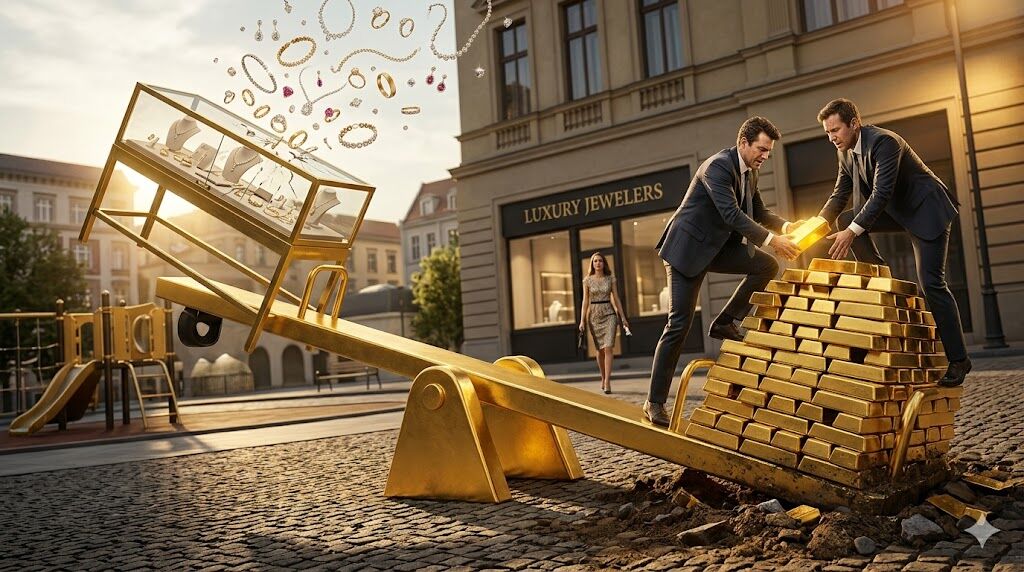
The World Gold Council reported 2025 total gold demand reached a record 5,002 tonnes — investment demand at 2,175 tonnes, central bank purchases at 863 tonnes. J.P. Morgan projects gold toward $5,000/oz by Q4 2026.
But global jewelry demand fell 18% in 2025, including -24% in China. Investors want gold. Jewelry consumers are walking away.
Gold Price Volatility Creates Dealer Risk in 2026
Spot gold hit $5,114/oz on March 13. By March 20, fell to ~$4,564. A swing of $600+ in nine days. For any dealer pricing in gold, that changes the math on everything.
Global Jewelry Demand Decline: -18% Overall, -24% in China
The 18% decline is structural — a response to sustained high prices. At $4,500+, consumers demand lighter pieces, lower karat, better value. Design efficiency becomes competitive advantage.
Gold Scrap and Refining Opportunity for Dealers
Elevated prices create strong scrap opportunity. Lock payout percentages and move to refining quickly. When gold drops $600/week, sitting on unhedged positions is accidental speculation.
Gold Watch Inventory Risk: Rolex, Patek, AP in Precious Metal
Rolex gold models up ~9% for 2026. Cumulative +20% vs end-of-2024. Every precious metal watch is now a bet on brand AND commodity. Factor two-way risk into acquisition pricing, hold periods, and sale pricing.
Gold Market Outlook: Central Banks, ETFs, 2026 Projections
Central bank demand projected ~755 tonnes in 2026. ETFs expected 250 tonnes. Bar/coin demand to surpass 1,200 tonnes. The structural bid remains — but for jewelry, gold has crossed a threshold where it suppresses the demand it's supposed to support.
The Investment-Jewelry Divergence
The 5,002-tonne global demand record masks a troubling divergence within the gold market. Investment demand — central bank purchases, ETF inflows, and bar-and-coin buying — surged to record levels, driven by geopolitical uncertainty, de-dollarization trends, and inflation hedging. But jewelry demand fell 18%, the sharpest decline in over a decade. Consumers who buy gold as adornment are being priced out by consumers who buy gold as insurance.
For jewelry dealers, this creates a strategic dilemma. Higher gold prices lift the value of existing inventory and increase walk-in traffic from sellers liquidating old pieces. But they also push fabrication costs higher, compress margins on new production, and shift consumer behavior toward lighter-weight designs and lower-karat alternatives. The 10K gold trend that JCK reported — designers embracing lower-karat metal as a design choice rather than a compromise — is a direct market response to this dynamic.
How Dealers Should Adapt
The practical response is threefold. First, expand your scrap and buying operation — higher spot prices mean more walk-in traffic from consumers liquidating old jewelry, and the margins on scrap are more predictable than on new fabrication. Second, diversify your gold jewelry offering across karat weights — 10K and 14K pieces at accessible price points keep customers in the gold category rather than losing them to silver or vermeil. Third, manage your unhedged metal exposure carefully — with gold swinging $100 or more in a single session, overnight exposure on memo inventory carries real risk.





Comments 0
No comments yet. Be the first to share your thoughts.