
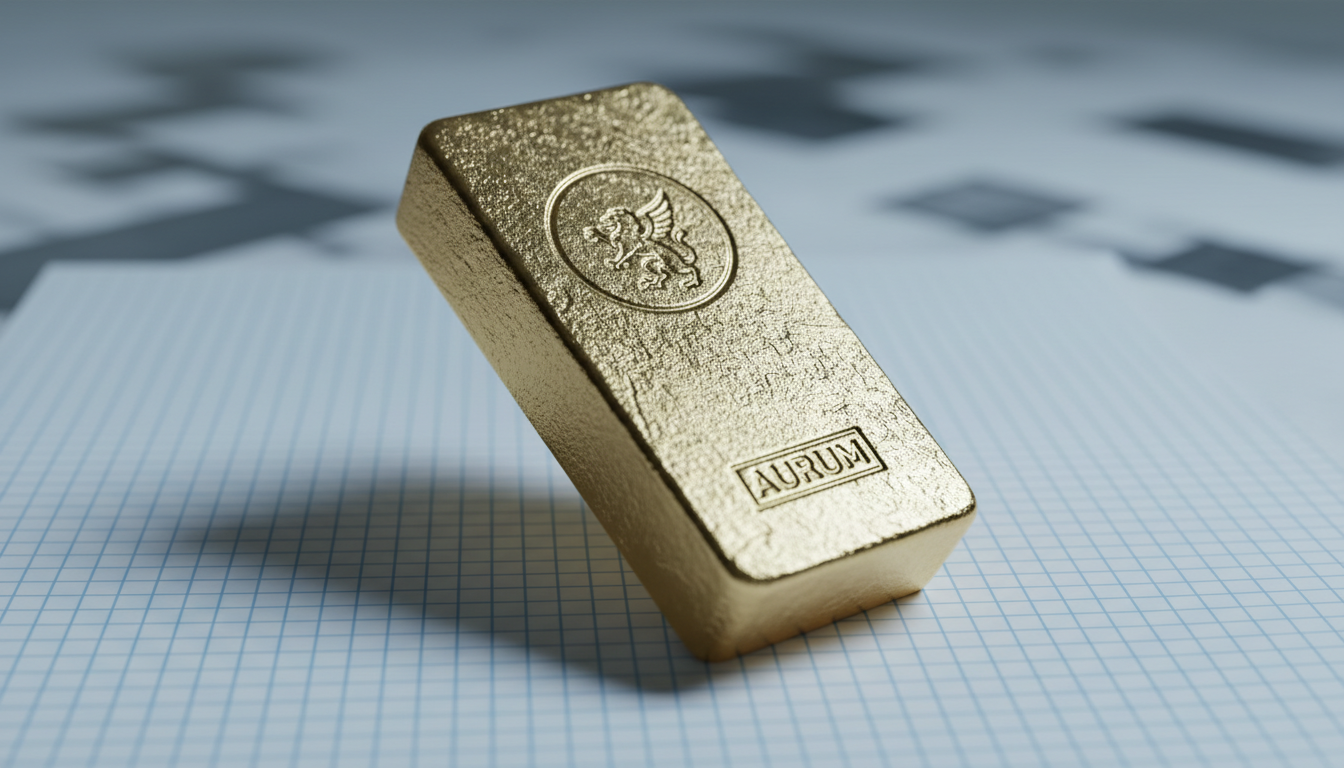
Gold spot settled May 2, 2026 at approximately $4,629 per troy ounce as of 10:26 AM EDT, capping a week of sharp intraday swings that saw the metal dip to $4,577 on April 28 before recovering to $4,653.69 by April 30. The April 28 decline represented a $125 drop from the prior session, the steepest single-day retreat since late March. April 30 brought a 2.24 percent rally, underscoring the choppy character of precious metals trading in the second quarter.
These levels remain well below the all-time record of $5,602.22 set January 28, yet gold has gained $1,260 per ounce year-over-year when comparing April 28, 2025 to April 28, 2026. Jewelers sourcing karat stock and watchmakers purchasing 18k case material continue to absorb double-digit input cost increases that began accelerating in late 2024 when spot hovered near $2,650.
Technical Boundaries and Treasury Dynamics
Chart watchers flag $4,300 as critical support, often cited as the current bull-bear demarcation. A break below that threshold would test the 200-day exponential moving average near $4,200, a zone that has contained pullbacks since mid-2025. On the upside, resistance clusters around $5,400, roughly the midpoint between present prices and the January peak.
The week's price action unfolded against a backdrop of Federal Reserve rate expectations holding at 3.50 to 3.75 percent with 99.5 percent implied probability. Ten-year Treasury yields oscillated between 4.3 and 4.4 percent, offering enough nominal return to draw capital away from non-yielding bullion during risk-off episodes. Meanwhile the dollar index held above 98.5, providing modest headwinds for overseas buyers converting local currency into greenback-denominated gold.
Dealers managing hedged inventory should monitor the $4,300 level; a close below risks accelerated selling into the 200-day EMA.
Silver Amplifies the Moves
Silver mirrored gold's volatility with greater amplitude. The May futures contract opened April 28 at $75.46 per ounce, then slid to $73.86 by 6:30 AM ET the same morning. By April 30 spot silver closed at $74.41, up 3.72 percent for the session. The $73.86,$75.46 range during the week illustrates how silver's smaller market capitalization magnifies percentage swings relative to gold.
Jewelers working in sterling report that refinery premiums have compressed slightly as volatility discourages speculative buying, but fabrication lead times for .925 findings remain extended. Secondary silver scrap flow has increased modestly as retail holders liquidate into strength, yet primary mine supply has not kept pace with industrial photovoltaic and electronics demand.
Silver's 3.72 percent single-day gain on April 30 signals that tactical buyers view sub-$74 levels as attractive; watch for further tests of $75.50 resistance.
Central Bank Accumulation Continues
World Gold Council data released April 30 confirmed that central banks expanded official gold reserves during the first quarter of 2026. Specific tonnage figures were not disclosed in the initial summary, but the trend extends a multi-year pattern of net purchases by monetary authorities in Asia, the Middle East, and Eastern Europe. Central bank buying provides a structural bid beneath spot markets, dampening the severity of corrections even when speculative positioning unwinds.
Geopolitical risk premiums also factored into the week's price swings. Tensions involving Iran and potential disruptions near the Strait of Hormuz kept a floor under safe-haven demand, though no actual supply interruptions materialized. Traders priced a modest risk premium into May and June contracts, visible in the forward curve's slight backwardation.
Ongoing central bank accumulation offers a backstop, but dealers should not assume official-sector bids will prevent sharp technical breaks if macro sentiment shifts.
Institutional Targets and Dealer Pricing
Sell-side forecasts for year-end 2026 range from $5,400 to $6,300 per ounce. Goldman Sachs maintains a $5,400 target, while JPMorgan projects $6,300. Deutsche Bank sits at $6,000, Wells Fargo between $6,100 and $6,300, and a Reuters poll of analysts yielded a median estimate of $4,746. The wide dispersion reflects uncertainty over Federal Reserve policy trajectory, inflation persistence, and the dollar's path through the second half.
For wholesalers marking up fabricated jewelry or watch cases, the spread between these forecasts translates into meaningful P&L risk. A dealer who locked in $4,600 gold for delivery in September faces potential margin compression if spot rallies toward $6,000, or windfall if it retreats toward $4,300. Forward contracts and options strategies have become standard tools to manage this exposure, particularly for businesses carrying significant karat inventory.
Retailers report that Rolex gold watch list prices have risen approximately 20 percent over the past year as the brand repriced models to reflect gold's climb from around $2,650 in late 2024 to above $4,500 in early 2026. Independent watchmakers using 18k stock note that case-blank costs have more than doubled since mid-2024, squeezing margins on bespoke commissions unless客户端 accept proportional retail adjustments.
With institutional targets spanning an $800 range, dealers writing forward commitments should stress-test scenarios at both $5,400 and $6,300 to quantify margin outcomes.
Platinum Disconnect and Arbitrage Signals
Platinum prices have surged 170 percent year-over-year, yet platinum-cased wristwatches have lagged gold models in secondary-market appreciation. Collectors and dealers familiar with both metals see a potential arbitrage: vintage platinum chronographs from Patek Philippe, Vacheron Constantin, and Audemars Piguet trade at premiums that have not kept pace with the metal's spot rally. Whether this gap closes depends on collector recognition of platinum scarcity and willingness to pay multiples aligned with current refining costs.
Fabricators using platinum for wedding bands and luxury watch cases face similar input-cost pressures as their gold counterparts, though platinum's industrial uses in catalytic converters add a demand layer absent in gold. Any slowdown in automotive production could ease platinum premiums, while jewelry and watch demand remains price-inelastic at the high end.
Dealers holding platinum watch inventory should evaluate whether spot's 170 percent gain will eventually lift secondary-market prices or if collector preference for gold and steel will cap upside.
Week Ahead: Fed Meeting and Technical Tests
Markets enter the first full week of May with the Federal Reserve policy decision in the rearview mirror and attention shifting to May payrolls data due later in the month. If ten-year yields push above 4.4 percent, gold could retest the April 28 low at $4,577. Conversely, any uptick in Middle East tensions or weaker-than-expected economic prints may propel a retest of $4,700 and beyond.
Refiners report stable premiums for .9999 kilo bars, typically 50 to 75 basis points over spot for wholesale lots. Smaller bars and sovereign coins carry higher premiums, reflecting fabrication and distribution costs. Scrap dealers note that consumer selling has ticked up as gold approaches $4,650, though the volume remains below the surge witnessed in late January when spot briefly touched $5,602.
For the trade week ending May 2, gold's $4,629 close leaves the metal 17.4 percent below its January peak and $117 above the recent $4,577 low, a tight range that underscores near-term indecision and the question of whether institutional forecasts in the $5,400,$6,300 band will prove conservative or optimistic by December.





Comments 0
No comments yet. Be the first to share your thoughts.