
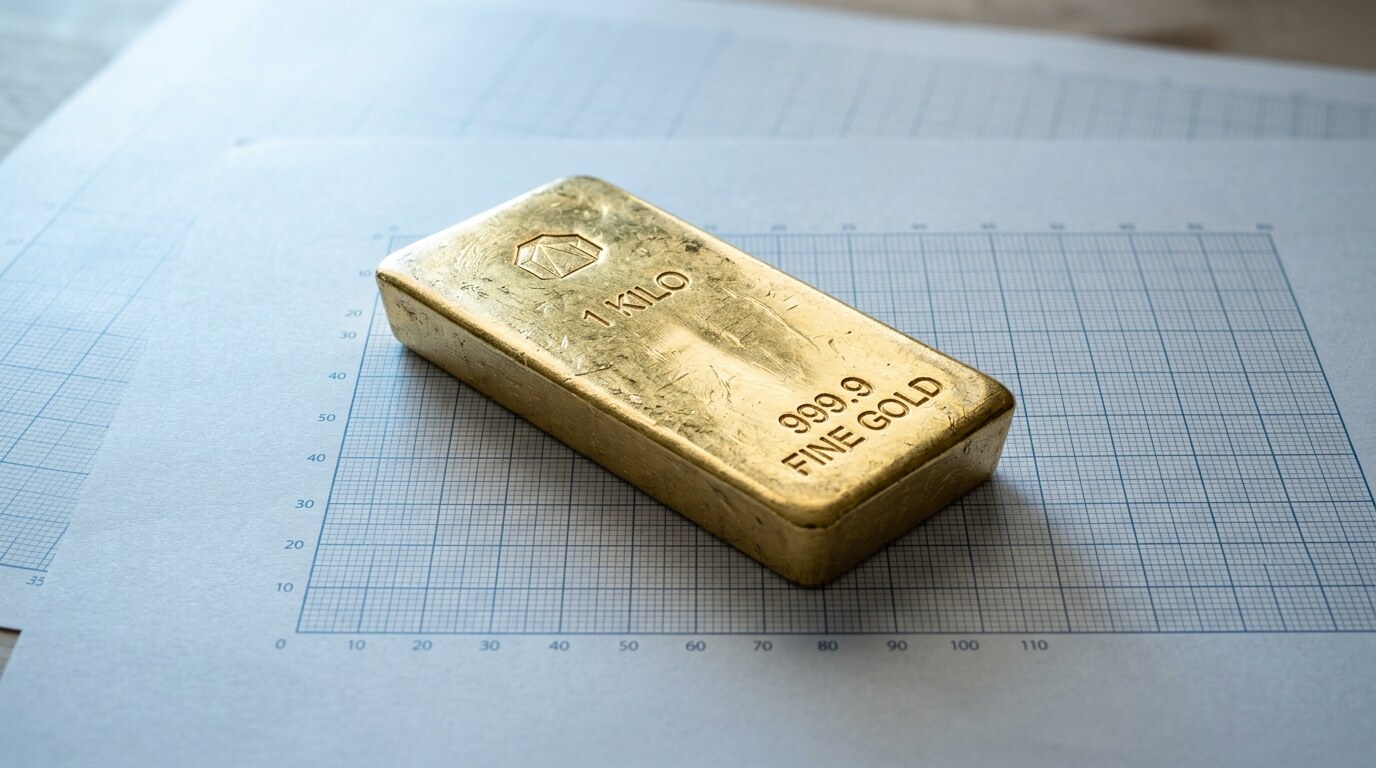
Gold settles at $4,308 into Warsh's first FOMC
Spot opened Monday at $4,356 an ounce after three sessions of gains tied to the emerging US-Iran peace framework that would reopen the Strait of Hormuz. By Friday's close in New York, gold was changing hands around $4,308. That puts the metal on track for a second consecutive weekly decline and sets up Wednesday's FOMC as the most-watched data print of the month. This is Kevin Warsh's first decision as Federal Reserve Chair, and the SEP, the Summary of Economic Projections including the dot plot, is the supplemental release the trade really cares about. Markets are pricing a 97% probability of no rate change.
The dot plot is the variable. If the median projection holds at the current path, gold likely rallies on relief, since positioning has skewed hawkish into the meeting. If the median shifts to one more hike by December, the metal takes another leg down toward $4,200. Forecast consensus for June puts the range at $4,186 to $4,933, a band wide enough to be useless for hedging but tight enough to bracket the realistic scenarios. J.P. Morgan Global Research is still pointing at $6,000 by year end. Other desks have $5,500 to $5,800. I am closer to $5,200 than to $6,000.
The Iran peace pressure is real but limited
The geopolitical premium that has been baked into gold since the Strait of Hormuz crisis in April started unwinding the moment the peace-framework headlines hit. Oil pulled back, the dollar firmed slightly, and gold gave back its risk-off bid. The unwind is not finished. If the framework holds into a signed agreement, the metal will absorb another $50 to $100 of risk-premium compression. If it falls apart, and these things often do, the bid returns immediately.
What I am watching from the dealer side is the spread between paper gold and physical bullion. Wholesale kilo bar premiums in Singapore and Dubai softened this week, which is consistent with the spot price action. Retail in the US showed the same pattern: dealers cut their over-spot markups modestly, and walk-in business slowed for the first time in a month. The 22-karat trade, which is the South Asian community business specifically, was the only segment that did not slow. That demand stays consistent regardless of the spot print.
Central bank demand is intact
The May 2026 official-sector data, released by the World Gold Council this week, holds the line on the structural bid. Kazakhstan was the largest net buyer at +7 tonnes, bringing year-to-date Kazakh accumulation to roughly 15 tonnes. Turkey added 6 tonnes. Poland was the marginal buyer of April at +14 tonnes. The trailing four-year average for central-bank purchases is roughly 1,000 tonnes annually, up from the 500-tonne average that defined the prior decade. WGC's 2026 forecast calls for 750 to 850 tonnes of net official-sector buying, which is consistent with the May print.
The point that does not get made often enough: the central bank bid is price-insensitive in the meaningful sense. These institutions buy on currency-reserve composition mandates, not on tactical entry levels. They will buy at $4,300 the same way they bought at $3,500. That is why the structural floor under gold has lifted by roughly $1,500 over the past two years, and it is why most desks are still pricing higher highs into 2027 even with the near-term consolidation.
Mining supply is constrained, refining is busy
Mine production has tightened on the margin. Q1 2026 mine output was up roughly 1% year over year, a deceleration from the 3% growth rate of 2024. Major Western producers are running at full capacity. The marginal tonnes are coming from artisanal supply in West Africa and Latin America, and from recycled jewellery. Recycled supply is up sharply on the back of $4,300 prices and pawn shop melt activity in the US Midwest is, by anecdote, at the highest level since 2020.
Refining capacity in Switzerland is fully booked. Argor-Heraeus, MKS PAMP, Valcambi, Metalor (the four major Swiss refiners) are all running at capacity with three to six month waiting lists for new bar orders. The kilo bar premium over spot widened by $4 to $8 in the secondary market this week, which is a margin signal rather than a supply signal. The trade press will misread it as scarcity. It is not. It is logistics.
What gold does after Wednesday
The path from $4,308 depends almost entirely on the dot plot. If the median stays at the current trajectory or shifts dovish, the path of least resistance is back to $4,400 to $4,500 by month-end. If the median goes hawkish, $4,200 retests within ten days and a $4,100 print becomes plausible. Beyond the Fed, the variables are the Iran-framework status, India's monsoon-cycle physical demand (which typically softens into August, and which we discussed in our India exports note), and the next Chinese central-bank reserve update. For the retail trade, the realistic guidance for clients this week is to stay flat into the FOMC and re-evaluate Thursday morning.
Rolex's June 1 retail action, plus 5% on gold references and plus 2.5% on two-tone with steel unchanged, is the cleanest read on how the luxury side prices the metal print. Another leg up post-Fed and Geneva will move again. For the broader market context this week, including Phillips XIV and the India jewellery print, see our Friday wrap-up. The question for next week is whether $4,200 holds, or whether Warsh's dot plot gives the bears one more leg.





Comments 0
No comments yet. Be the first to share your thoughts.