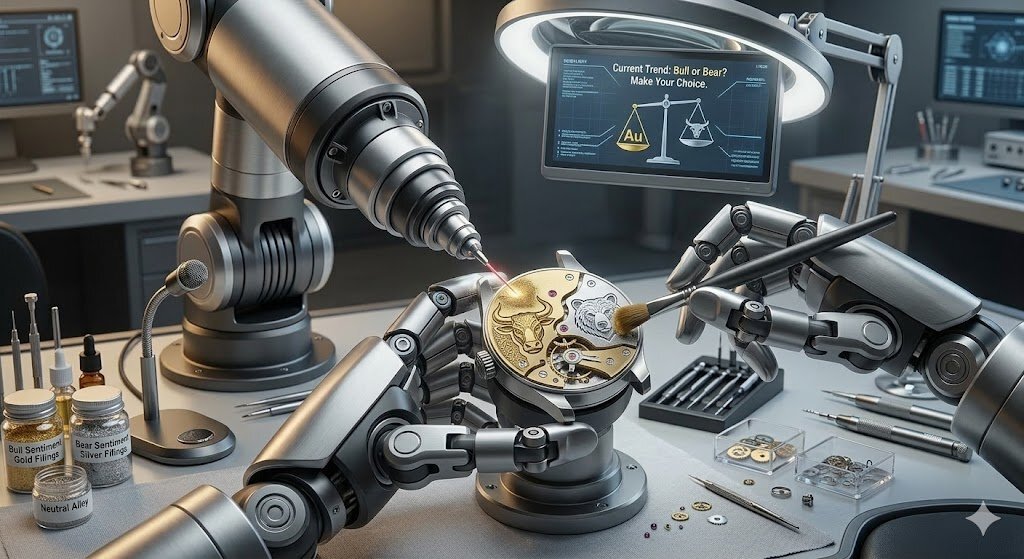
Artificial intelligence is already changing the world. It is helping companies move faster, reduce repetitive work, improve communication, organize information, and operate more efficiently than ever before. The jewelry and watch industry will benefit from many of these advancements.
But there is one thing AI still cannot replace: skilled labor.
That matters more than ever in an industry built on craftsmanship, precision, touch, patience, and experience. Jewelry and watches are not just products of software, ideas, and sales. They are physical objects that have to be made, repaired, restored, finished, tested, and trusted.
AI Can Assist the Industry — But It Cannot Be the Industry
There is no question that artificial intelligence will play a bigger role in the jewelry and watch business going forward. Retailers can use AI to improve product listings. Manufacturers can use it to organize processes. Sales teams can use it to communicate better with customers. Marketing teams can use it to write content, generate ideas, and test campaigns more quickly.
All of that is real. But there is a difference between helping a business run and actually doing the skilled work that gives the business value.
AI can help draft a ring concept. It cannot sit at a bench and execute it with judgment. AI can help identify a trend. It cannot restore a damaged heirloom with hand skills. AI can help write a watch service intake description. It cannot disassemble, inspect, regulate, and reassemble a fine movement with the touch of a trained watchmaker.
The Backbone of the Trade
Watchmakers keep mechanical time alive. They diagnose issues invisible to the average person. They understand movement architecture, wear patterns, tolerances, lubrication, timing, and restoration.
Bench jewelers turn loose ideas into wearable reality. They size rings, repair chains, rebuild prongs, retip settings, solder, assemble, modify, and finish pieces with precision.
Setters bring security and beauty together in a way that few outside the trade fully appreciate. A setter has to know pressure, angle, fragility, symmetry, spacing, and stone behavior.
Casters and melters work at the stage where raw material becomes possibility. They understand metal behavior, temperatures, shrinkage, contamination risks, alloy issues, and production flow.
Assayers protect trust in precious metals. Whether in refining, manufacturing, buying, or quality control, accurate testing and metal knowledge remain essential.
Polishers are often overlooked by people outside the trade, but they are a major part of what separates mediocre work from finished work.
As Automation Increases, Human Skill Becomes More Valuable
The more automated the world becomes, the more valuable real skilled labor often becomes. Genuine craftsmanship becomes easier to recognize when everything around it starts feeling automated, templated, and interchangeable.
Luxury has always depended in part on rarity. Skilled labor is becoming rarer.
That means skilled jewelry labor and watch industry labor may become even more important, not less. Businesses that can combine modern tools with real craftsmanship will likely be in the strongest position.
The Best Future Is Technology Plus Craft
This should not be framed as old versus new. Technology is not the enemy. AI is not the enemy. But the strongest future is not one where technology replaces craftsmanship. It is one where technology supports craftsmanship.
Let AI help with the repetitive tasks. Let software improve workflow. Let systems save time. Then let the real experts do the real work.
The future of jewelry depends on skilled labor, not just AI. And the sooner the industry treats that as a central truth instead of a side note, the stronger the future will be.





Comments 0
No comments yet. Be the first to share your thoughts.