
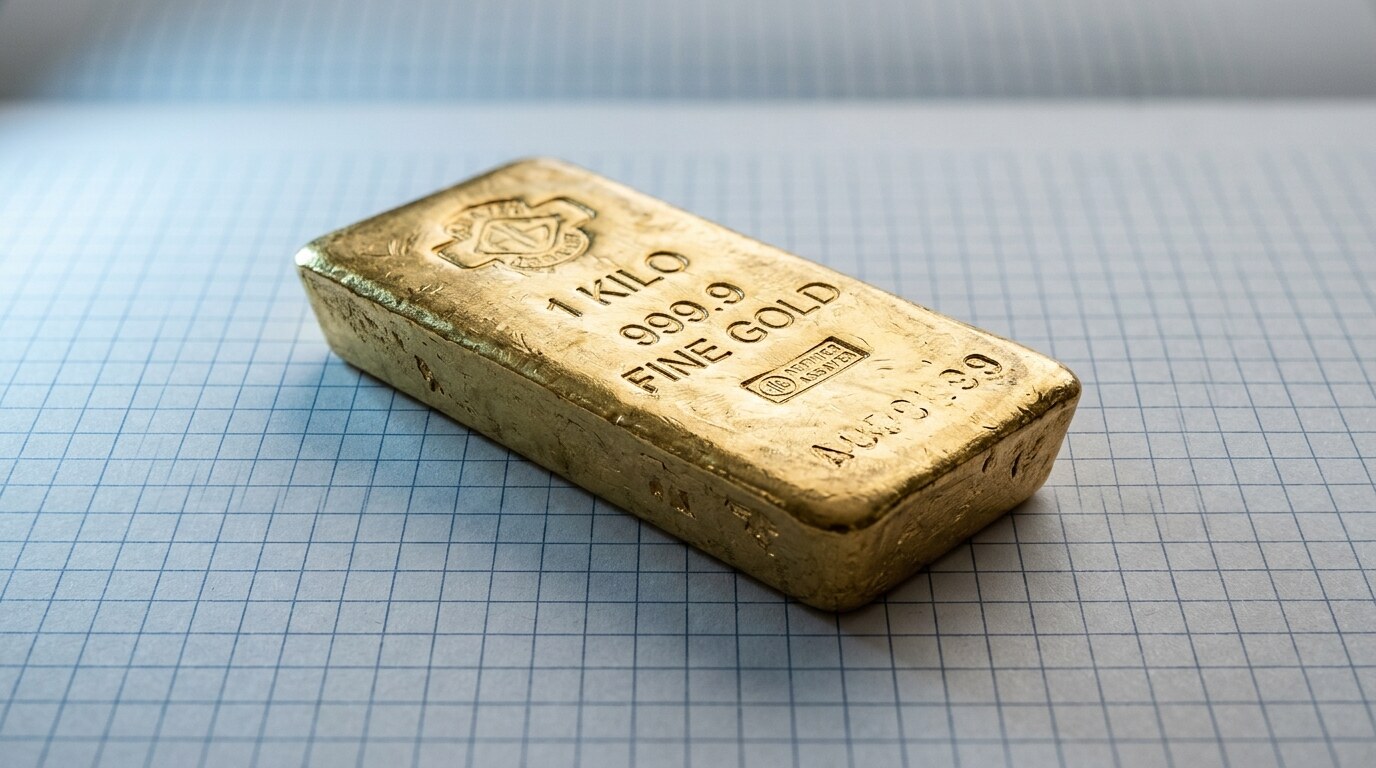
Gold spent the month proving a point the desk had half-forgotten: this is not a one-way trade. As of the close on July 27 the metal sat at $4,090.16 an ounce, a comfortable-looking number that hides a rougher two weeks underneath it.
The break that mattered
During the week ended July 17, spot gold broke below $4,000 for the first time since last autumn. That move handed the metals desk its worst five sessions in six weeks. For a metal that had treated $4,000 as a psychological anchor all year, actually trading through it changes how everyone on the floor thinks about the level.
A round number holds until it does not, and once it breaks the memory of the break stays in the tape. The recovery to $4,090 retraced most of the damage, but it did not restore $4,000 as a floor. It reset it as a level the market has now proven it will trade through when the selling comes. That is a different thing to price around.
Worst-five-sessions language gets thrown around loosely, so it is worth being precise about what it means at the counter. Six weeks of relative calm let dealers quote metal tight, because a spot that only grinds does not punish you for holding a position overnight. The July 17 sequence broke that calm. When the biggest down-run in a month-and-a-half arrives in the same stretch that carries a round number through, the two events compound. You are not just marking a lower price, you are marking a lower price that arrived fast, and speed is what widens spreads.
What the recovery does and does not say
The bounce back above $4,000 tells you buyers stepped in near the lows. It does not tell you the top is back in place. Roughly $90 of recovery off a break is a market finding a footing, not a market resuming a trend. Until the metal puts distance between itself and the $4,000 line on the upside, the honest read is that gold is ranging, not climbing.
For the bench, that matters more than the headline. Every gold-case watch, every scrap lot, every trade-in gets quoted off spot, and a spot price that just demonstrated it can wick under $4,000 forces a wider bid-ask on anyone carrying metal-heavy inventory. When you cannot trust the round number to hold intraday, you quote defensively.
Defensive quoting is not caution for its own sake, it is arithmetic. On a heavy 18k case the melt component moves in step with spot, so a two-percent intraday wick is real money against a piece you already own. The dealer who quoted a trade-in at Monday spot and could not move it before the July 17 slide learned that lesson in one week. The response is not to stop buying metal-heavy goods, it is to build the round-number risk into the bid, which is exactly what a wider spread does.
The cross-currents
The timing is awkward because the metal side of the watch trade is finally warming up. Swiss watch exports rose 11.2% in June to nearly CHF 2.4 billion, with U.S. Shipments up 12.7% to CHF 349 million, and gold-case demand has firmed on dealer floors, a thread I follow in the watch column. A wobbling spot price complicates that recovery: stronger demand for gold pieces meets a metal input that just proved it can move against you inside a single week.
Read those two export lines together and the squeeze gets clearer. June was a strong month for gold-case product moving out of Switzerland, and the U.S. Led it. That is fresh inventory landing on floors at precisely the moment the input cost stopped behaving. A retailer restocking gold pieces in June bought forward on the assumption that $4,000 was a floor. The July 17 break did not change what he paid, but it changed what the same case is worth if he has to remark it, and that gap is where the ranging spot price bites hardest.
The broader week backs the caution. Luxury demand split hard between Richemont and LVMH, the diamond counter reset again, and now the one input that touches nearly every category on the bench has shown it can trade with a three-handle. I tie those threads together in the trade week wrap.
The diamond side is the useful contrast here. De Beers took its consolidated average realized price down 32% year-over-year to $105 a carat, a slow structural bleed that a dealer can see coming and plan around. Gold is the opposite problem: the level is high and the direction is unsettled, so the risk is not a known decline but an unknown swing inside a single session. One input you mark down on a schedule, the other you quote around in real time.
Where it leaves the desk
The number to watch is $4,000, not $4,090. If the metal holds its recovery and builds a base above the line it just broke, the summer scare reads as a shakeout. If it drifts back and retests $4,000 from above, the break of July 17 becomes the first of a series rather than a one-off. At $4,090.16 the tape is sitting on the fence, and the only wrong move for anyone quoting metal this week is to assume the round number will save them. Does $4,000 become support again, or the ceiling of a lower range?





Comments 0
No comments yet. Be the first to share your thoughts.