
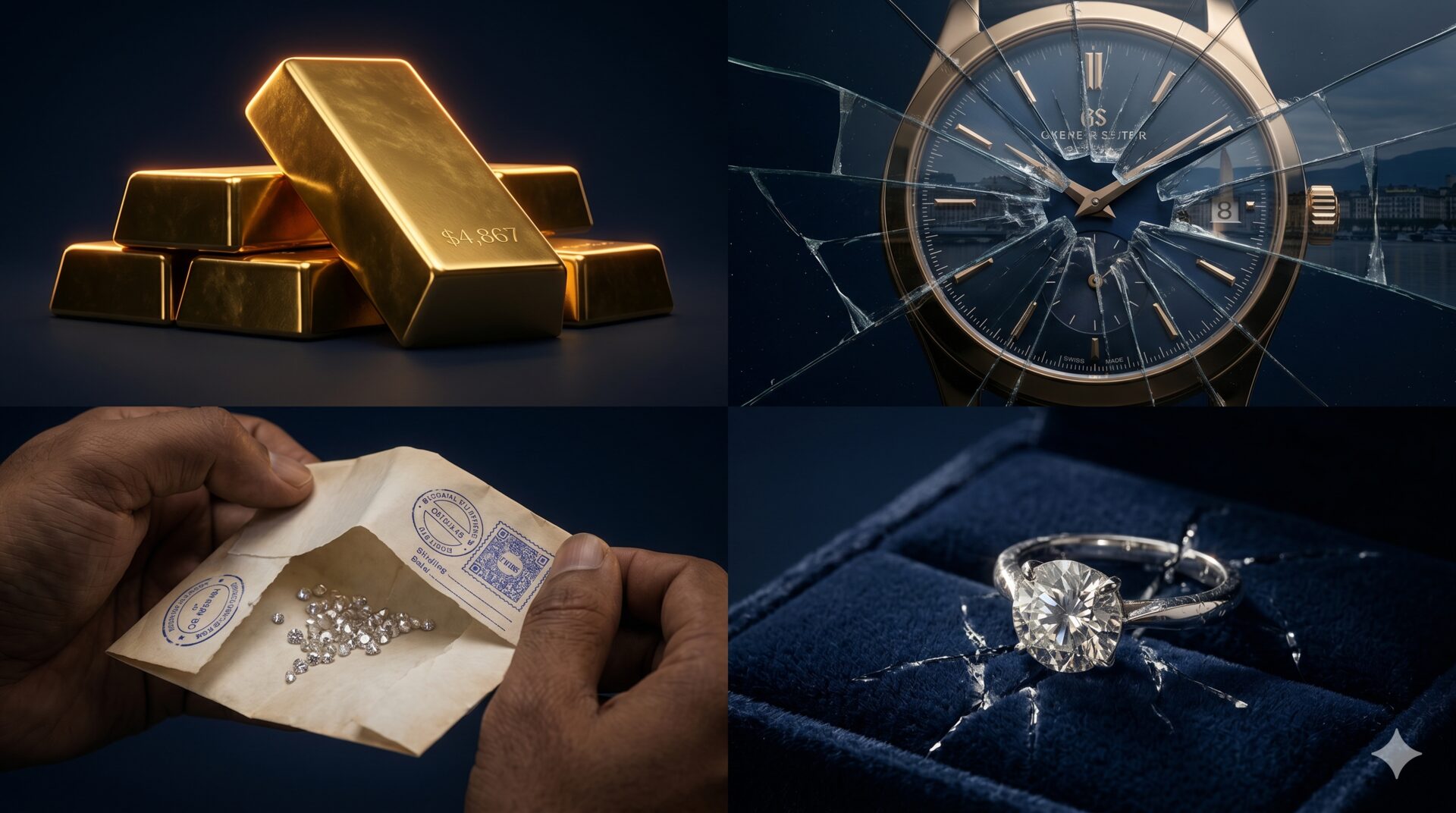
This week did not deliver one clean message. It delivered four. Gold stayed expensive, not cheap. Swiss watches found support again. The jewelry export pipeline showed real stress. And diamonds kept separating into two very different businesses: goods that still move, and goods that just sit.
Each of those signals matters on its own. Put them together and the pattern is clear — this is still a margin market, not a volume market, and the dealers doing well are the ones buying carefully, turning fast, and refusing to force weak inventory.
Gold and Bullion: $4,867 and the Run Keeps Going
Spot gold closed at $4,867.92 per ounce on April 17, up $70.65 on the day — the fourth consecutive weekly gain. Silver ripped higher to $82.52, a +4.74 percent session move that narrowed the gold-silver ratio to 59.0. The immediate catalyst was the US-Iran ceasefire negotiation and talks around reopening the Strait of Hormuz, but the underlying bid has been building for months.
Context matters here. Gold set its all-time intraday record of $5,594.82 on January 29 before dropping 9 percent the next session to an intraday low of $4,400. Since then, prices have consolidated in a $4,500-to-$4,900 range that UBS called a "reset rather than regime change." Forecasts are still stacked bullish — UBS raised its gold target to $6,200 for the first three quarters of 2026, and J.P. Morgan is modeling $5,200 to $5,300 by year-end. Bank of America, HSBC, Goldman Sachs, and State Street are all clustered around $5,000.
The dealer read: scrap and refining desks are in the best position they've been in modern history. New production margins are under real pressure because retail price increases have not kept pace with spot. And gold-cased watch inventory bought when spot was sub-$3,000 is now carrying a structural replacement-cost tailwind.
Luxury Watches: Geneva Delivers New Product and Export Data Supports It
Watches and Wonders Geneva 2026 runs through April 20 with 65 exhibiting brands, the biggest edition to date. Audemars Piguet joined the official roster for the first time and stole the week with the Neo Frame Jumping Hour. Cartier released a new Santos-Dumont on a 394-link gold mesh bracelet — a piece that changes the entire value proposition of the reference. Rolex refreshed the Oyster Perpetual 41. A. Lange and Söhne unveiled the Lange 1 Tourbillon Perpetual Calendar "Lumen" in platinum. IWC went dark olive green ceramic with the Ingenieur Automatic 42. Panerai put out a case made from 95 percent hafnium. Grand Seiko introduced the Spring Drive Calibre 9RB1 with ±20 seconds annual accuracy.
Swiss watch exports for February 2026 came in at CHF 2.2 billion, up 9.2 percent year over year, with exports to the US surging 26.8 percent. That is the single best export data print for the sector since Q3 2024 and gives the Geneva week real fundamental support. But it does not mean every release becomes a winner. Hermès said this week that Middle East sales were weaker, and travel retail was hit by regional conflict disruption. The top of the market is still moving. The middle is still selective.
Jewelry and Diamonds: India Exports Flash a Warning, De Beers Pivots to Desert Diamond
India's Gem and Jewellery Export Promotion Council reported fiscal 2025/26 exports fell 3.3 percent to $27.72 billion — the lowest level in five years. Exports to the US dropped about 45 percent to $5.09 billion. Cut-and-polished diamond exports fell 8.5 percent to $12.16 billion, their weakest print in more than two decades. The numbers are not a cosmetic miss. They are a structural signal about what happens to the pipeline when too much volume rides on one market and one policy environment.
At the same time, De Beers launched its "Desert Diamond" bridal campaign on April 13 — a warm-tone natural diamond positioning built to carve out a category that lab-grown cannot easily commoditize. The campaign lands a week after the first sustained rebound in lab-grown pricing (+3.32 percent) and in the same week that Allied Market Research projected the lab-grown market will hit $59.2 billion by 2032. Rapaport's March summary had the diamond trade cautious, 1-carat RAPI down 1.7 percent, with trading in Israel and Dubai briefly frozen during the recent conflict shock. Anglo American has written down De Beers by $4.5 billion over two years; it is now valued at roughly $4.1 billion, less than half its 2022 level.
Industry: Retail Consolidation Accelerates
Signet Jewelers reported fiscal 2026 sales of $6.81 billion, up about 2 percent, with same-store sales up 1.3 percent. Merchandise average unit retail rose 7 percent for the year. The company is closing roughly 100 stores in fiscal 2027, shutting James Allen (the brand gets absorbed into Blue Nile, with jamesallen.com going dark), and folding Rocksbox into the core portfolio. Pandora is introducing platinum-plated pieces to reduce silver reliance. Saks Global's bankruptcy has reshuffled the department-store jewelry channel, with Bloomingdale's picking up meaningful share.
The pattern is consistent: price up, units down, portfolio consolidation, mix shift toward higher-ticket product. Entry-level buyers at the $99 silver price point have largely left the category, and analysts now peg the new entry floor at $200 to $500.
The Takeaway
Dealers who buy carefully, turn faster, and avoid forcing weak inventory will keep finding opportunity. Dealers waiting for "normal" conditions may be waiting a while. Every story this week pointed in the same direction — discipline is paying more than optimism, and the businesses that adapt to the split-market reality now will be the ones still standing when the next demand cycle arrives.





Comments 0
No comments yet. Be the first to share your thoughts.