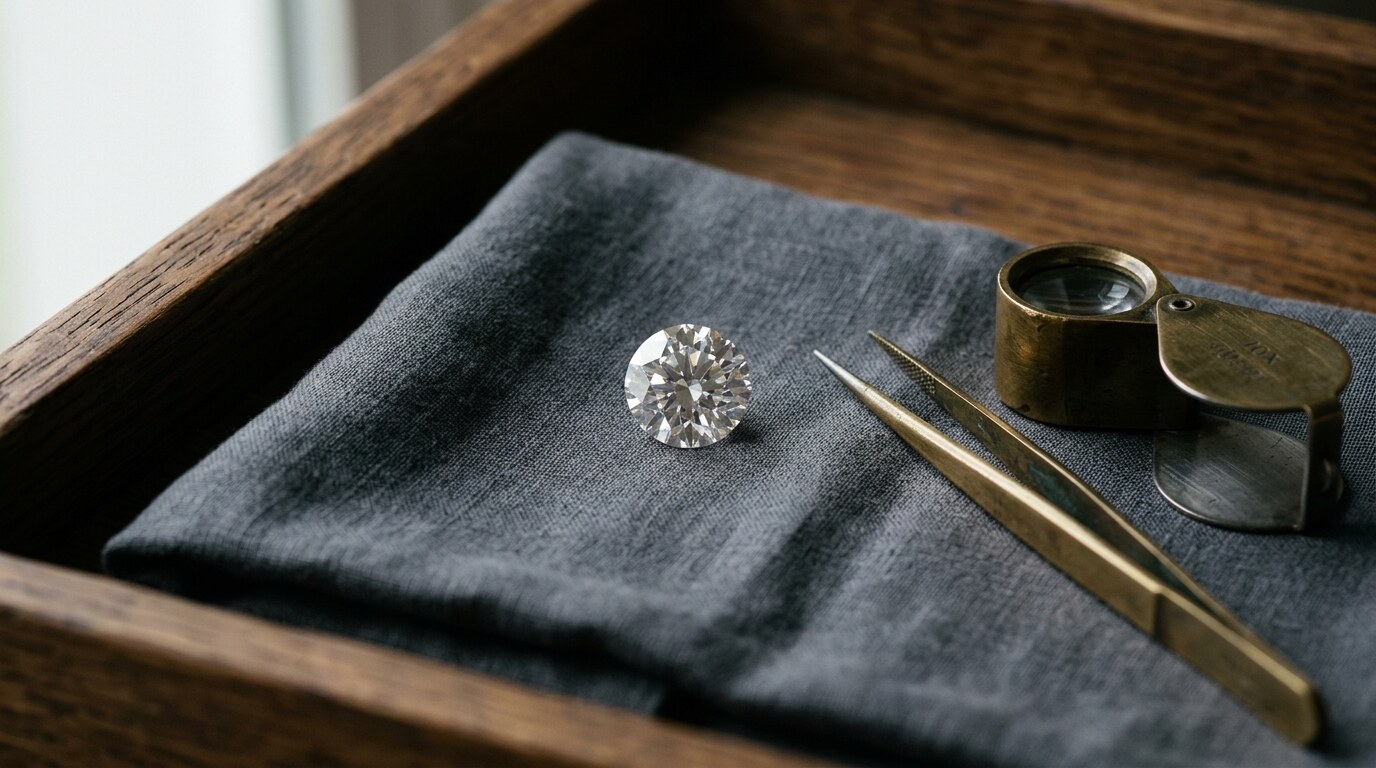
The Q2 2026 lab-grown wholesale data does not read like a single market anymore. Edahn Golan's Lab-Grown Diamond Wholesale Price Index fell 13% year over year and is now down 96% since the series began in July 2018. The headline decline is real, but it masks a split that matters more to anyone stocking a case.
The averages hide a bifurcation
Wholesale prices for one-carat rounds rose 1% in the quarter. At the same time, 1.50 to 1.99-carat stones fell 11% year over year, two-carat stones dropped 20%, and fancy shapes, including hearts, marquises, ovals and pears, gave up an average of 17%. The pattern is consistent: the sizes and shapes that carry an engagement ring are stabilizing, while the larger and more speculative tiers keep deflating toward a commodity floor.
That divergence is the operative fact for retailers. A one-carat round grown stone is behaving like a stable input cost. A two-carat oval is still a falling knife. Buying to a fixed retail price point works in the first case and destroys margin in the second.
Volume keeps climbing
Price weakness has not dented demand. Total sales of lab-grown diamond jewelry at US specialty retailers rose 24% in the second quarter, with growth driven by higher unit sales rather than higher tickets. Consumers are buying more stones at lower prices, which is precisely the dynamic that lets a retailer hold dollar volume while unit economics compress. Lab-grown has defied the textbook relationship between price and demand for three years running, and Q2 did nothing to break the streak.
The rough side of lab-grown told a stranger story. While polished wholesale kept sliding, some rough grown categories firmed in the quarter as producers throttled output to defend margin, a rare instance of the supply chain acting on price signals it spent years ignoring. Whether that discipline holds through the second half is the open question for anyone sourcing melee at volume.
The natural spread has never been wider
The gap against natural stones keeps stretching. A natural one-carat D/VVS2 round retails near $4,600 in the United States and closer to $5,300 in Asian markets. The optically identical grown stone can be bought for roughly $305 direct from a producer. That is a spread wide enough that the two products increasingly serve different buyers rather than competing for the same one.
That separation is showing up at the counter. Natural-diamond consumer spending has been rising even as unit counts stay roughly flat, with buyers trading up on the stones they do purchase, while lab-grown captures the volume-driven, fashion-led sale. The two categories are settling into different jobs rather than one cannibalizing the other, which is a healthier setup for a retailer carrying both than the price war of two years ago.
On the natural side, the recovery in small stones is gaining momentum. The RapNet Diamond Index for 0.30-carat rounds rose 4.2% in June, up from a 2.1% gain in May, and the 0.50-carat index added 1.3%. The one-carat index slipped 0.7% and the three-carat turned positive at 0.4%. Inventory reductions are doing the work, with two-carat and larger G-I, VS-SI rounds and long fancies still the strongest category in US sales.
Supply is tightening behind the prices
The pricing story sits on top of a supply story. De Beers eased official rough prices at its July sight, its first sale after cutting its buyer roster to roughly 45, and confirmed a two-year production pause at its Venetia mine in South Africa, detailed in our industry report. Less rough entering the pipeline eventually supports polished, though the lag runs quarters, not weeks. With Venetia idled for two years and the roster down to roughly 45 buyers, the volume of natural rough entering the pipeline is set to fall on two fronts at once. The wider trade picture is in this week's market wrap.
The retail calendar offers a near-term test. The IJO summer conference runs July 25 to 28 in Louisville, and the JIS Fall show opens October 16 in Miami Beach, the two windows where independents place the orders that set holiday inventory. Buyers walking those floors now have to decide whether the one-carat grown floor is real or just a pause before the next leg down.
The number retailers should track into the fall is that 1% gain on one-carat rounds. If the anchor size holds while the tails keep falling, the lab-grown case stabilizes around the products that actually sell. If it rolls over, does the category have a floor at all?





Comments 0
No comments yet. Be the first to share your thoughts.