
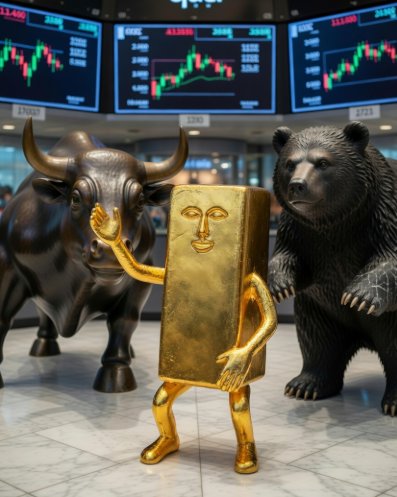
Gold bulls are not wrong. They are just often too casual about how hard this trade has become. Spot gold closed at $4,867.92 per ounce on April 17 — up 1.47 percent on the session, capping a fourth consecutive weekly gain. Silver ripped higher to $82.52, up 4.74 percent the same day. That is a historic run by any honest standard. But markets that move this far this fast also stop being simple. High prices help sellers. They also compress consumer confidence, distort scrap flows, and make inventory replacement more dangerous for anyone buying lazily.
The January Flash That Reset Expectations
The most important piece of context for anyone pricing gold inventory right now: gold hit an all-time intraday record of $5,594.82 on January 29, then dropped 9 percent in a single session to an intraday low of $4,400. UBS strategist Vincent Heaney called the move "unsettled investors" but framed the reset as "not a regime change." Prices have since stabilized in a $4,500-to-$4,900 range, with April's action consolidating between $4,750 and $4,850 before the April 17 breakout.
The flash-crash episode is the piece that every bullion desk and jewelry wholesaler needs to keep in mind. Paper-gain volatility on gold-heavy inventory is now a real P&L risk, not a theoretical one. A 9 percent single-day move on $5 million of 18K gold inventory is a $450,000 mark-to-market swing. Dealers running thin inventory financing should know exactly what their coverage ratios look like at $4,400 gold as well as at $4,900 gold.
The Bullish Case Is Still Alive
UBS raised its gold target to $6,200 for the first three quarters of 2026 and $5,900 for year-end. J.P. Morgan is modeling $5,200 to $5,300 by end-2026. HSBC, Bank of America, State Street, and Goldman Sachs are all clustered around $5,000. Michael Hartnett at BofA is calling for $6,000 in Q2.
The supporting drivers are consistent: continued central bank buying averaging around 585 tonnes per quarter per J.P. Morgan, ETF inflows that have been net-positive weekly since February, expected Federal Reserve rate cuts (futures markets are pricing a 68 percent probability of at least one cut before year-end), and persistent retail physical demand in Asia as the yuan and rupee weaken against the dollar. Gold delivered a 64 percent annual gain in 2025 — its best year since 1979.
The Real Dealer Story Is Three Different Conversations
The most honest way to read the current gold environment is to separate it into three distinct dealer conversations that have almost nothing to do with each other.
Scrap and refining: Unambiguous win. Any gold bought on a scrap or refiner basis at earlier prices is worth meaningfully more today. Spreads on gold-buying operations have widened structurally. Dealers with active scrap-buying programs are operating on payout economics that did not exist at $2,500 gold. This is the cleanest opportunity in the current market.
New production: Unambiguous problem. Replacement cost for raw material is higher than at any point in modern trading. Production margins on new 14K and 18K pieces are being squeezed because retail price increases have not kept pace with spot. Independent jewelers have been raising prices, but not fast enough. The 60-plus percent move in gold over the past 12 months has not been fully passed through at retail, and the gap is eating into the bench side of the business. Entry-level price points have been redefined — the old $99 silver entry point is gone, and the new floor is $200 to $500.
Luxury watch gold models: Structural tailwind. Rolex built a 7 percent average price increase into 2026, with gold models up roughly 9 percent. Patek Philippe, Audemars Piguet, and Vacheron Constantin have moved similarly. For dealers holding gold-cased secondary market inventory, the replacement cost story is supporting pre-owned pricing, particularly on 18K references bought when spot was sub-$3,000.
The Signet Tell
Signet Jewelers described fiscal 2026 as "unprecedented tariffs, record gold costs, and a measured consumer." Sales came in at $6.81 billion, up about 2 percent, with merchandise average unit retail up 7 percent for the year. Translation: the business is shrinking in unit terms and growing in dollar terms, almost entirely on price. Pandora is introducing platinum-plated pieces to reduce silver reliance. Saks Global's restructuring is reshuffling the department-store channel. The shared pattern across every major jewelry retailer: price up, units down, portfolio consolidation.
What Discipline Looks Like Right Now
The practical question is better than the social-media question. The social-media question is "Are we bullish or bearish?" The practical question is: "Can we still operate intelligently in a metal market this elevated and this volatile?" The answer is yes, but only with real discipline.
Quote carefully on every transaction — both buying and selling. Reprice jewelry production against current spot, not last quarter's spot. Run scrap-buying promotions if the infrastructure is there; the payout math favors it. Review gold-cased watch inventory at current replacement cost, not at original cost. Avoid pretending volatility is conviction. And have a plan for when the entry-level customer comes back — because when they do, they'll come back at a $300 price point, not a $99 one.
Gold can remain structurally strong while still being tactically unforgiving. Both things are true at the same time. The dealers who internalize that reality now will outperform the ones still waiting for a clean story to develop.





Comments 0
No comments yet. Be the first to share your thoughts.